
Turning Pain into Power
By Cameron Gobermann
The discovery and love for protest music and art started for me in 2020. After Covid-19 hit the world, we also saw a plethora of injustice on the Black community. My very first protest that I can vividly remember was after Tony Robinson was killed in 2015. This one hurt more than usual because it happened in my hometown. Our families went camping together one year. I think they had the same family friends as us at the time. I’m sure they don’t even remember us, but that made it kind of surreal. I was in my sophomore year of high school when he was murdered, attending West High. I remember walking out of school with my classmates and heading to the Capitol. It was beautiful, moving, and empowering. It was around then that I realized I had a voice, and I was going to use it. Looking back at that time, there wasn’t a music or art boom or anything that I deeply resonated with that reminds me of that specific time. I didn’t notice music or visual art until the protests in 2020 where creativity was a major way of resisting and an outlet for the pain. That is something that AI cannot do, feel and then create from that pain.
That shift in 2020 was unavoidable when it came to music and art , at its core a protest. I have always been passionate about using my voice when it comes to injustice or oppression. I would write poetry, do research to back up the patterns I would see, and eventually took up podcasting and journalism. All of these outlets were empowering and gave me a sense of purpose. I love what those things brought me, but I also want to feel peace, fulfillment, and joy. As an activist you do want to protest and be active by calling your representatives and voting, but joy is also an act of resistance. I think that is also the heart of creative outlets like protest music. You release that pain to feel joy and full. In 2020 the first piece of work I did to release some of my pain and anger was a collage.
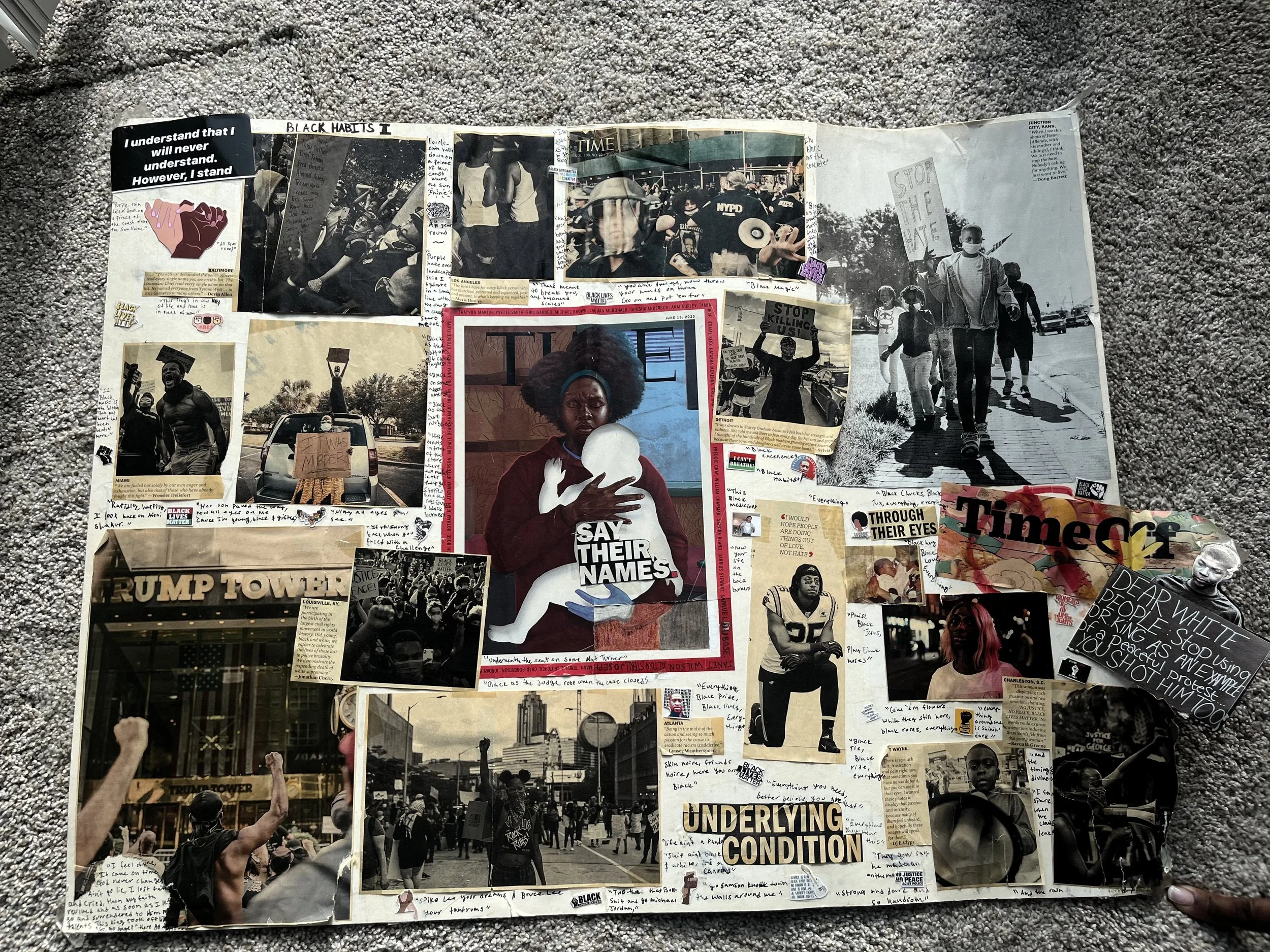
Collage by Cameron Gobermann, 2020, Magazine Cutouts.
I placed my cutouts intentionally. I wanted to tell a story, one that represented generational pain and trauma, and the fight we keep fighting. My favorite part is the middle of the collage. The picture of the mother holding the empty child was the front of the magazine, and the ‘say their name’ was on the back of the magazine. I thought bringing these images together was impactful because it tells the whole story right there in the center of the piece. The very start and the very end presented as one. I think you can interpret it in many different ways: a nameless, faceless child in the arms of his mother, because we are all someone’s child. Our children matter and they have names, and they shouldn’t be seen as just another Black boy that lost their life. “Say their name’ is such an important statement for the movement because their name makes you see them as who they are, a person. These are real people who lived real lives, and there are so many names unfortunately, that it makes it even more important to say their names. The more we humanize people, the more people will care. Say their name is about making them a real person and not just another tragedy to scroll past. In a sea of constant injustice, I think it’s easy for some people to see it as another person killed by the police; it’s important to stop and remind yourself to say their names, make them a person again. Breonna Taylor should still be here. Trayvon Martin should still be here. Tony Robinson, George Floyd, Ahmaud Arbery should still be here. There are so many more people who should still be here.
I also added small lyrics around the piece of a song called “Black Habits” by D Smoke feat. Jackie Gouche. All the words tie the piece together and tells more of the story I wanted to convey, this almost universal experience in the Black community of loss, hope, community, and culture. For example, some lyrics say
‘Give ‘em flowers while they still here, black roses, everything’
Loudly calling attention to the fact that Black people’s lives ended prematurely, while also reminding us that we deserve our flowers before we are gone. Pushing for our community to love on one another before it’s too late. The entire song could be broken down line by line with what it means and how you may interpret it. It really is a masterpiece. What I feel is the entire Black experience wrapped up into this one song. There are so many cultural references in this song that are so important and make me feel so seen and so proud to be me and in my community.
I have been listening to music for years that I would absolutely consider protest music. Hip-hop in general is a great example of this. People like Tupac have been rapping about injustice their whole career. which D Smoke references Tupac and his mother in this song, because his mother, too, was a huge activist, specifically for the Black Panther Party: A full circle moment. I can think of many songs that I know and love where the complete essence of it is resistance. I think what changed for me though was the inspiration to also create and not just listen and see, but didn’t know the impact that creating can have on others and myself. I remember one of the protest days in 2020 encouraging Black and Brown people to come out and make art downtown. I saw this as an opportunity to highlight Black and Brown artists, give them an opportunity to be seen and platformed. I also think it was a stress relief type of resistance. Go out there, get creative, meet other artists, let your voice be heard. It was a reclamation of our spirits. A few friends and I ended up going to this art resistance day and each created something of our own that spoke to us, and that we wanted to say and show the world.
AI steals from the real artist who want to share their stories in the way we did. It takes away from the community building that happens on days like those. Whether that be music, painting, or collaging, art from a person comes with deeper meaning and intention. AI mimics, recreates, and combines things it gathers from the internet. That’s why around this time it became frustrating seeing simple, but cute info graphics going around online. They were empty of the pain and anger felt in the community. Sometimes they are very informative, but they lack the deep rooted culture of protest art.
The art I wanted to create was inspired by the song ‘I am Light’ by India Arie. That summer I started to listen to her more and discovered this song. While it’s not explicitly protest music, it’s very empowering. Which is exactly what we all need in times like those. So, my painting was about being the light in the darkness. I wanted to keep it simple, only using black for the outline because my skin on the outside isn’t what’s important, its the light on the inside. The flowers represent our hair because it is like a beautiful bouquet in full bloom on our heads. I need to water it to keep it moisturized, and give it plenty of nutrients with conditioner. Hair is very important to Black woman and I wanted to show its beauty.
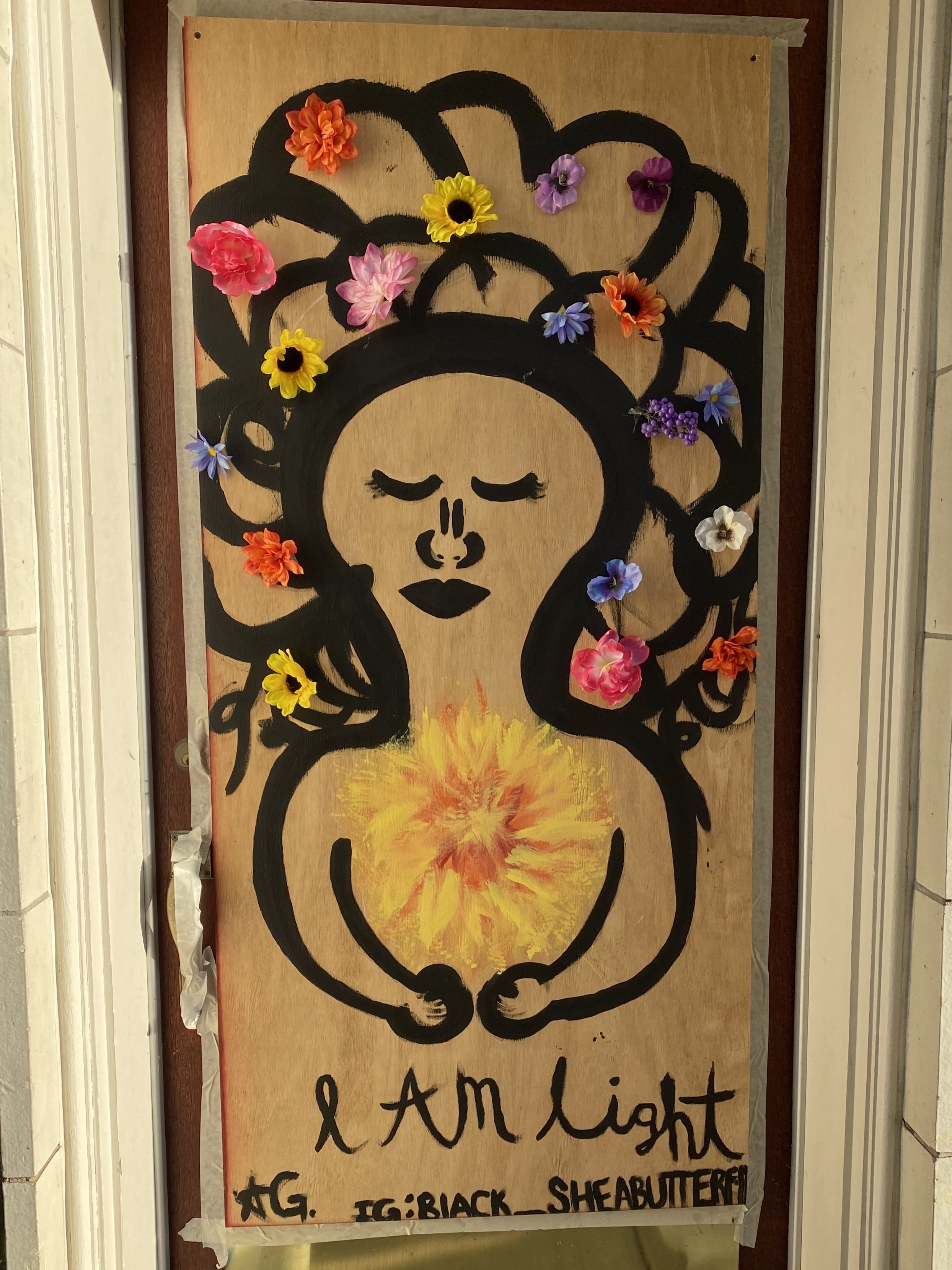
Painting by Cameron Gobermann, Acrylic and fake flowers on wood, 2020
Some of the lyrics from her song are
I am light, I am light
I am not the colour of my eyes
I am not the skin on the outside
I am not my age
I am not my race, my soul inside is all light
I wanted to share those lyrics specifically because I want to share the uplifting message that is at the core of this song. I think it was very culturally relevant, even though the song came out well before 2020. A main and simple point through all the protesting is that Black people are people too. We are not just our race or our gender, we are light. We have souls and families; we have goals and aspirations. Not only should we see the light within ourselves, but we hope others see that too. This song was a huge piece in my activism because it reminded me of who I am, and the resilience that our community has.
My friends also worked on paintings of their own, big murals that definitely took a lot more time and patience than mine. My long-time friend and artist Valendice Payne did a piece about Martin Luther King in a nightmare to contrast from his famous speech ‘I have a dream’. It was beautiful and addressed a sad truth, that there was still so much work to be done.
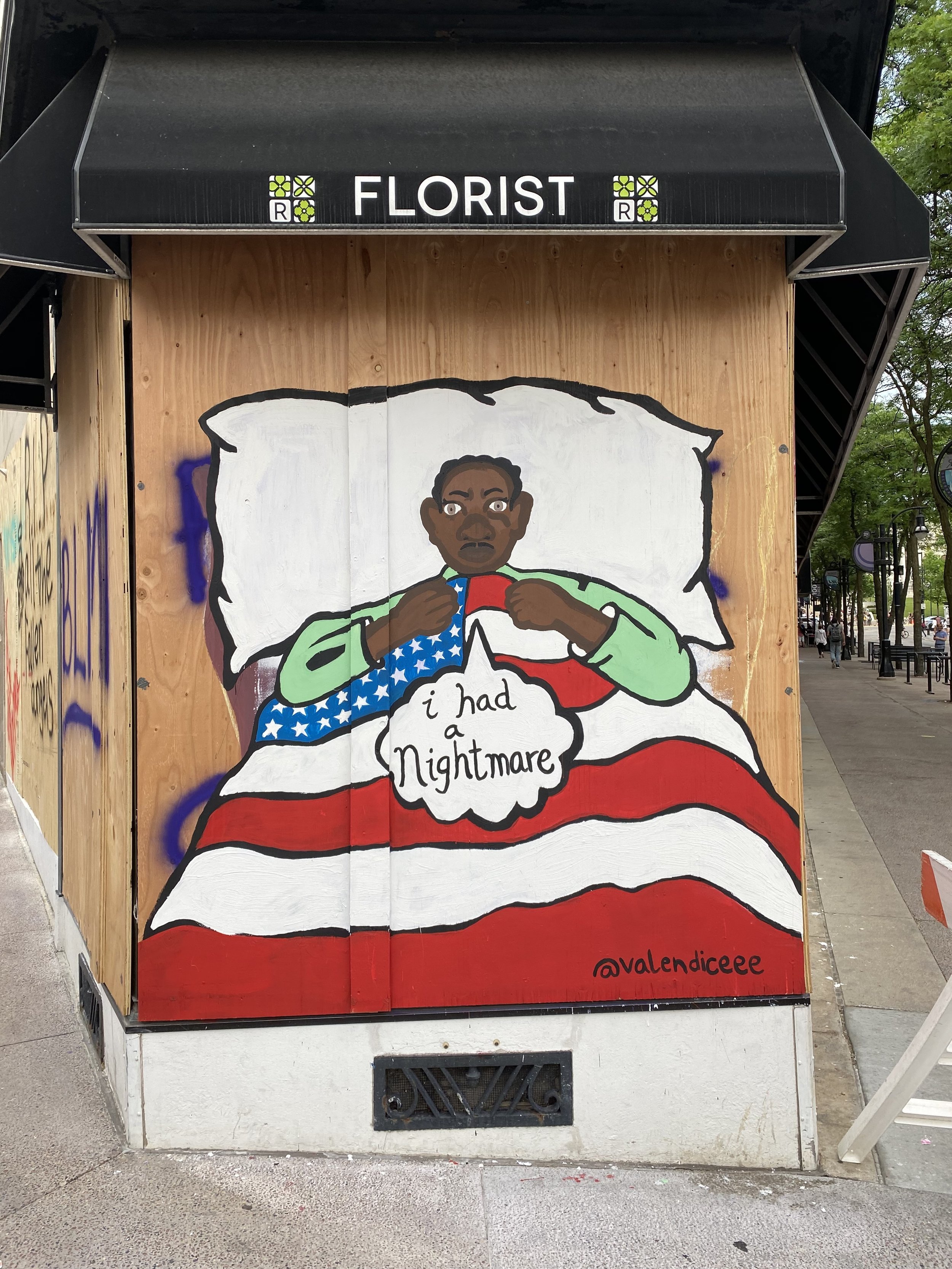
Painting by Valendice Payne, Acrylic, 2020
I asked her what she wanted people to think and feel when seeing her painting, and what does it mean to her? She wanted her piece to be symbolic and a representation of how the world was feeling. She told me “As a Black person, America has never felt like a dream.” She expressed that as Black people we have to constantly protect ourselves from micro-aggressions, blatant racism, and even being seen as a threat simply because of the color of our skin. She wanted people to see the parallels from Martin Luther King’s speech to the reality that we wake up to everyday on the news, and it’s anything but a dream, a real nightmare. She wanted people to see through the lens of Black people and not just what the media is telling you.
I also wanted to know if there was any music in particular that may have inspired her to create or take action at that time, she said the one song that she always thinks of and references to that era of 2020 is a song called ‘The Bigger Picture’ by Lil Baby. She points out how in the very beginning of the song he says “I can’t breathe.” You also hear protesters yelling in the background the same thing, “I can’t breathe.” This was a very clear and vivid memory for her of this song and the impact it had on her, that she still thinks about it to this day as the protest music from 2020.
My other good friend Infinity Gamble, also made a stunning mural about Black boy Joy. I remember at the time her having so much passion about this piece and talking about how young Black men deserve to be happy and live long lives. I asked her more about her thoughts on her piece and she said that she wanted Black men to feel included in the upliftment of the Black community. She talked about how Black women have Black girl magic, and a level of acceptance for our emotions, while Black men have to strictly stay emotionless. The other words and pictures on her mural are there to represent what she hopes Black men can embody in their lives and futures. Black men deserve to feel brilliant, kind, and compassionate.
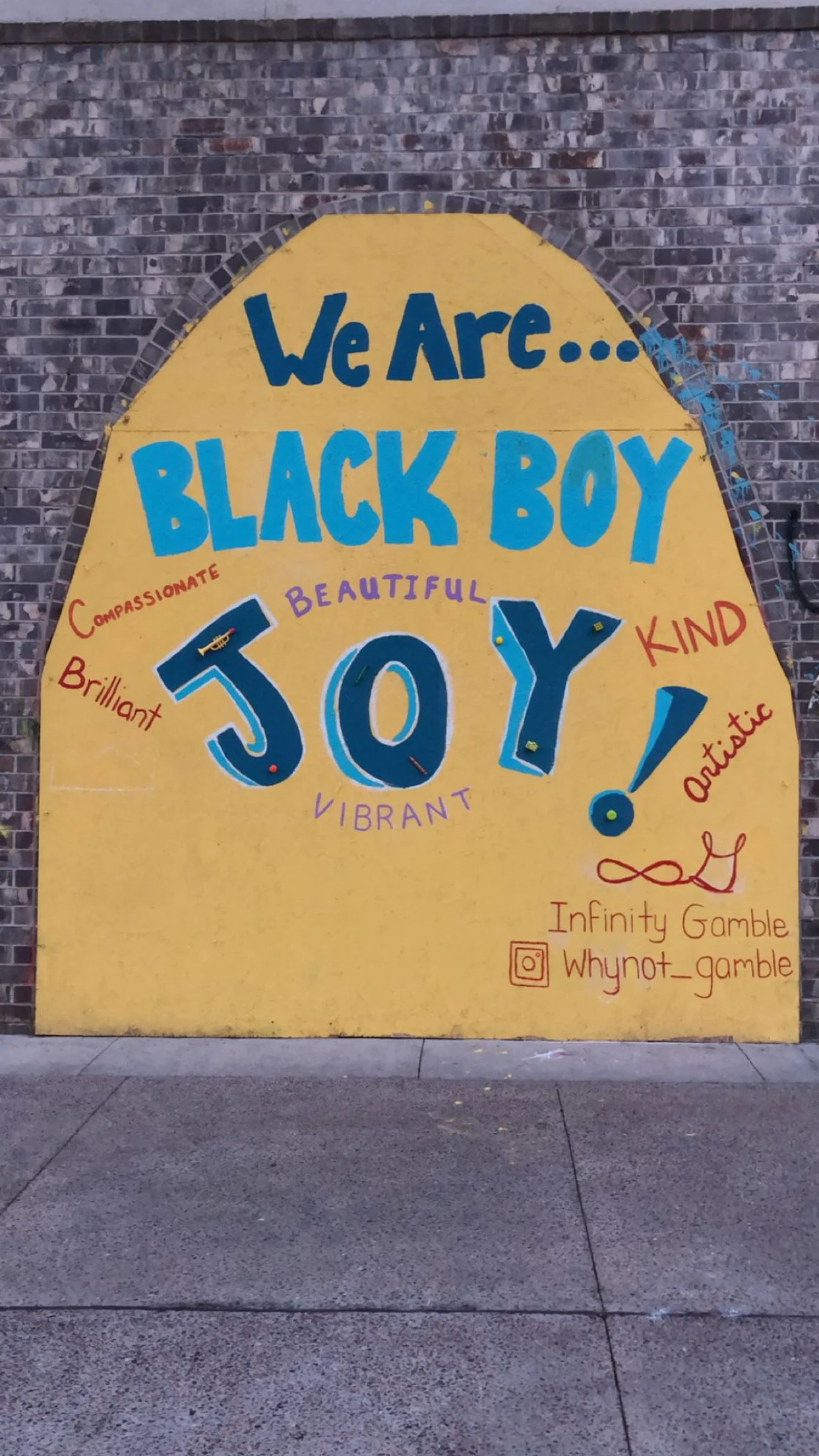
Painting By Infinity Gamble, Acrylic, 2020
Some music that she was listening to was ‘Stay right here’ by Saba, ‘Dang!’ by Mac Miller, and ‘Make it out alive’ by NAO. She told me that she was feeling all over the place at this time, not only due to the political climate, but also personal issues. Her music was a light for her, helping her navigate through such a tough time. She told me that some of the music was upbeat because that’s what she needed then, something that was going to keep her going, and show that joy while working on her Black boy joy art.
I had never seen anything like what happened in 2020 with the collective creative push, and when it came to such current, relevant music being released. One that had a big impact on me was a song by G-Eazy Feat. YG called Endless Summer Freestyle. Some of the lyrics read
Black lives matter, Fuck the chitter chatter’ and
‘life’s a fight, live right yeah, fight back
but wait, my hands up don’t shoot
moment of silence for all the racist shit we goin’ through
The end of the song is probably my favorite part though, a decisive proclamation that Black Lives Matter coming from someone white. The song ends with
Cops killin’ black kids and get off scot free
What’s the difference, what would happen if a cop shot me?
White privilege is real, black lives matter
I hope the barbecues at Lake Merritt get blacker
Racial inequality, police brutality
This shit is all real, please pay attention to reality
This song completely spells out the energy that was in the air of 2020. There were more people making a statement with their platforms. A few other examples of songs that came out and had an impact on me at that time are ‘Melanated’ by Katori Walker, some lyrics saying
‘Judge talkin’ dirty ‘cause he black and he hate his face
You know the system fucked up when you black as me
At the door of success but we ain’t get a key
So we ain’t knockin’ now through the window now
Just don’t make a sound, if you make a sound
Police prolly (prolly gun us down)’
This song discusses injustice but also the experience of being black: people taking our culture and co-opting it as their own, poverty struggles, but an overall pride for the skin we are in. Another song that came out that was in direct correlation with what was happening was a song called ‘6 million Ways’ by Kemba. This one is a little darker, but very impactful. There is a story being told in the beginning that represents the heartache that so many Black families deal with. The reality behind a headline. The lyrics are
‘My heart sunk deep in my chest, the phone call
My knees got weak then I fled, and drove off
A voice saying “sorry to say this but man your son didn’t make it”
And damn, the videos taken, it seemed awful
Cops had a small altercation and teed off on him’
The fact that these lyrics could apply to almost any and all current police brutality stories is sad, and shows that this isn’t an individual or one-off issue. This is a pattern in our country that too many people have to live through and experience. The song ‘BlacKKK Baby’ by Anoyd is a song that has a similar story telling element about it, and encapsulates the black experience growing up as or raising Black children. For example, having to sit your child down and explain to them that they have to be more careful when it comes to the police because it could mean their lives are at stake. This is a conversation we all know too well growing up, especially if you are a young Black man. The artist says all that he wants for his Black child, but having to tell them the truth about how the world works for a black child. Some lyrics reading
‘You see it’s pure innocence inside a black baby
Should I tell this black baby about the world or should you’
The last song that I want to mention is a song called ‘Angry Black Woman’ by Terry Ellis. Obviously, the name of the song is a statement within itself, calling out the stereotype of the angry black woman but also calling attention to fact that we should all be angry! The song starts with talking, “throughout the history of the United States the construct of racism was created specifically to oppress black people, to try to suppress our determination to achieve iteration. Like Angela Davis said it’s built into the system.” This is a very powerful way to start the song. It acknowledges the deep-rooted systematic oppression that has gone on in this country. This issue has a lot of history and isn’t something that just happened overnight. First, it was lynching and Jim Crow, and that has evolved to police brutality and racial profiling that we still see today. I watched a short interview of the artist talking about this song. She wrote this song years prior to 2020. Some lyrics say
‘What’s goin’ on in front of me
I don’t wanna watch TV
And find another casualty’
Things have changed so much while also staying the same. The same things that were causing her pain and anger were happening for decades before 2020. People didn’t want to believe or pay attention to what was happening before 2020. It’s funny how perfectly the timing of it was, the fact that she already had this song, but waited to release it, it feels like poetic timing.
My mom and I recently had a conversation about Rodney King after I told her what I was writing about, and she told me that she remembers when that video of his beating had come out and how it sent shock waves through the country because of how vile it was. People had never seen such brutality on a widespread scale. I think Rodney King was a huge eyeopener for people at that time. You couldn’t ignore it or excuse it. It was blatant and in your face. 2020 as a whole was another Rodney King moment for this country. People were in horror seeing what they saw, and had to do something about it. While AI is efficient, it does not enact change, people do.
The reason we got this in 2020 and not 2015 was because the murder of Trayvon Martin and Tony Robinson happened a few years apart, and there were still debates about whether or not racial profiling, systemic racism, and unconscious bias were real issues. In 2020 we saw Black people getting killed in a condensed timeframe, there was no way to look away or debate the matter, especially when it was all caught on camera. Social media was a huge factor. There were millions of eyes on this issue, rightfully upset. We saw things firsthand that we didn’t see in 2015. The collective voice was louder in 2020. We saw a protest music and art boom. More people were listening, impacted, and moved and it led to them making art. Because music feeds the soul. When we are in bad times, we try to look for the good, or at least make something out of the bad.
