
The Song of Angry Men? Les Misérables as Protest Music
Does protest music have to be written with protest as an intention, or does context matter? A phenomenon that raises this question is the occasional use of music from the Broadway behemoth Les Misérables as protest music.
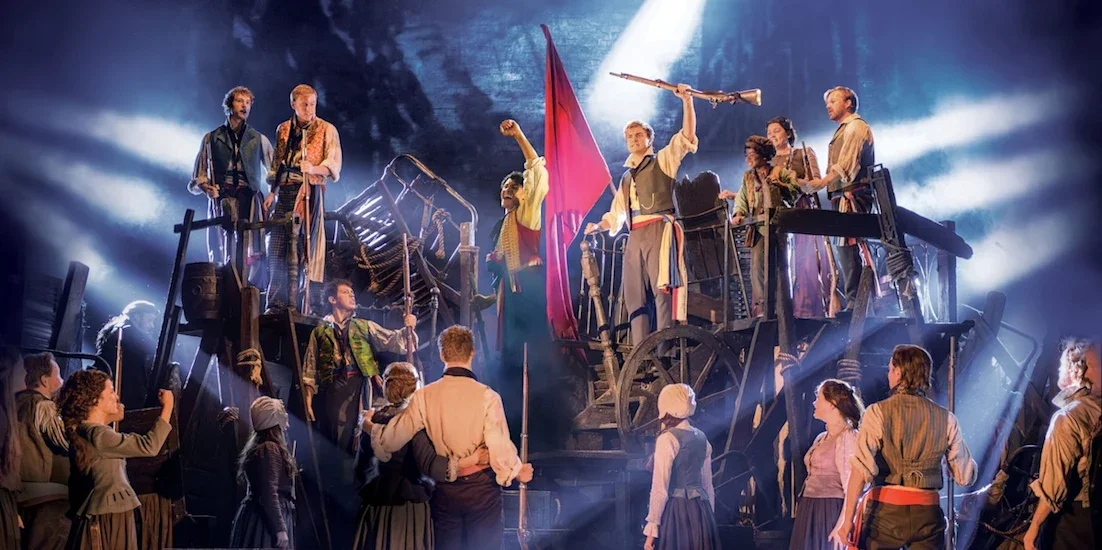
Les Miserables, London Production
Any Broadway show sounds like an unlikely source of protest music. Musical Broadway has always been conservative and sometimes reactionary. Broadway blithely sang through the turbulence of the late 1960s largely without acknowledging the Vietnam War, the Civil Rights movement, Stonewall, the rise of feminism, or the protest movement that accompanied all of that. When Broadway did comment on social or political tyranny, it was in easily contained forms, such as Hair (which celebrated “hippies” but also reduced them to eroticized caricature) or Pippin (an anti-war protest encapsulated in a high-concept dance revue that survives largely as a high-school drama staple). La Cage Aux Folles’s “I am what I am” became a gay liberation anthem, and is designed that way, but Rent, Broadway’s most obvious response to the HIV-AIDS crisis, notoriously centers the one straight white male character, marginalizing the LGBT characters, people of color, and, ironically, all the characters who have contracted HIV. Worse, its composer, the late Jonathan Larson, plagiarized its basic premise from a novel by (very much living) lesbian playwright Sarah Schulman, People in Trouble; Schulman has never received credit or royalties for her premise. The extent to which anything about Hamilton excepting its casting schemata is a radical interpretation of American history is debatable and has been vigorously debated. There is even a play–The Haunting of Lin-Manuel Miranda, written by African American playwright Ishmael Reed and produced by the storied Nuyorican Poets Café, that exposes Miranda’s Hamilton’s misrepresentation of Alexander Hamilton and his slave-owning in-laws as abolitionists.
Les Misérables is an especially unlikely vehicle for protest of any status quo. Written by Frenchmen Claude-Michel Schonberg (music) and Alain Boublil and Marc Natel (lyrics), Les Misérables premiered in Paris in 1980. It was then translated into English by Herbert Kretzmer and opened in London in 1985, making it the longest-running West End musical and the second-longest-running musical in the world (and the longest that is still running today). There are productions in more than 50 countries and it has been translated into 22 languages. These productions have made its producers and investors nearly 6 billion dollars–slightly less than the other 1980s megamusical, Andrew Lloyd Webber’s 1986 The Phantom of the Opera, but far more than the most lucrative Hollywood movies. Current ticket prices prevent Les Misérables from being accessible to the modern equivalents of the demographic it serenades. Right now, tickets are on sale for a 40th anniversary concert performance at New York City’s Radio City Music Hall for $259 (on Thursdays) and up; in the West End for a reasonable £43 (for bad seats) to £15, albeit with a £25 last-minute promotion, and a bargain $100 in Boise–where salaries and wages are lower, too. This is not economically accessible entertainment.
Its inaccessibility is ironic given its themes: the struggles of the impoverished and otherwise marginalized (working-class women) against political, social, and economic systems that exploit and disenfranchise them, reproducing trauma intergenerationally; the ethics of protest and violent revolution; the limitations of individual charity or piety’s ability to amend or transcend all of this; and, far more in Victor Hugo’s 1862 epic novel than in the musical, the betrayal and revival of the ideals of the 1789 French Revolution by the generations that followed it. Unintentionally, the novel also acknowledges how patriarchy, sexual hypocrisy, and capitalism harm women and children, though Hugo never allows his main female characters, factory worker Fantine, her daughter Cosette, and Cosette’s romantic rival, the streetwise Eponine, to display much agency in their struggles with injustice.
The source material makes the novel an insightful analysis of the ethics of protest and political violence. The context is the failed 1832 Paris uprising against the constitutional monarchy of King Louis-Philippe. The insurrectionists were trying to get rid of Louis-Philippe, who had been crowned in 1830 after another revolution deposed the profoundly reactionary restored Bourbon monarchy of Charles IX. One of the causes of the 1832 uprising was Louis-Philippe’s non-response to a devastating cholera outbreak. Instead of going back to Bourbon or Orleanist monarchic systems, the rebels of 1832 wanted a republic. They were brutally suppressed within 48 hours. In the novel, completed exactly 30 years after Hugo witnessed the revolt and its suppression, argues that the rebels were ethical. A brief preface lays out an indictment of Louis-Philippe’s regime and of the socioeconomic order that lingered long after it, one that is sexist but far more social-democratic than anything Dickens ever wrote about “Dickensian” London:
So long as there shall exist, by reason of law and custom, a social condemnation which, in the midst of [industrialized] civilization, artificially creates a hell on earth… so long as the three problems of the century–the degradation of man by the exploitation of his labor, the ruin of woman by starvation, and the atrophy of childhood by physical and spiritual night–are not solved… so long as misery and ignorance remain on this earth, there should be a need for books such as this.
He characterizes his fictional rebel leader Enjolras as the proponent of an “insurrection,” or principled response to tyranny that aims to correct injustices experienced by an unheard, disenfranchised majority, rather than an “emeute” (riot), or violent temper tantrum thrown by privileged people that aims to sustain or increase inequality or suffering. (Confusingly, in Hugo’s taxonomy, January 6 would be an “emeute” while the George Floyd protests were an “insurrection.”)
The musical is another story. Gone is the distinction between insurrection and emeute, as is a pivotal early scene in which hero Jean Valjean’s spiritual mentor, the Bishop of Digne, is held to account by a dying “Conventionist,” or member of the provisional body that prosecuted and condemned Louis XVI. Gone too is Marius’s uncle, a rickety unrepentant aristocrat who has somehow survived the Revolution, never forgiven the Revolutionaries or his Napoleonic officer son-in-law, and estranges Marius by telling him to rape Cosette, and Father Mabeuf, an elderly book lover and horticulturalist who becomes an informal mentor to the students living in the slums of Saint-Antoine and dies at the Barricade after selling his last book for food money.
Still, there is something progressive about the lyrics of the musical’s most famous song, “Do You Hear the People Sing?” There is an insistence that the rebellion must be violent: it is a Crusade (“Will you join in our crusade?”) and trades in stereotypes of heroic masculinity (“Who will be strong and stand with me?”) Rebels are asked to die for their cause in terms that sound ripped from a World War I era recruitment campaign and would seem to invite the derision of those who protested the Vietnam War–not to mention many of the Vietnamese and American characters of Boublil and Schonberg’s well-intentioned but deeply problematic, appropriative show Miss Saigon. This is frightening death-cult rhetoric:
Will you give all you can give
So that our banner may advance?
Some will fall and some will live
Will you stand up and take your chance?
The blood of the martyrs will water the meadows of France!
That these lyrics survived 9-11 testifies to Americans’ ability to excuse in Americans and in long-dead white Europeans behavior and ideas that some of them find execrable in anyone else. The voice of the establishment is the self-hating, intergenerationally traumatized prison camp guard, policeman, and government spy Inspector Javert, who was “born inside a jail” and constantly trying to prove himself on the right side of the authoritarian regime, declares that the protesters should be killed in terms reminiscent of MAGA screeds against the late Renee Nicole Good and Alex Pretti (“We’ll be ready for these schoolboys: / They will wet themselves with blood.”)
However, Krezmer’s lyrics also invest the 1832 revolt with explicitly progressive objectives. Any demonstration, especially any violent one, can be “the song of angry men,” but “Do You Hear the People Sing” isn’t really about toxic male anger. The new national “life” is “about to start” and a new “tomorrow”: it is not a return to the past, even though the original 1789 Revolution and the Republic that briefly followed it are in the past. “Sweeney wishes the world away / Sweeney’s waiting for yesterday,” Stephen Sondheim wrote about the anachronistically Fascist antihero of his 1979 musical Sweeney Todd, the Demon Barber of Fleet Street, a Musical Thriller. Not so Enjolras and company. They remember the past as something terrible, not to be either romanticized nor revived. It is when they were “slaves.” This is a problematic choice of words because no white Frenchmen in 1832 were actually “slaves,” while chattel slavery continued to exist in the Caribbean (including British and French colonies), the United States, and much of Latin America. It is possible that the Jewish translator Krezmer’s word choice is informed by the rhetoric of the Book of Exodus and the Passover Haggadah, which render the (anachronistic - it never happened) ancient Jewish “slavery in Egypt” a signifier for any kind of injustice, a reading radically reinvented by enslaved people who organized escapes to freedom from the American South and generations of African-Americans subsequently. However, the idea that the characters of Les Misérables could become “slaves again” and so do not want the past to return makes the song impossible to appropriate for reactionary causes that romanticize historical tyrannies, such as the “Lost Cause” of American white supremacists and the “Make America Great Again” movement.
It is in this spirit, apparently, that one of the original Los Angeles production’s actors, Dann Fink, told the New York Times that it works because it engages with just protest. Fink remembered watching the brutal suppression of the protest in Tiananmen Square on the news in the green room in 1989 and relating those events to what he was performing onstage.
The same New York Times article claims that songs from Les Misérables were sung at political demonstrations in Venezuela and Turkey. In Hong Kong, pro-democracy protesters, including (as in Les Misérables) many students, sang the musical’s most famous song, “Do You Hear the People Sing?” in English at a massive protest march in 2019. The lyrics, though anodyne in their refusal to state exactly what the rebels of 1832 Paris wanted changed, come to life in the context of a population demanding self-governance from an authoritarian state:
Do you hear the people sing?
Singing a song of angry men?
It is the music of a people
Who will not be slaves again!
When the beating of your heart
Echoes the beating of the drums
There is a life about to start
When tomorrow comes!
Demonstrators also made a music video, which featured 40 musicians and 60 singers performing in English, Cantonese, and Mandarin. In response, the government of mainland China banned the song and removed it from streaming sites such as QQ music. Les Misérables cast recordings of the entire show, however, are not banned, suggesting that the government considers the song’s topicality in the Hong Kong context mitigated by the larger storyline, the historical and European costumes, or the arguably proto-Communist focus on the role of economic disparity and worker exploitation by capitalists in what the musical claims were the instigations of the 1832 revolt.
In April 2022, Ukrainians, Broadway singers, and other people sang “Do You Hear the People Sing (For Ukraine)” in Times Square. Some of them waved blue and yellow Ukrainian flags in the manner of the red flags waved in the official staging of the original song. Later in 2022, another Les Misérables song, “Bring Him Home,” was featured in an American event that might be considered a protest of sorts.
A group of Broadway singers made a viral video of “Bring Him Home” sung as “a Broadway prayer” for the multinational hostages of 7 October. “A prayer” is not a protest: prayers are directed at God or saints, not at people who can practically do something about the problem highlighted. There is no mention in the video of who should release the hostages (Hamas?) or work to get them released (the Israeli government? The American government? Some other body?) Variations on this interpretation include a rendition by 1000 Israelis in a stadium and a version with a change of lyrics (“Bring Them Home”) by a cantor (Jewish ritual singer).
None of these performances were either as controversial as the Hong Kong reinvention or had any noticeable impact on public opinion or political events. They are at best attempts at organizing affinity groups; notably, the Broadway “prayer” was recorded before the Israeli invasion of Gaza turned American public opinion against Israel. More recently, the song has made an appearance in No Kings protests and related video.
As these protests have both helped to cause actual change (as in Wisconsin, where they amplified messaging around local and Supreme Court Justice elections that resulted in a statewide blue wave) and have been criticized as “Boomer”-dominated performance stunts with little risk or impact, Les Misérables seems to keep doing what it (or, rather, the musical) has done with the 1980s: mostly exploiting popular outrage and desire for collective action and repackaging it as a safe commodity for increasingly wealthy consumers, but occasionally being reinvented as protest in spite of its creators’ apparent intentions.
