
The Gilded Power at 1600 Pennsylvania Avenue
By Lanita Brooks-Colbert
The Resolute Desk, in the White House Oval Office, long an austere symbol of democratic gravity, now appears surrounded by high-gloss theatricality, recasting the Oval Office from a restrained civic space into something closer to a private showroom, where urns, trophies, cherubs, eagles, medallions, and ornamental objects crowd out the traditional language of institutional modesty. What was once meant to communicate continuity, humility, and public purpose now projects luxury branding and permanent celebration.
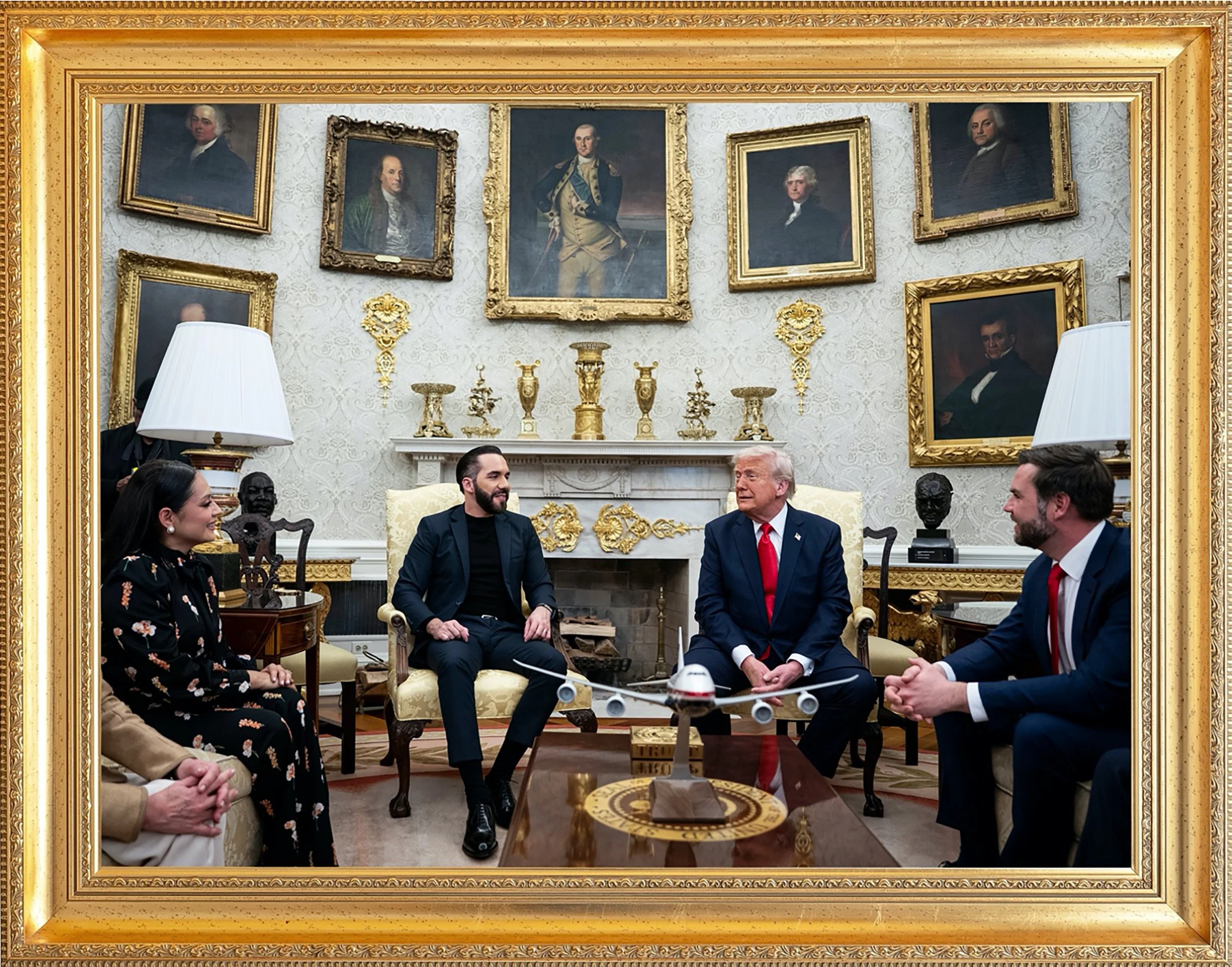
President Donald Trump and Salvadoran President Nayib Bukele in the Oval Office on April 14. (Al Drago/For The Washington Post; iStock)
This transformation is not simply a matter of taste. It operates as political performance, turning decoration into a declaration of power. Objects engraved with “Trump 47” and “TRUMP,” a replica World Cup trophy, and shimmering signage marking “The Oval Office” personalize a room that belongs to the public. The effect is a triumph of political kitsch: a style that uses exaggeration, sentiment, imitation, and easy symbolism to create instant emotional recognition in place of deeper reflection.
The term kitsch emerged in nineteenth-century German art markets, where it described cheap, popular, and marketable pictures made for quick consumption rather than serious contemplation. By the early twentieth century, critics used it more broadly to describe mass-produced culture that borrowed the surface features of art—beauty, drama, grandeur, emotion—while stripping them of critical depth. Clement Greenberg’s 1939 essay “Avant-Garde and Kitsch” sharpened that distinction, framing kitsch as a commercial substitute for genuine art and as a cultural language especially useful to propaganda because it offers ready-made feelings instead of independent judgment.
That history explains why political kitsch becomes powerful and appeals to the masses erasing the demand for informed judgment. As Milan Kundera argued in The Unbearable Lightness of Being, “totalitarian kitsch” excludes doubt, discomfort, and dissent. It offers sentiment in place of information and considered judgment, showing viewers what to feel before they have a chance to think. In that sense, Trump’s aesthetic is not merely decorative; it is a visual argument for authority, certainty, spectacle and the illusion of power.
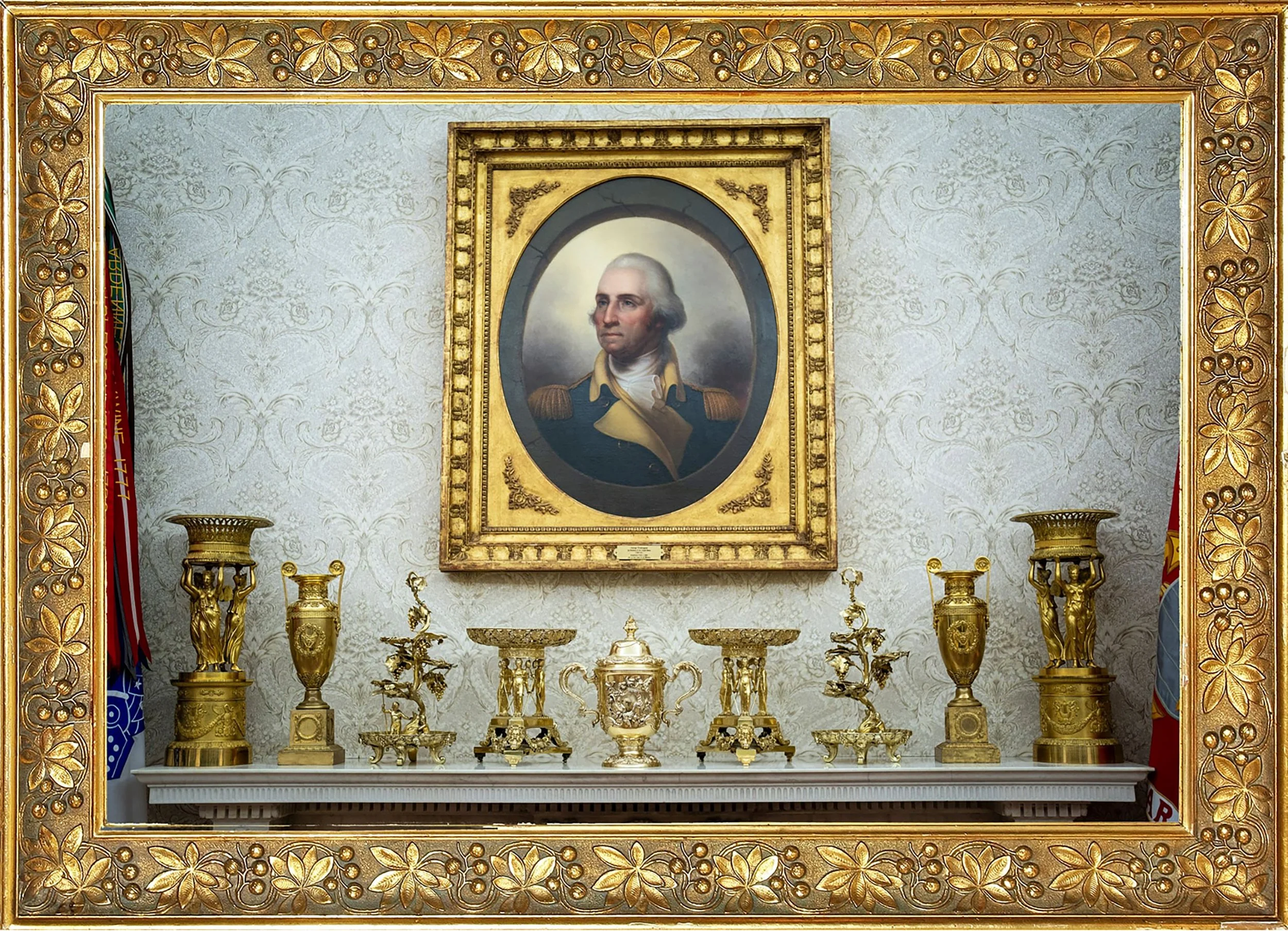
Gold decorations on a fireplace mantel in the Oval Office. (Jabin Botsford/The Washington
The contrast with American civic architecture is stark. Neoclassical public design traditionally relies on white marble, stone, proportion, and restraint to evoke the democratic ideals of ancient Greece and Rome. Trump’s preferred style, by contrast, draws from the visual culture of palaces, casinos, and absolute monarchy: chandeliers, ceilings adorned with mythological gods and goddesses, and symbols of personal magnificence. In this setting, the ruler’s splendor eclipses the dignity of the institution.
That aesthetic also functions as a political weapon. Rather than seeking approval from traditional cultural and political elites, Trump uses Kitch to antagonize them. The clash between his preferred style and the understated preferences of Washington and New York establishments allows supporters to read the décor as defiance. What critics mock as gaudy or autocratic, his base often interprets as authentic, aspirational, and unapologetically successful.
For many MAGA supporters, this display does not weaken Trump’s appeal; it strengthens it. It presents wealth as proof of the American Dream, turns “golden age” rhetoric into a promise of national revival, and signals contempt for norms associated with the old establishment and the masses. In populist politics, extravagance can read as strength: a larger-than-life leader displaying the power his followers want projected on their behalf.
This is why critics often describe the style as “dictator chic.” The phrase captures an aesthetic built from faux-historical grandeur, oversized symbols, and the rejection of modest institutional design. Its lineage is not limited to democratic pageantry. It echoes the palatial self-display of autocrats who use opulence to project dominance, overwhelm visitors, and replace legitimacy with personal power.
Historically, this visual language has been most effective when it fuses splendor with distance. Pharaohs, emperors, kings, and modern dictators have used gilded rooms, crowns, monuments, and palaces to suggest that power is sacred, permanent, and above ordinary life. Yet the image can turn brittle when the public sees luxury beside hunger, debt, corruption, or political exclusion. Across history, gold has promised invincibility, but under conditions of mass dissatisfaction it can become evidence of moral separation: proof that the ruler has decorated himself while the people carry the cost.
In the current voting climate, that dynamic means the same display that energizes loyal supporters may alienate voters anxious about cost of living, wages, debt, housing, health care, or political exclusion. For them, wealth-coded imagery may read less as success than as indifference—a reminder that leaders can celebrate abundance while ordinary people absorb the burden. Voters facing economic strain or institutional distrust may see such decoration not as confidence, but as contempt. In that sense, the imagery becomes politically unstable: it may still inspire a base, but it also risks sharpening resentment among persuadable or disillusioned voters who see power drifting away from public need.
In this political language, the shine signals wealth, victory, permanence, and command without requiring facts or explanation. Its purpose is not subtle persuasion but visual conquest: to make power feel inevitable and unquestionable.
Ultimately, the kitsch of the White House matters because it asks the public to confuse display with strength. The question is not simply whether the room looks tasteful or vulgar. The deeper question is why such imagery works at all—and what it asks citizens to surrender in exchange for the feeling of power. If democratic space begins to resemble a throne room, are we witnessing confidence, or compensation? If public office becomes a stage for personal magnificence, where does the public itself stand? Perhaps the danger of gilded politics is not only that it glorifies the leader, but that it trains citizens to admire their own distance from power. History reminds us that the masses often endure pageantry until hardship makes the shine unbearable. Then gold changes meaning. It no longer symbolizes greatness; it exposes separation. To look at this state of affairs honestly is to ask whether we are being inspired, entertained, distracted, or warned. The spectacle is not incidental. It is the message—but whether that message persuades or indicts depends on what we the people are willing to see.
