
Nick Cave: Mammoth
By Elaine A. King
February 13, 2026–January 3, 2027
Smithsonian American Art Museum
Washington, D.C.
The Trojan Horse of Dazzle: Inside Nick Cave’s ‘Mammoth’ at SAAM
Nick Cave is a distinguished American artist who masterfully blends sculpture, dance, sound, and video into a singular, interdisciplinary practice. Having trained as a dancer with the Alvin Ailey American Dance Theater, performance operates as a natural extension of his craft. He remains most widely recognized for his Soundsuits—vibrant, wearable costumes constructed from repurposed objects and discarded materials that clatter and chime with the wearer’s movement. Cave built his first iconic Soundsuit in 1992 as a direct response to the Rodney King verdict. By completely concealing the body, these suits function as protective armor, obscuring race, gender, and class to force an encounter with the art entirely free of societal bias.

In an era where collective history is routinely contested, rewritten, and systematically flattened, Cave has staged an enormously defiant, archaeological cultural site deeply rooted in African American history. According to Sarah Newman, SAAM’s curator of contemporary art, this excavation of Cave’s personal archive is vital to the exhibition: “It’s about memory, and creativity and the process of memory, and how memory affects our lives,” Newman noted.
Beyond the sheer scale of the exhibition, it is a testament to SAAM’s institutional courage to present a show so unapologetically anchored in Cave’s identity and socio-political views. The exhibition arrives at a tense cultural moment as the Smithsonian faces scrutiny under the Trump administration’s anti-woke lens. The institution has spent months navigating White House demands to submit exhibit plans and wall texts for vetting against "improper ideology."
Yet, Nick Cave: Mammoth stands tall. A monumental, site-specific commission at SAAM, the show is a colossal conglomerate of personal ancestry, environmental anxiety, and social critique. Spanning the vast expanse of the museum’s grand Lincoln Gallery, this landmark exhibition marks SAAM's largest, single-artist commission to date. It utilizes the heavy, evocative metaphor of an archaeological dig to explore exactly what America buries, what it desperately tries to erase, and what inevitably—and powerfully—resurfaces.
Walk through the grand Lincoln Gallery, and the post-apocalyptic undertones of Mammoth become impossible to ignore. Cave populates the space with massive, elevated structures, towering lifeguard chairs topped with skeletal, hand-beaded mammoth heads. The ominous towers evoke ideas of societal surveillance and state-sanctioned oversight, while the extinct mammoth skulls introduce an environmental layer of climate anxiety and historical grief.

Paired with these are phantom-like husks and crafted hides, hanging like the hollowed-out remains of a forgotten history. In Cave's hands, these husks are not just empty shells; they represent the protective casings left behind, connecting to the defensive, armor-like philosophy of his early Soundsuits. Under the watchful eye of these shadowing towers, the entire exhibit feels less like a traditional museum gallery and more like a reclaimed wasteland where the past refuses to stay hidden. Together, these figures act as modern guardians of a forgotten past, posing a silent but heavy question to the viewer: “Who is watching over our fragile national history, and what happens when it goes completely extinct?”

Nick Cave Portrait
The back wall in this gallery is decorated with a 60-by-20-foot hand-beaded tapestry depicting a sweeping Missouri landscape. It is beautifully impressive although the juxtaposition of this bejeweled wall hanging is uncanny in the unnerving setting near the looming, unsettling towers.

Detail of object featured in A Lit History
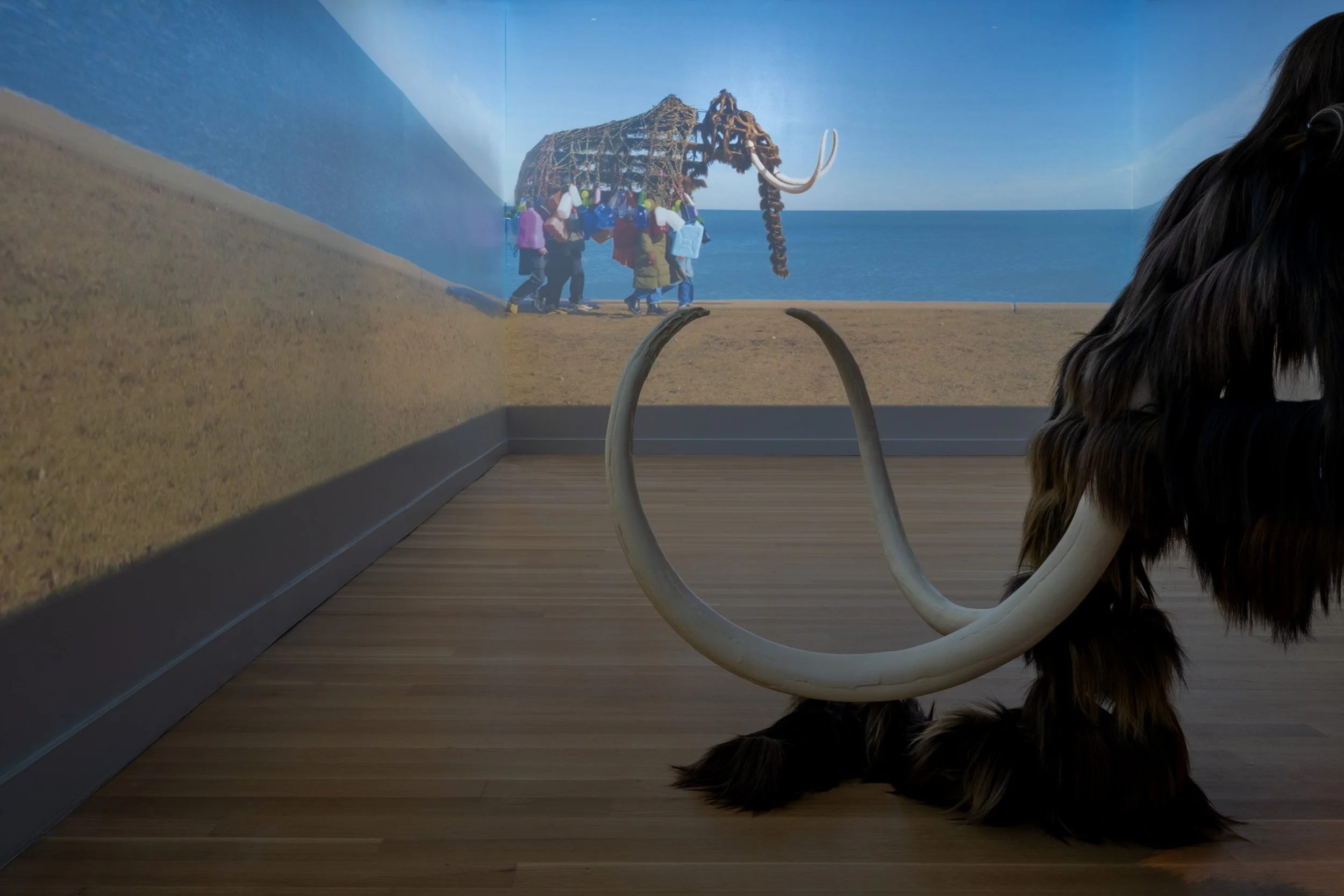
The eerie sense of surveillance in the main gallery completely shifts inside an adjoining side room. Here, Cave presents Roam, a video installation projected across four gallery walls that fills the space with an uncanny resurrection. The film tracks a herd of colossal mammoth puppets making a slow, woolly trek along Lake Michigan. Framed against the stark silhouette of the modern urban landscape of present-day Chicago skyline, these ancient beasts feel profoundly out of time.

2026 February, Nick Cave, Albert Ting
The visual effect triggers a mesmerizing collapse of historical time, bridging a deep ancestral past with our fractured contemporary landscape as extinct beasts wander past modern skyscrapers. Immersive and all enveloping, the four-wall video projection captures the staggering physical scale and performance aspect of Cave's vision, activating the gallery into a living, breathing archive of collective memory. The soundscape functions as the work's atmospheric backbone: its low, thudding footsteps and dense ambient noise materialize a heavy, reflective mood that evokes collective energy and buried histories. Rather than relying on archival animal recordings, Cave and his sound designers built a bespoke audio track from scratch—synthesizing electronic and acoustic elements to give these handcrafted titans a visceral, living presence.
In a brilliant creative choice, Nick Cave leaves the mammoth hides partially translucent, allowing the viewer to spot the winter coats and scarves of the human performers moving beneath the heavy metal ribs. By revealing the humans operating the history, the film serves as a moving metaphor for how collective memory is actively carried on the shoulders of the living.
NICK CAVE MAMMOTH, Ron Blunt
The exhibition’s most overtly political and devastating note is struck in an adjacent room housing Amalgam (Plot). Here, Cave shifts the viewer's gaze sharply downward, presenting two life-size Black figures cast in dark bronze, sprawled somberly across the gallery floor. The scene deliberately evokes the cold, distressing reality of a crime scene or a still from video footage of racially motivated violence. One figure lays face down, hands locked protectively behind his head, his face hidden by a hoodie and a tuba-like speaker shape that silences him. The other lies twisted on his back as if frozen mid-fall.

NICK CAVE MAMMOTH, Ron Blunt
Keeping with Cave’s positive philosophy, death is not given the final word. Bursting directly from their bodies and heads is a dynamic, flourishing garden of vintage metal flowers. By transforming a site of systemic violence into a site of active cultivation, the installation operates as both a memorial and a defiant symbol of resistance, growth, and spiritual rebirth.
At the spatial and emotional center of this dramatic landscape is a glowing, 700-square-foot light table that anchors the entire room. This expansive structure functions as both a literal and figurative excavation site, displaying thousands of meticulously arranged found objects. Within this grid, sit ordinary, discarded items—ranging from vintage industrial tools, chains, rusted keys, sequined slippers, badminton racquets to the artist's own grandmother’s sewing thimbles—are elevated into bejeweled, sacred artifacts.

True to Cave’s signature aesthetic strategy, the historical weight of trauma, racism, and state surveillance is masterfully couched in thick layers of beads, sequins, and vibrant color. This deliberate use of "dazzle" operates effectively as a conceptual Trojan horse. It seduces the spectator's eye with sheer visual splendor, only to trap the viewer in an urgent, inescapable confrontation with the deeper, more unsettling realities of systemic violence and historical omission.
Yet, it is precisely within this dazzling abundance that Mammoth encounters its most significant conceptual hurdle: the installation simply contains too much. The sheer volume of material borders on the overwhelming; creating an environment of sensory saturation that risks dilution. As the eye darts from vintage bric-a-brac to glittering tapestries and ancient beasts, the exhibition struggles to provide viewers with a cohesive narrative. Because Cave relies so heavily on conceptual, abstract associations, the lack of connective tissue or curatorial explanatory signposting leaves the viewer adrift in a sea of beautiful objects. Without a clearer structural blueprint to guide the audience through the dense presentation, the profound political messaging can occasionally feel buried under the weight of its own maximalist opulence, transforming a rigorous critique of systemic erasure into an aestheticized spectacle.
To navigate the exhibition’s overpowering extravagance, I recommend acquiring the official Nick Cave: Mammoth exhibition catalogue. The volume features rich illustrations detailing Cave’s studio production alongside relevant historical imagery that provides a vital contextual perspective on his artistic evolution. Crucially, the astute essays by Sarah Newman, Cherise Smith, Gwendolyn DuBois Shaw, and J. Drew Lanham offer the exact curatorial signposting and intellectual depth needed to decode the political messages embedded within the immense amalgamation of symbols.
