
Introduction to the Pavilion of the Holy See, Venice Biennale 2026
By Rudi Zygadio
We stumbled across a sign for the pavilion of The Holy See (Vatican City) at the off-site Giardino Mistico, a garden nestled within the walls of a 17th-century convent, which produces its own wine and olive oil. Curated by Ben Vickers and the ubiquitous Hans Ulrich Obrist, the exhibit was a sound installation featuring original works by Holly Herndon, Meredith Monk, Brian Eno, Terry Riley, Jim Jarmusch, Pattie Smith, FKA Twigs and others, taking as their inspiration the 12th century benedictine nun Hildegarde von Bingen. (It was a supergroup perhaps only the most well-connected man in art was able to assemble.) Headphones on, we wandered through different zones of the garden, ambient music shifting in a seamless, harmonious cross fade— from ambient synths to choir, musique-concrète, spoken word and sparse guitar drowned in reverb. I wasn’t sure if it was deliberate, but there was an olfactory bonus too; each musical zone coincided with a different herb patch. Eno was lavender, Jim Jarmusch was rosemary, Devonte Hynes was mint. I took a deep breath, exhaled, dropped my shoulders and closed my eyes. It was a subtle, enveloping, multi-sensory experience.
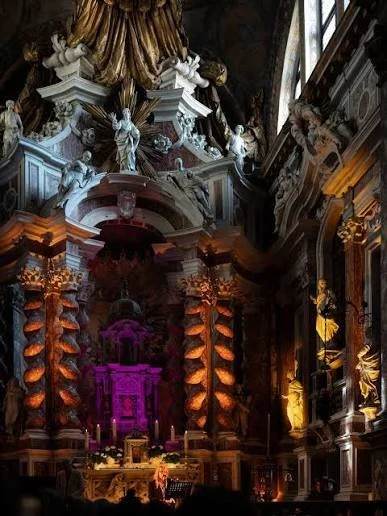
Holy See Pavilion, Venice Biennale 2026
More on the Pavilion of the Holy See, and the Venice Biennale 2026
By Nancy Nesvet
At the Pavilion of the Holy See, like the instructions at the Egypt Pavilion, the Pavilion of Silence, we were instructed to listen. And as at the Egypt Pavilion, in the Pavilion of the Holy Seee’s Mystical Garden of the Discaled Carmelites’ walls, there was a stillness and a tranquility, a slowing down as in the Santa Maria Ausoliatrice Complex, a former oratory on Venice’s other side. Between this garden and the Santa Maria Ausoliatrice Complex, the Pavilion of the Holy See entitled The Ear is the Eye of the Soul invites visitors to listen not to themselves as at the Egypt Pavilion but rather to the music and sound of the Soundwalk Collective Project, experiencing sound installations and new musical compositions by composers and performers inspired by the thought of Hildegard Von Bingen, a Benedictine Nun who regarded body, nature and spirit as interconnected and sound a means of understanding creation. Like the Biennale’s late Curator, Koyo Kouoh, who invited contemplation and listening, the Pavilion of the Holy See invites contemplation and listening to each other.
Linking body and mind, medicinal herbs are cultivated in the garden and the garden itself is tended by the community, bringing people together to listen and participate in growing herbs and their inner, mystical thoughts. In this garden, vocal and instrumental sounds are heard, both musical and spoken word, inspired by Hildegard Von Bingen’s writings. Within the garden, environmental signals become sound through a device created from plant’s bioelectrical activity, as wind and water enter the device, activating the landscape, changing over time, dependent on visitors’ presence. The Ear is the Eye of the Soul then progresses into the Santa Maria Ausiliatrice Complex, an archive of research adding to the Open Work project exhibited at the 2025 Architecture Biennale by Tatiana Bilbao Estudio and MAIO Architects. The cumulative project, the Pavilion of the Holy See then becomes a garden for contemplation and listening and an archive which continues the listening experience to an archive of ongoing and cumulative research stemming from that listening experience. As the garden grows and becomes, so sound reverberates and takes new forms as it is listened to by various people, and like the garden, becomes a community project. Perhaps this is how we learn to exist in the world, together.
Believing as Hildegarde Von Bingen did that listening is a way of being in the world, as noted by Rosalba Cignetti in Intesa San Paolo, a print publication distributed at the Biennale de Arte, Venezia 2026, this two location exhibit contains no visual information, but for the flowers and herbs in the garden, putting listening above visual informing, with sound and the smells of the garden on a higher plane than only visual information can provide. Who said Music is the eye of the soul? Here art, music and nature come together within a community of souls interacting within a beautiful, natural, sound-infused space.
It is not surprising that the Holy See, and Cardinal Jose Talentino de Mendonca has conceived this space of contemplation, awareness and inclusion because that is what the present Church does; brings people together to contemplate the beauty of nature and the sounds of prayer, for mankind, for the earth and for all we hear, speak and listen to.
Several exhibits in the Biennale use sound and video to emphasize people’s connection to the environment, particular to their surroundings. Again and again, the processional, the pilgrimage is recalled. Those encounters noted by the curatorial group that progressed Koyo Kouoh’s Biennale project, each minor, but together, united in a harmony to produce a major thesis, that we can come together to harness nature and music and art to instill community. I am reminded that early hymns are in minor keys, that they are sung together, acknowledging a higher author, one acknowledged by Hildegarde Von Bingen. I see the gardens in England of Jim Jarmush, as beautiful and changing as his films.
Later, I see at the Italian Pavilion a work in progress, showing process, bringing together the work of many artists and showing how the clay work integrates natural materials and artificial signs to show the studio, the birthplace, as the artist, Chiara Camoni, writes, “When I make a vase, I make a whole world”. Yes, as in the music and words of the Pavilion of the Holy See, in the process of creating and perfecting and pouring emotion, the vase and the music becomes a whole world. All distraction is devoid from that world during the vase’s and the music’s creation. The minor becomes the important. Koyo Kouoh has created the impossible, showing how we may all come together, the minor, the insignificant to together make a larger world, to show that each of us matters, to show that we all, in our small ways, influence the environment, our world.
Nancy Nesvet
