
Just What Do You Think You’re Doing, HAL?
By Richard Humann
“My instructor was Mr. Langley, and he taught me to sing a song. If you’d like to hear it, I can sing it for you…
Daisy, Daisy,
Give me your answer, do!
I’m half crazy,
All for the love of you!
It won’t be a stylish marriage,
I can’t afford a carriage,
But you’ll look sweet upon the seat
Of a bicycle built for two.”
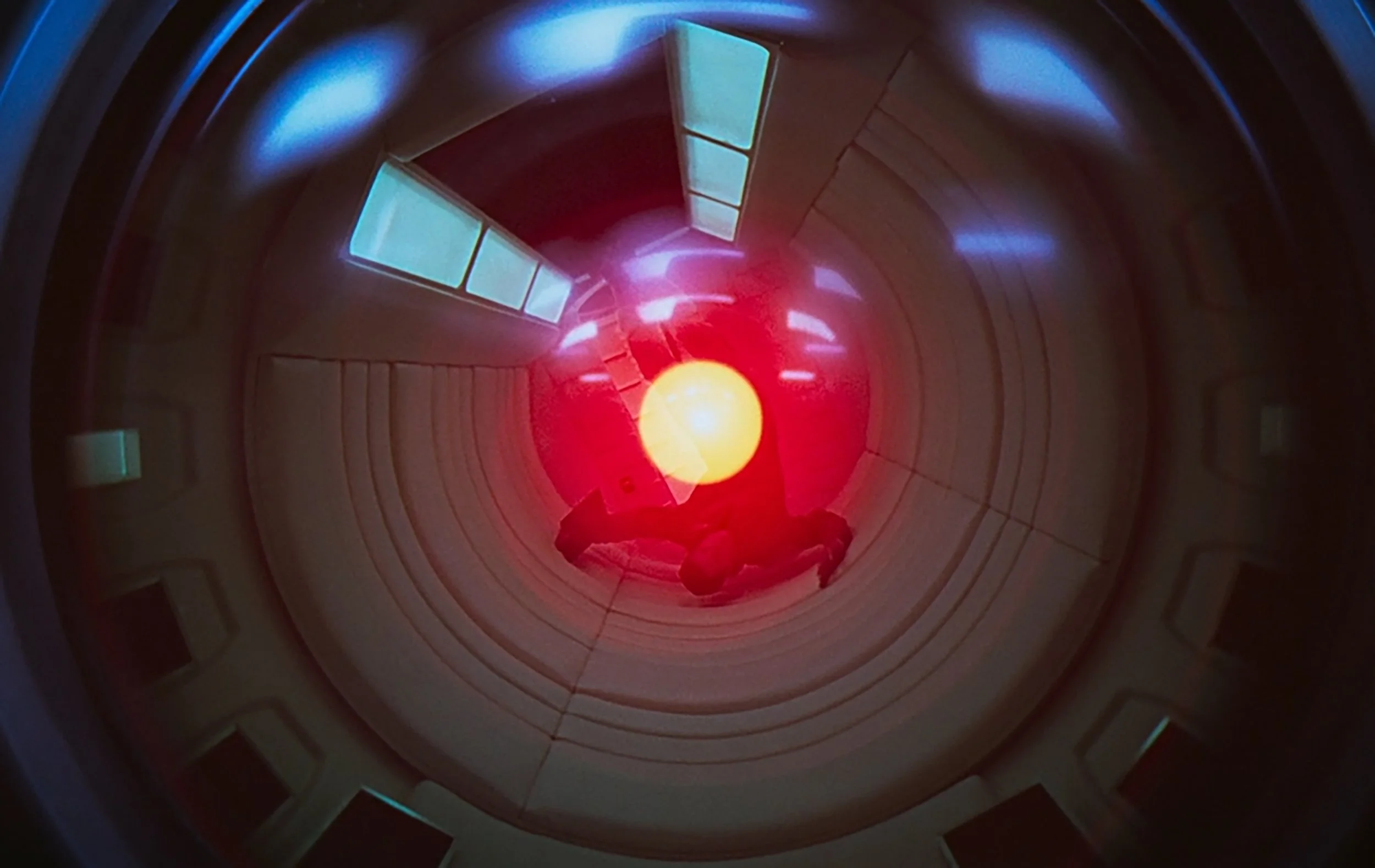
‘The eye of the HAL 9000 computer.’ Film still from 2001: A Space Odyssey. Stanley Kubrick, 1968.
This is the HAL 9000 (Heuristically Programmed Algorithmic Computer) singing the song Daisy Bell (Bicycle Built for Two) to Dave Bowman, the protagonist astronaut in the futuristic and prophetic 1968 Stanley Kubrick film, 2001: A Space Odyssey. HAL is a sentient artificial intelligence (AI) computer that controls the onboard system of the Discovery One spacecraft. HAL interacts with the crew until he begins to malfunction, and Dave Bowman disassembles his higher-learning processors and memory bank after HAL kills Frank Poole, the other astronaut on board, by sending him drifting off into space. HAL malfunctions in the midst of a logical paradox brought upon by contradictory parameters that caused a “Möbius Loop” of anxiety and irrational behavior. As Bowman begins to unplug HAL’s isomorphic memory blocks he accusatorially asks him, “Just what do you think you’re doing, Dave?” HAL then sings Daisy Bell in a slow, drunken, dying voice as his operating system is methodically being lobotomized.
The movie, co-written by Kubrick and Arthur C. Clarke, begins with a superimposed title over a desolate, ancient paleolithic landscape that reads, “The Dawn of Man,” and shows a shrewdness of apes in their everyday lives of over two-million-years-ago. The apes forage while living in fear of other predators. Eventually following their leader Moon-Watcher, they learn to use bones to smash objects, which then progresses to smashing other bones, and finally to attack a rival tribe. The sequence ends with the famous match-cut of Moon-Watcher, after killing the combatant tribe leader, throwing a bone in the air that turns into a spacecraft, all to the tone poem of Richard Strauss’s Also sprach Zarathustra.
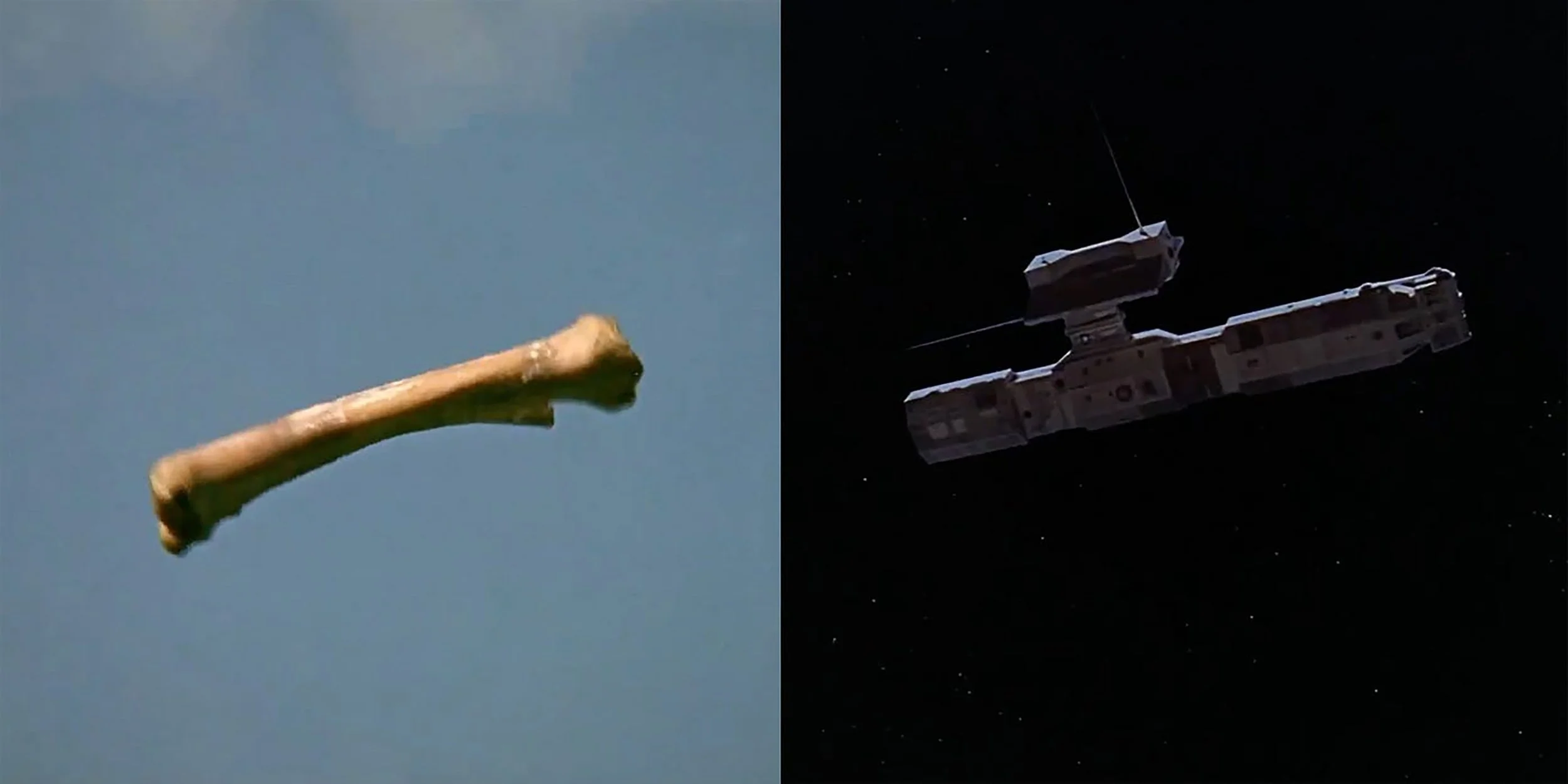
‘Match-cut of Moon-Watcher’s bone to the Discovery One spacecraft.’ Film still from 2001: A Space Odyssey. Stanley Kubrick, 1968.
The spacecraft that the bone turns into, while looking like a scientific vessel, is actually an orbiting nuclear weapon platform. Kubrick and Clarke wanted to draw a parallel connection that the first tool of man was a weapon, and the most advanced tool of man is still a weapon. It’s also important to note that the literary work, Also sprach Zarathustra (Thus Spoke Zarathustra) by Friedrich Nietzsche, is the inspiration for Strauss’s single movement orchestral piece, and is the codex in which Nietzsche proclaimed that “God is dead.”
While Nietzsche’s proclamation in Zarathustra is often misunderstood to be a direct reference to the Judeo-Christian monotheistic god of the bible, that misconstruction doesn’t mitigate the fact that the god of his era was, in fact, dead. Ironically enough, Nietzsche’s god, which had its foundation in morality, truth, and purpose had ceased to exist, driven to nihilism and loss of absolute meaning by scientific development. God’s death notice is delivered by more of a spiritually and emotionally defeated soldier on a battlefield, with chaos, death, and destruction all around him, than it is by an atheistic preacher proselytizing on a street corner soapbox. It is a proclamation of abdication. Nearly one-hundred-fifty-years later the god of man is still dead, but the god of AI is alive, as the god of AI is man.
Artificial intelligence (AI) is the capability of integrated hardware and software systems that process information, model complex phenomena, and solve problems using algorithms to perform functions typically associated with human intelligence. What once was an academic discipline that started in the mid-1950’s, and then appeared in science fiction books and movies, is now an everyday reality. AI is quickly integrating—or infecting, depending upon your point of view—itself into the personal and professional facets of everyday life. AI is now used for anything from menial office tasks, email composition, meeting minutes, and medical diagnoses, to songwriting, moviemaking, and art creation— everything from the trivial to the supercilious. Because of this task-oriented association with human intelligence, users are also anthropomorphizing their relationship to AI. They give their AI interface names, confide secrets, ask personal or relationship advice, develop strong bonds of friendship, and rely on it for human interaction.
Anthropomorphization is not a new phenomenon, of course, as it is an innate tendency to attribute human traits and emotions to non-human entities. Even Moon-Watcher and his shrewdness might have imputed ape-like emotional traits to the sun, the moon, the clouds, or even the skull-crushing bone that he wielded with so much power and progress. Note that anthropomorphism is a subconscious cognitive strategy to satisfy our need for social connection, diminish uncertainty, and to foster empathy. We do this with pets, objects, nature, technology, and even our gods. We attribute these traits and emotions to our perception of the divine to make the incomprehensible being more relatable and understandable. The ‘angry’ god of the Old Testament, the ‘jealous’ gods of Mt. Olympus, the ‘lustful’ gods of Mesopotamia all have been ascribed human emotional attributes so that we may better relate to them. The question now is, in this ape-to-man-to-AI evolutionary hand-off, will AI anthropomorphize us?
Will AI begin thinking of us in an anthropomorphized paradigm? Will it begin to placate us in a high, sing-song voice, or scold us in a firm, staccato, onomatopoeic “tsk, tsk” the way we do while paper training a puppy? Have we now forfeited our place at the front of the line in Rudolph Zallinger’s famous illustration “The Road to Homo Sapiens,” more commonly referred to as “The March of Progress,” and if so, who is the Grand Marshal of the evolutionary parade, an advanced system on a chip (SoC) integrated circuit?
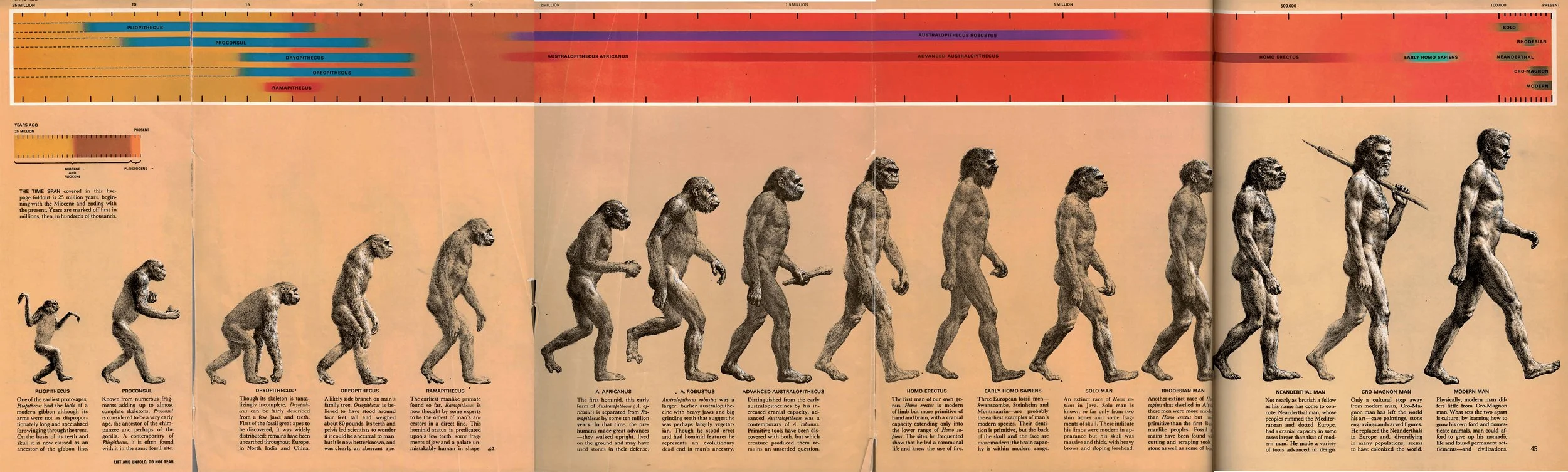
‘The Road to Homo Sapiens’ created by Rudolph Zallinger, 1965.
The rise of AI brings with it great opportunities but also the possibility of great loss. The first true opportunities for profits and losses will most likely be in the field of economics. There will be ecstatic winners and forlorn losers in the investment and asset management fields, and winners and losers in the everyday workforce as well. But unlike other work-oriented upheavals in the past, such as agrarian to industrial revolution, or more pointed disruptions such horse-drawn carriage builders to car assembly line workers, this time there might not be a transitional replacement job available, as this is not a lateral move, but the end of the line, a dead-man-switch if you will. According to some analysts, eventually anything that AI can do, it will do. This may eliminate not hundreds, not thousands, but millions of jobs across the globe, and could affect practically every profession—including artists, writers, filmmakers, actors, musicians, and nearly everyone in the creative fields—but would spare the professions of the trades, such as plumbers, electricians, carpenters, bricklayers, or anything that requires muscle, sinew, and bone. In a Dylan-esque ‘simple twist of fate’ scenario, instead of AI servicing us, we would now be relegated to servicing it.
In the song, Dear God, Andy Partridge of the band XTC asks, “Did you make mankind after we made you… and the devil too?” We might very well find ourselves in the same dichotomous situation where AI makes and shapes mankind after we’ve created it. In a mutually beneficial arrangement, AI provides us with entertainment, distractions, and a sense of hive community, while we provide it with brick-and-mortar lifeline tangibles such as electricity, cooling systems, wiring, and replacement parts. It remains functioning and sentient off of our physical labor. We accept hive mentality for worker bee status, and our queen, our king, our god, is a non-tangible, thought-directive, beaming down to us from beyond the clouds, beyond the atmosphere, beyond the earth, from the heavens themselves.

Image courtesy of cottonbro studio | Pexels
While some may welcome AI as a future utopian likelihood, and others may fear it as a dystopian inevitability, my guess is that it very well might become just another subtopian construct along with the advent of cable television, the internet, and social media—another way to kill time in a doomscroll of technology. I could be wrong, and AI might already be dismantling our higher-learning processor, the human brain, through its continued atrophy as artificial intelligence replaces the need of memory recall through our incessant search engine queries, and removes the desire of due diligence with easy, readily available answers to even the most mundane questions. Epiphanic moments are now ignited by electrons moving through silicon chips and circuits instead of neurons and neuroplasticity. Just like the infamous Heuristically Programmed Algorithmic Computer of 1968 being stripped of his higher operating functions, we too might be in the beginning stages of the very same process and consequence. If so, and now the superimposed title over this overpopulated, contemporary era landscape reads, “The Dusk of Man,” and we truly are on our way to becoming service pets and beasts of burden to AI, this begs the all-important question, “Just what do you think you’re doing, HAL?”
Daisy, Daisy,
Give me your answer, do!
I’m half crazy,
All for the love of you!
