
Holding Space
Gerald McEachern at the Saint John Arts Centre, Saint John, New Brunswick, February 19 through March 28, 2026
By Jorge M. Benitez
Modernism and its aftermath eclipsed the old debate between the followers of Rubens and those of Poussin. Gerald McEachern reminds us that the debate remains relevant, if only in a sublimated form. From neo-classicism to romanticism and expressionism to minimalism, the argument has not changed since the early 1800s. Should painting be cerebral or visceral? Gerald McEachern does not answer the question. He paints it. And the full title of his recent exhibition at the Saint John Arts Centre clarifies the issue succinctly: Holding Space, ‘Liminal’ as Bridge from Modern to Postreal [sic].
Through 15 small- to medium-format acrylic paintings and one sculpture, McEachern invites the viewer into a non-illustrative and non-didactic story. He provides the prompt. The audience writes the tale, but only if it opens its eyes. His supremely visual paintings tease the brain with metaphysical morsels. Soon, the heart and the mind begin to dance a waltz that ends in a tango. Sex is never far away, although invisible to prurient eyes. Like the salonnières of Enlightenment France, the coquette is a thinker. She subdues the male gaze and turns it inward. She tames the wild boy and helps him grow into a man capable of love and reason. Balance is restored. Everyone wins, at least until the zero-sum obscenity of power reappears.
McEachern is metaphorical up to a point. In three non-representational square paintings titled Borderlines, the symbolic flirts with the concrete. The Fort William, Ontario, native can see the border of his bellicose southern neighbor from his home in Saint Andrews, New Brunswick. The threat is real. The paintings say nothing and point to everything through subtle, chromatic greys and thin barriers of muted rust and paradoxically warm blue. Each has a miniscule, thin red vertical rectangle that crosses the grey field into the horizontal, wedge-like barriers. The shapes matter. There are menacing wedges throughout the once friendly border. Does the viewer see the threat? The paintings are deceptively formal, like diplomacy, the liminal space between peace and invasion.
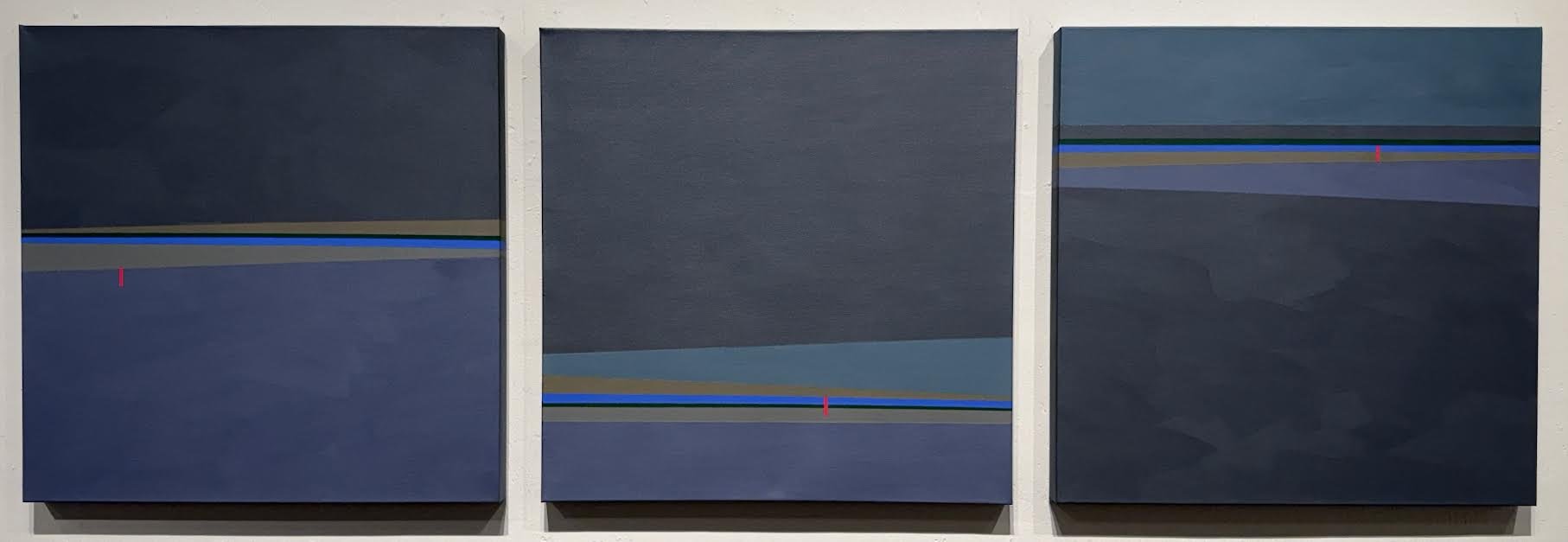
Gerald McEachern, “Borderlines,” 2026, acrylic on canvas, 24” x 24” each
Life, a square canvas with a deep cadmium yellow ground, depicts a single, disembodied nipple; supposedly female. Therein lies the problem. Male nipples are mostly uncensored. Female nipples must be hidden. Life plays with such hypocrisy by forcing the viewer to approach the canvas and confront the biological nutritional device. From a distance, the painting appears to be completely non-representational, like the mocking story of the modern artist who paints a single dot and calls it art. But Life is art. If it were music, it would be a scherzo; a serious piece passing as a joke. Nipples are essential to the survival of mammals, but the human ape denies its animality. The human ape fears life, intimacy, and all forms of physical messiness. One nipple is enough to cause distress. Two would cause paralysis and death, except as porn or advertising. Is there a difference?
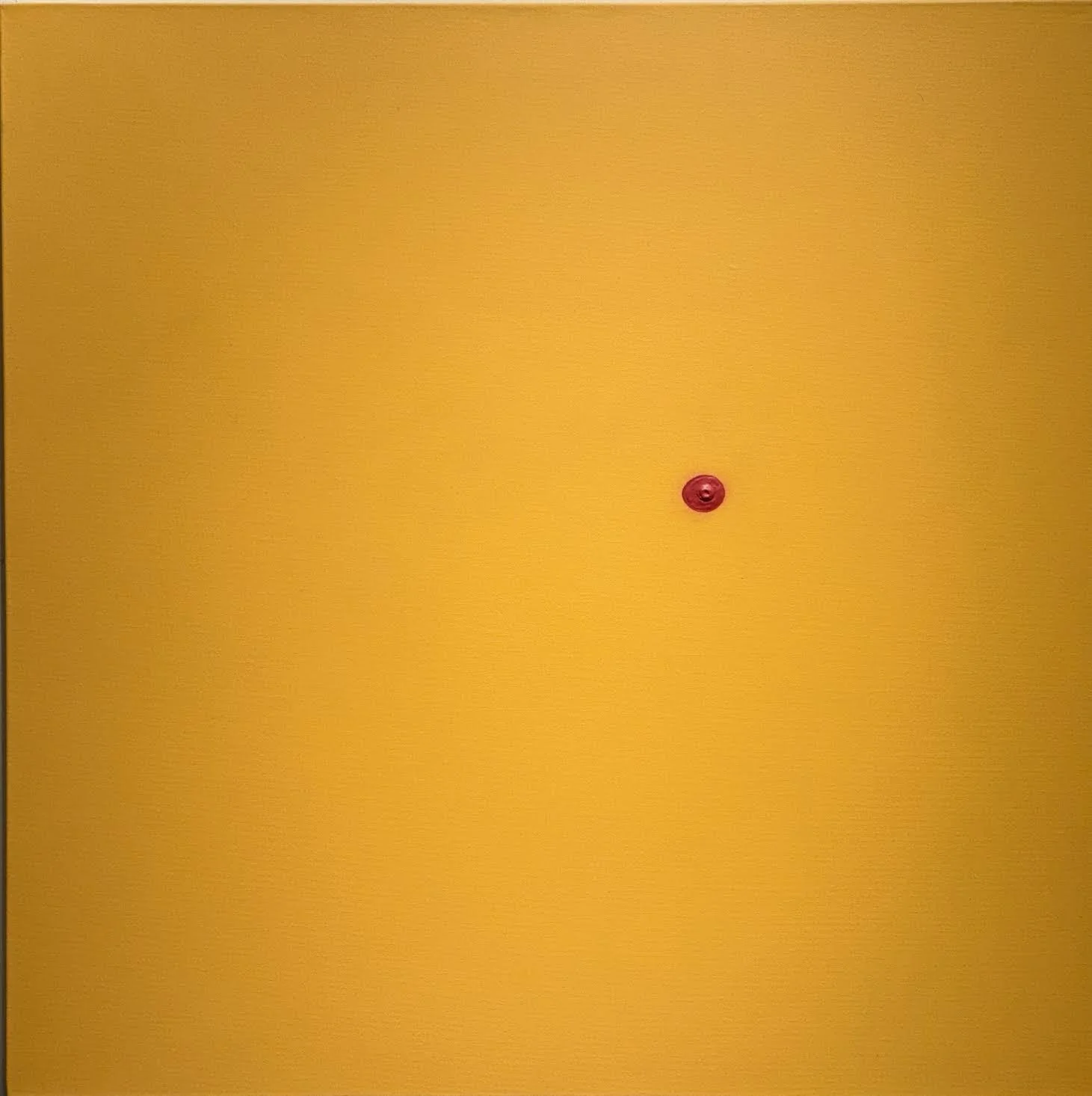
Gerald McEachern, “Life,” 2023, acrylic on canvas, 36” x 36”
Exposed and Enigma are diagonally hung square canvases. The former depicts a small butterfly on a lime-green field, and the latter depicts a small lip-sticked mouth on a red field. Like the canvas, the mouth is also at 45 degrees, a disconcerting angle with deliberate sexual overtones reminiscent of Courbet’s penchant for scandal. Have we changed since the 1800s? Did something die in the late 1900s? Whatever happened to the Swinging Sixties?
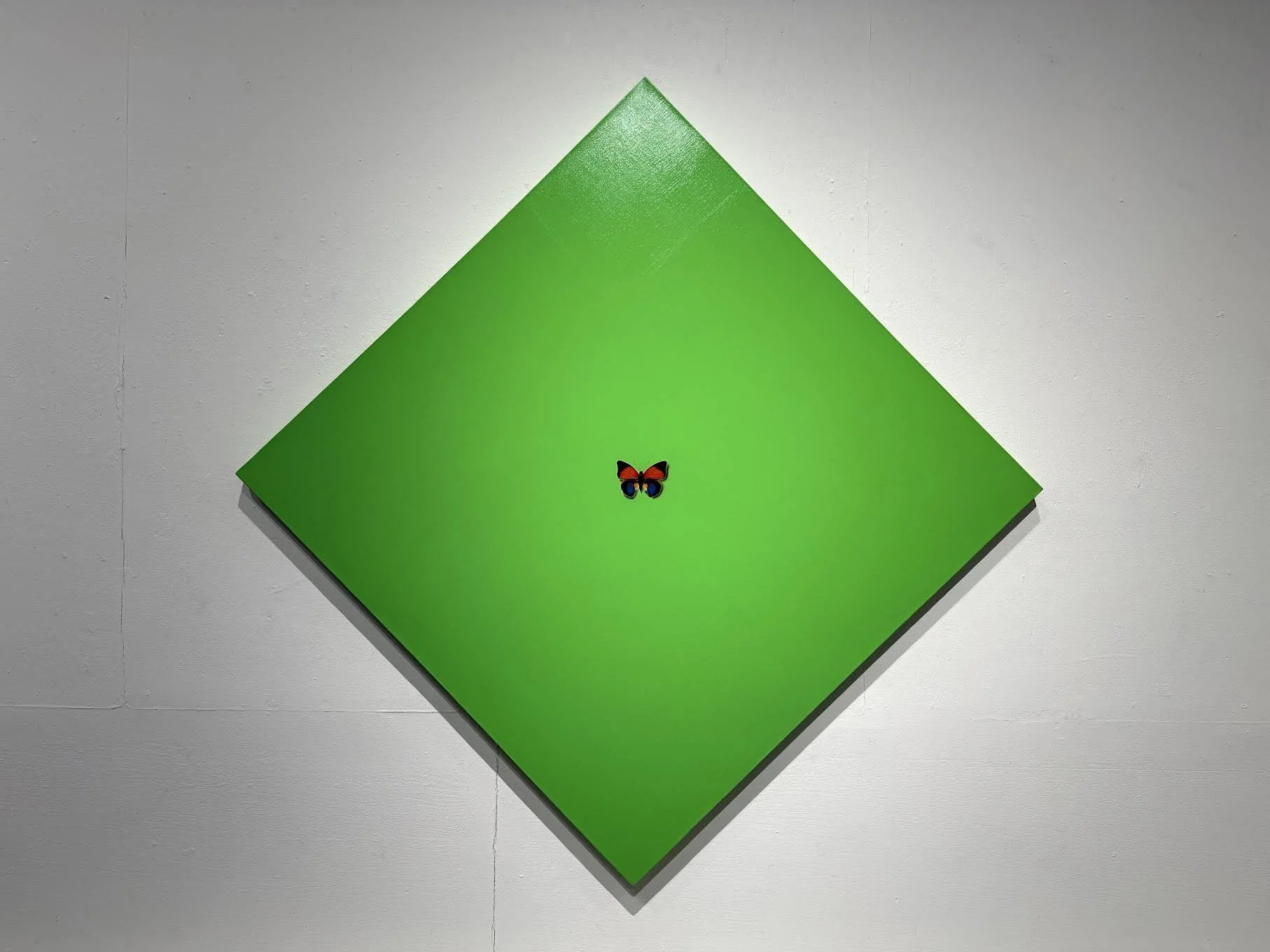
Gerald McEachern, “Exposed,” 1986-2023, acrylic on canvas, 36” x 36”
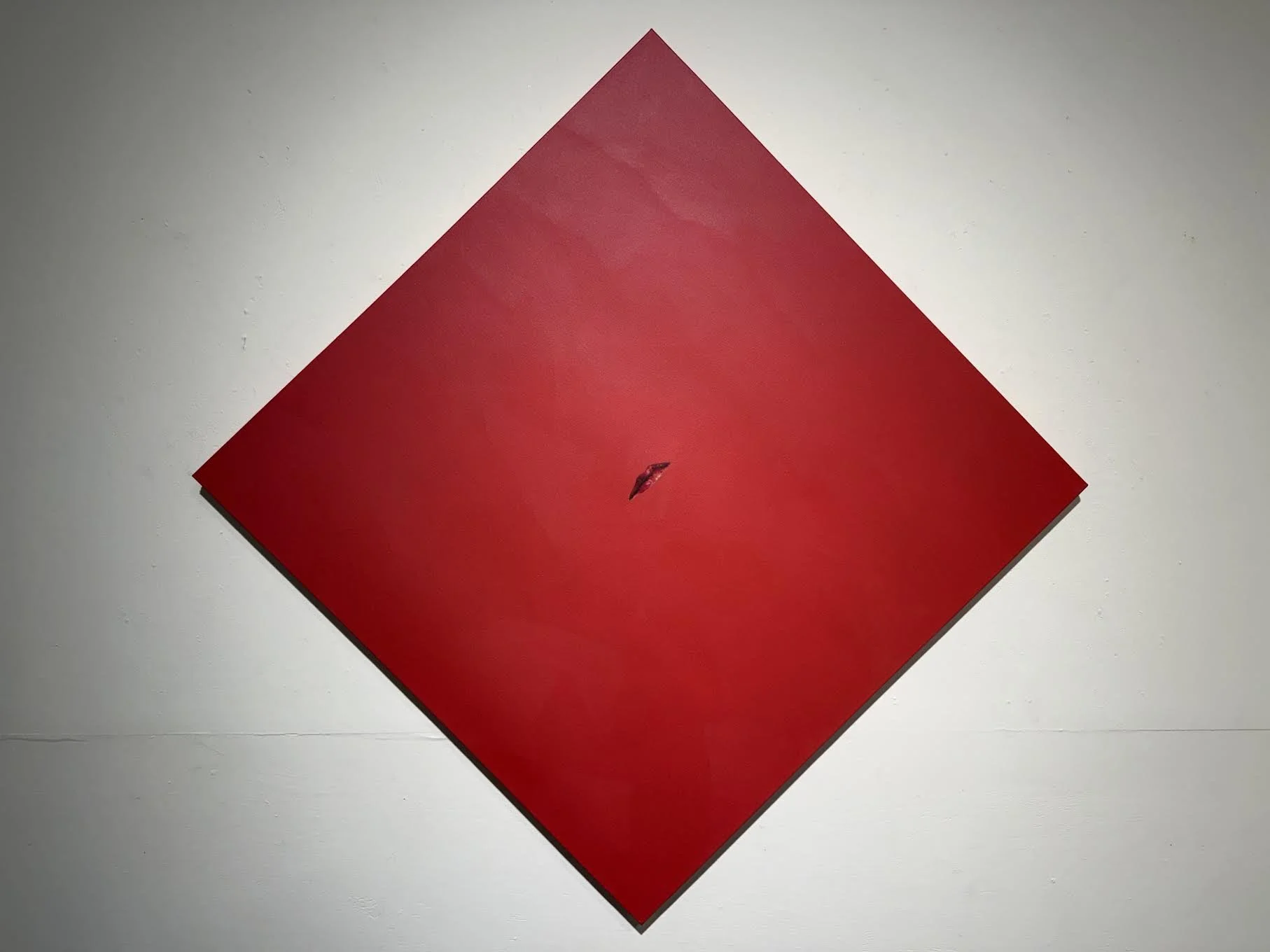
Gerald McEachern, “Enigma,” 2025, acrylic on canvas, 36” x 36”
An aggressively horizontal, mostly blue, painting titled No Planet B shows what looks like Earth at the extreme left and a cloud at the extreme right. The planet butts up against a black wedge to its left, while the cloud butts against a red wedge to its right. The horizontal format compresses the piece and dissolves all sense of outer space. There is no exit. No place to go. No planet B.
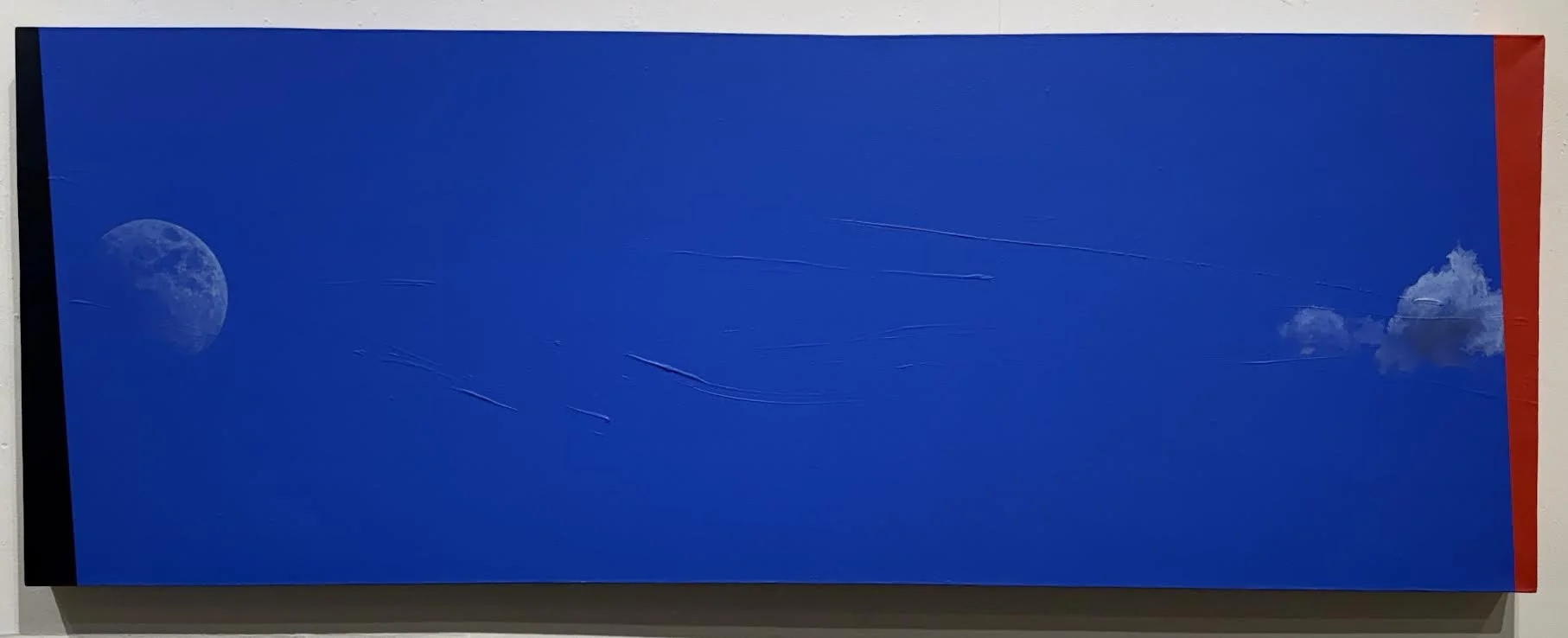
Gerald McEachern, “No Planet B’” 1987-2026, acrylic on canvas, 36” x 36”
Despite their sense of place, the open spaces that echo a Canadian landscape, these are not diatribes on identity, Canadian or otherwise. Nor are they overtly political paintings or works of outraged victimhood. Their quiet presence speaks to a higher subversion. They are whispers from an observant monk who kills with a prayer and a glance. As McEachern says in his artist statement:
The events now unfolding are unprecedented in our lifetimes. The breakdown of our rules-based society is well underway. It has become more difficult to separate fake news from factual reporting. The lie now distorts reality. Postrealism has arrived. The lie is the active virus infecting our social, political, and cultural spaces. Artists—and all the rest of us—are at a crossroads. Do we embrace AI or do we resist?
Perhaps the lone sculpture in the show answers the question. Man Up is a found object with a rod of welded steel that holds up the shorter leg. The piece of hardwood suggests the mutilated legs and torso of an emasculated man, assuming it is nude. It looks innocuous, like a Ken doll, the perfect boyfriend—sexless and mute. The title mocks the order to undo male vulnerability. Society demands sensitive men whom it then destroys with well-aimed cruelty. The boy who cries gets crushed: “Man up. Man up or die!” We resist at our peril.
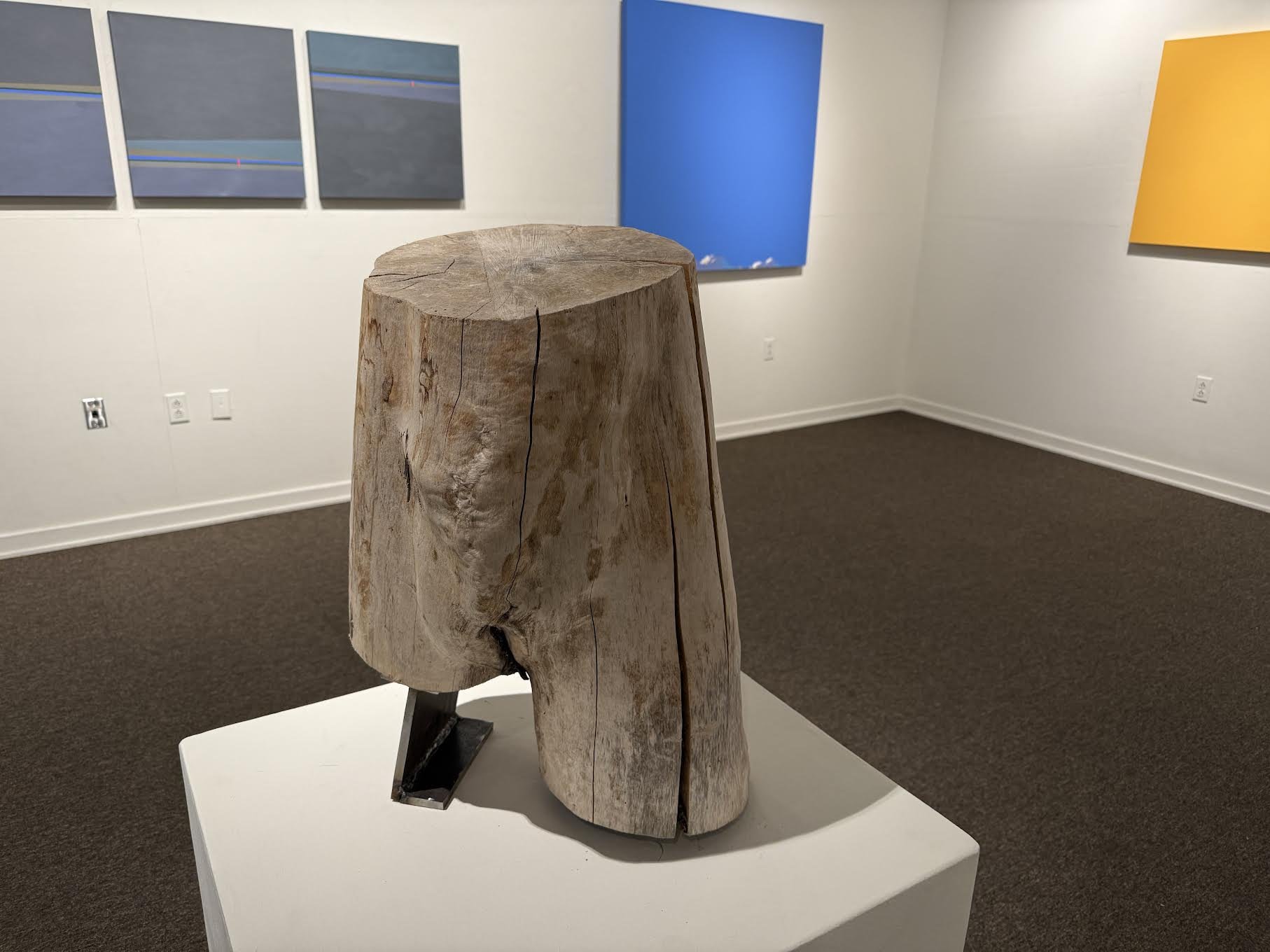
Gerald McEachern, “Man Up,” 2026, found object (wood and steel), 23” x 14”
Words matter to a man with a keen literary sensibility. McEachern is a writer as well as a painter. The former ad man and former director of the Sunbury Shores Arts and Nature Centre in Saint Andrews, New Brunswick, also managed a civic center project and rescued the Thunder Bay Symphony Orquestra from debt. Such experiences, in addition to having run a provincial political party, inform a worldview balanced between wonder and sorrow, possibilities and tragedy. It is an Old-World outlook untarnished by entitlement. His two unpublished novels, One Hundred Days Home and The Euth Group, are extended meditations on quiet compassion without the indignity of public virtue. His approach is straightforward and unadorned. The language flows without self-conscious preciousness or calculated sensitivity. He writes like a man who has made friends with pain and shared a beer without remorse or recrimination. He deserves to be read.
