
Review, Biennale de Arte, Venezia 2026
By Nancy Nesvet
Humanity was front and center, in the crowds, protests, pavilions and collateral and unofficial exhibitions at the Biennale de Arte, in Venice, The President of La Biennale di Venezia, Pietrangelo Buttafuoco wrote that “care reveals our active engagement with the world, …the intentionality of being there, of finding oneself in this world through relationships with others. Care was the premise from which this journey began.” He went on to write that the late Curator, Koyo Kouoh’s exhibition bears a “reconnection with life and the Earth” keeping the focus on the individual as part of a community, not only of people, but of plants, the land, the oceans and animal life, placing the person as the Curator, one who cares for, from the Latin curare. Although Kouoh has now joined the world of the immaterial, the focus on the Biennale she developed is on the material world, where seeds she and the other curators sowed have come to life, as the people who nurtured continue to nurture those seeds, imbued with the waters of the earth. I would like to think that, that Kouoh herself in body and spirit is nurturing those seeds as well.
The title, “In Minor Keys” refers to the small, the minor, the music played in the minor key that underscores but plays lightly before the major and louder melodic line. Koyo herself wrote: “Artists are channels to and between the minor keys and listening to, rather than speaking for them is at the core of the curatorial conceit”. Music came before the keys, produced by the body, by the voice.
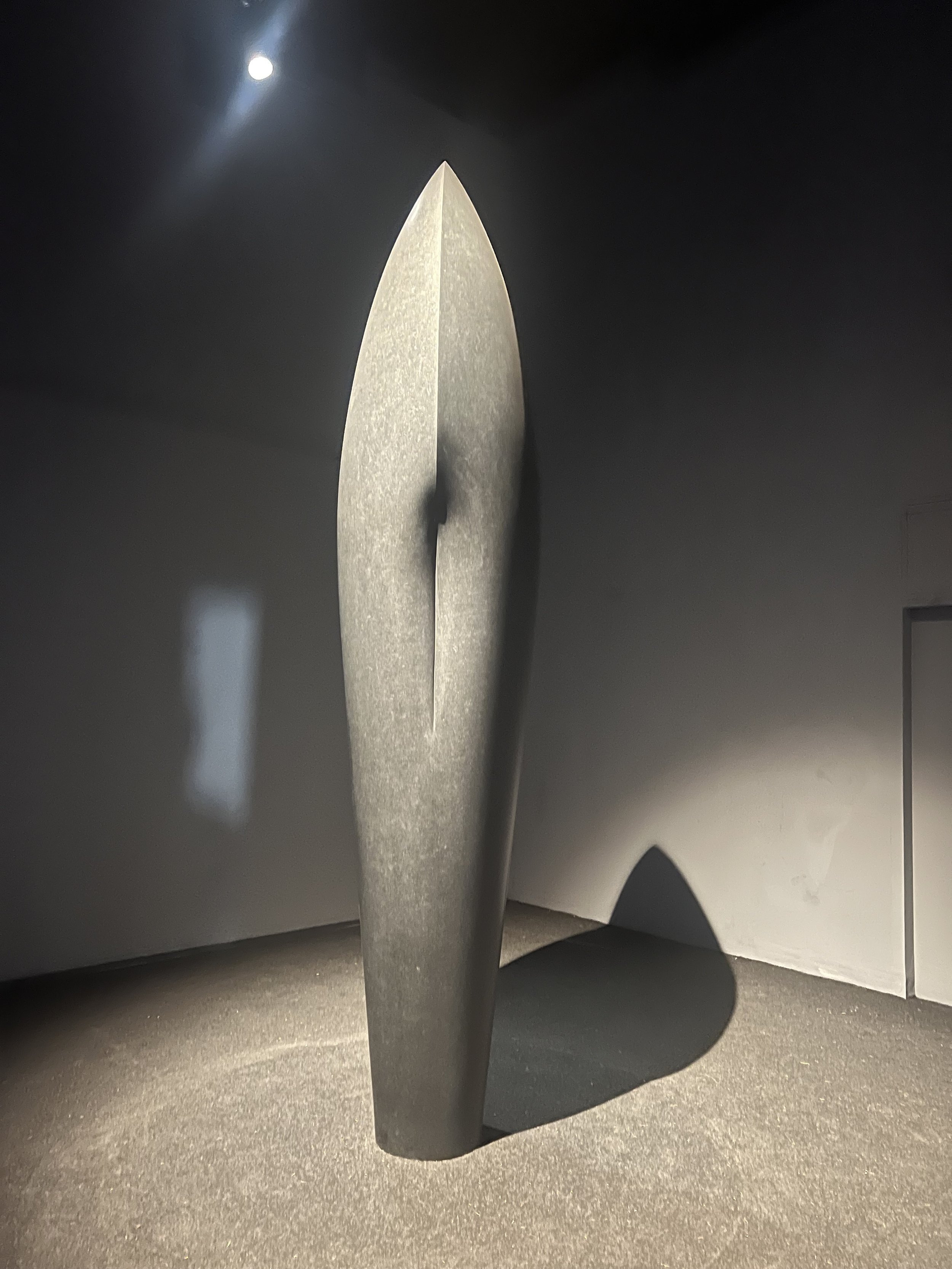
Armen Agop, Egypt, Silence Pavilion
The artist featured at the Egyptian pavilion, Arman Agop, directed visitors to “Please touch” his granite curvilinear columns, like bodies bent backwards to look at the stars, to be quiet so we could listen to our own thoughts and emotions. He emphasized in his opening remarks that we must listen to ourselves before we can hear and interact with others. The dark room of the Egyptian pavilion encouraged the visitor to walk carefully, to look carefully, to listen to our own breath and heartbeat and note our own emotional response to the work, to be above conflict in the world, to listen not to politics or technology but to our own bodies, to know thyself before others. There were photographs on black ground, showing a thin blue line, that became colored, rainbow-like at the edge, when one turned away, like noticing the varied shades of multiple people and trees and water when you turn rather than look straight on, noticing only one, or only oneself. That listening to oneself becomes listening to oneself within the multitude. In a darkened room, Egyptian artist, Armen Agop’s pillars and photographs at Egypt’s Pavilion, named by the artist, Silence Pavilion: Between the Tangible and the Intangible featured granite monoliths, curved, sail-like or enveloping, like a nurturing breast, The placard attached ,“Please touch” invited me to feel the smooth, cool, polished, curved rock. That touch, something only humans and animals can intentionally do, was shared by so many. I listened, as directed by the artist, to listen to my inner thoughts, mark my inner emotions, not allow others to intrude on the pavilion’s silence. Only then, knowing thyself, noted the artist in his opening remarks, can one interact with others. This was a world devoted to human and animal life, devoid of technology. Like Beethoven’s last symphony, the Unfinished, where the first stanza recorded the beats of his heart, a heart damaged by disease, the sounds of my body, of my blood streaming and my heart beating, then was able to join with others’ rhythms in a world that we all must care for. Like the work of the artist Rafael Lozano Hemmer, who merges 300 heartbeats in a chandelier-like cascade of blinking heartbeats, the community of beating hearts, feeling emotions, seemed the theme of this Biennale.
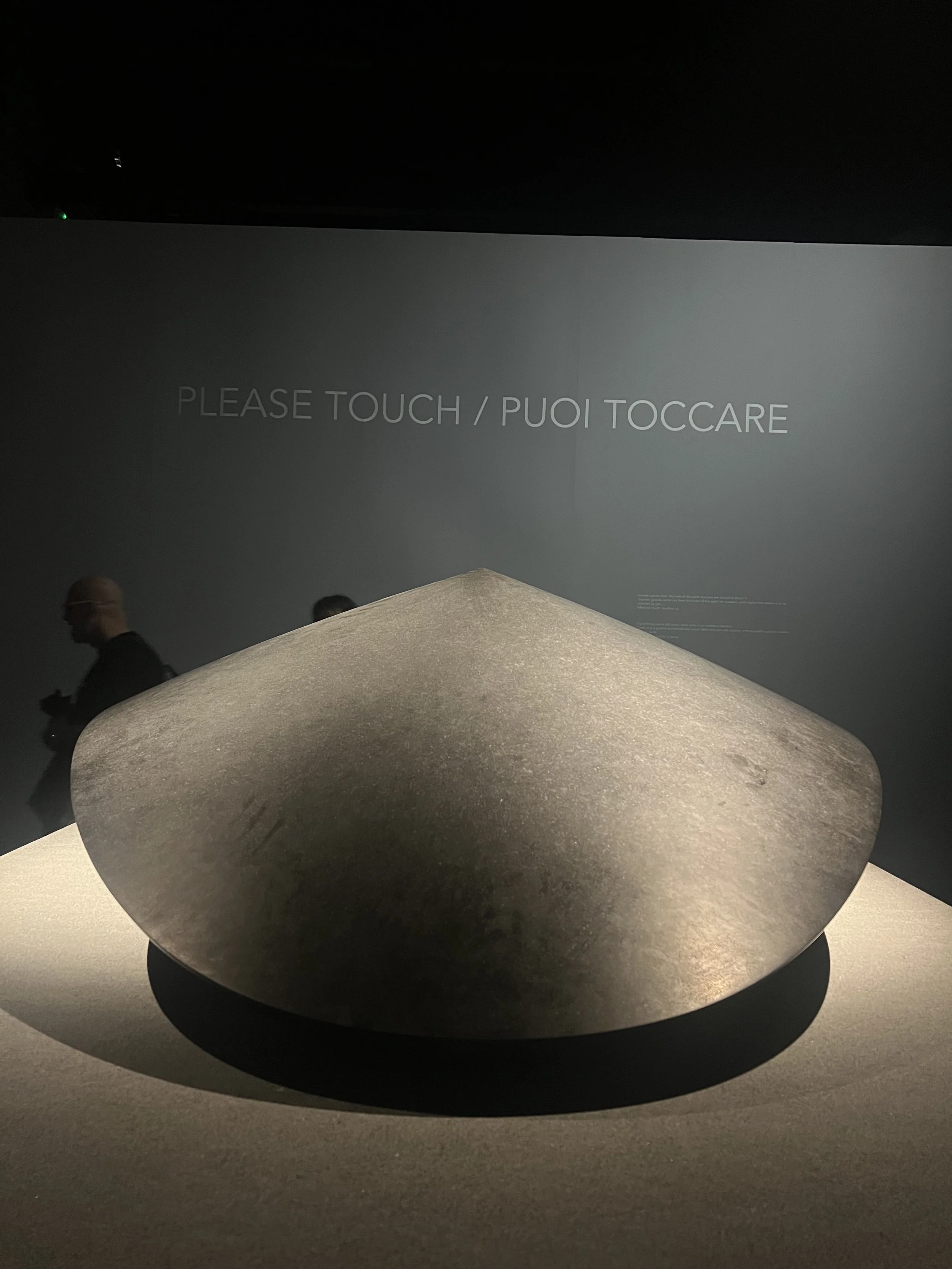
Armen Agop, Egypt, Silence Pavilion Pavilion, Between the Tangible and the Intangible
That humanity extended to handcrafted art, shown throughout that demanded touch, including the hand-tufted tapestries of Isabel Nolan, the exhibited artist at the Irish Pavilion who also employed materials as varied as steel in her sculptures and renditions of dust. Curator Georgina Jackson writes that Nolan’s work is haunted by the question of “how to love a tumultuous world, an indifferent universe and humans that are often so awful to each other” finding part of the answer in these touchable sculptures and paintings. Within the Arsenale exhibit including work by artists handpicked by Koyo, dividers were made of indigo cloth, dark blue, like the night sky, in a darkened room, to be opened, set aside so the art could be seen and cherished, like Egyptian artist, Armen Agop’s pillars and photographs at Egypt’s Pavilion, named by the artist, Silence Pavilion: Between the Tangible and the Intangible. Like the Shrines, the second section named by Koyo, in the Central Pavilion of the Giardini, the natural environment was valued and attention drawn to it as trees and forms of living architecture prevailed, as in the “Forest”, in the Pavilion of the Republic of Equatorial Guinea, subtitled The Forest of the Undergrowth, calling attention to, in the Curator’s words, “what is controlled and what escapes human order” Similarly, Aeolian Suite at the Finnish Pavilion enlists wind, transforming the pavilion into a windscape, noting that “wind is unpredictable, a “source of true randomness, It is uncomputable” addressing environmental questions with scenes of the lagoon, listening to the winds singing the weather. In perhaps the best incorporation of science and art, the Giardini Mistico, at the Pavilion of the Holy See contributes to a shared sonic composition of sound and music formed in a shared collaboration of new commissions by composers, musicians and poets, the garden supplying an instrument translating plant bioelectric activity into sound. Like so many other exhibits at this Biennale, it begs us to listen, to ourselves and to others.
Human rights as well as the earth’s rights and our rights and responsibility to cherish our earth was a central theme. Water, the color of the indigo cloth forming the wavelike entrances to the exhibits at the Arsenale, as an element covering the earth was featured at many exhibitions at this Biennale. At Romania’s exploration of all aspects of the Black Sea, water was seen again, this time the Black Sea was as a unifier, an oxygen starved body of water culminating from other streams and rivers. The video featured a swimmer, overtaken by the waves of the Black Sea, then quieting to a peaceable waterway, and reaching a crescendo again, evoking the history of Romania and the nations surrounding and sharing the Black Sea.
The naming of the sections of the exhibition, Kouoh’s naming, Shrines, Schools encouraged us to learn from, to worship, the earth and all its inhabitants, the waters that envelop us, that flow from one to another, and the sky that shields us, that turns from dark to light. This is a biennale that celebrates life, that asks us to together protect it.
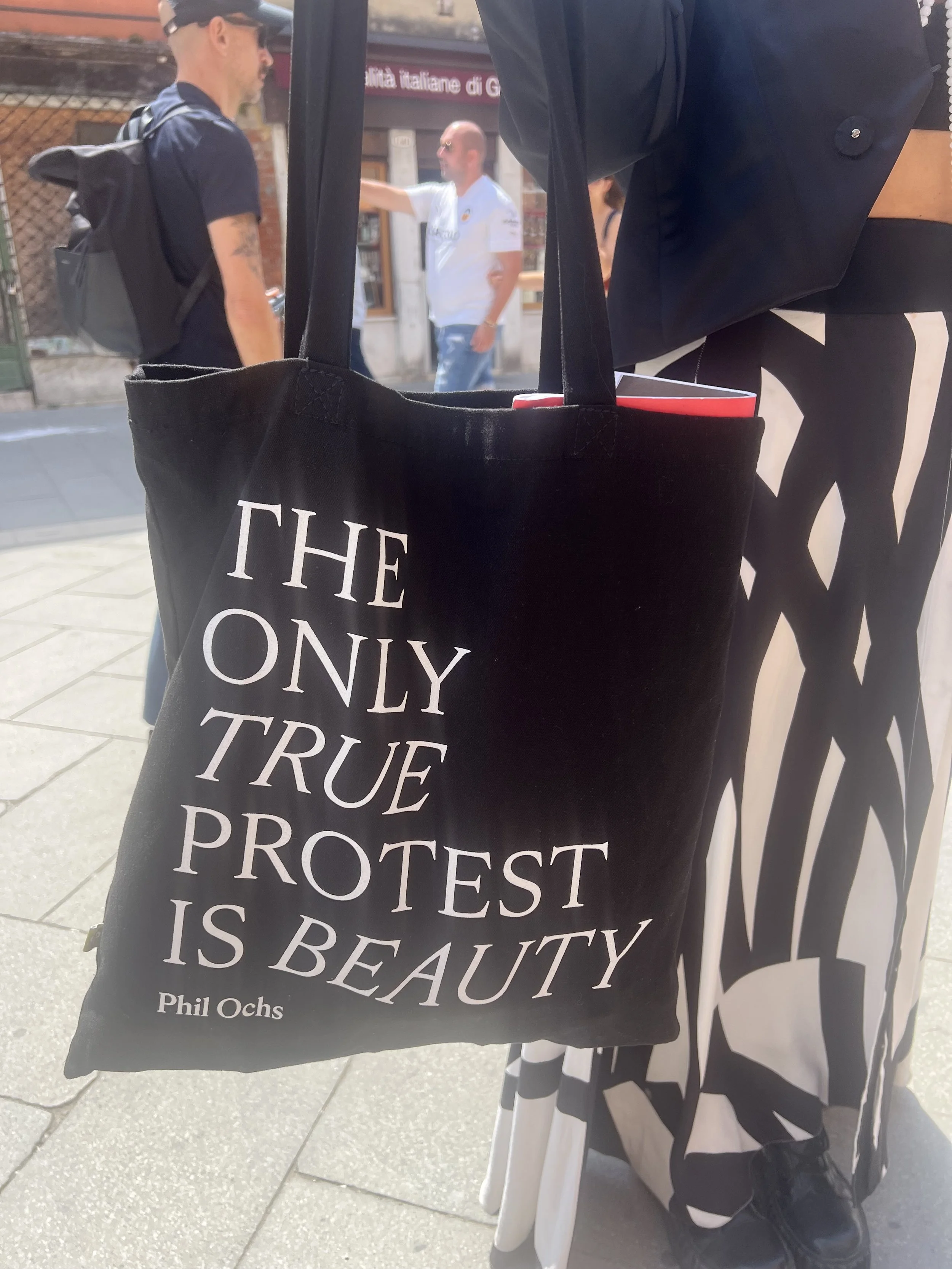
Demonstrations threatened the Biennale. Protest was the order of the first two days, shutting down numerous pavilions. The five judges of the Golden Lion prize for best national pavilion resigned in protest of the inclusion in the competition for the prize of Russia and Israel, due to their citing by the International Criminal Court of human rights abuses. Demonstrators believed that abusers of human rights should not be considered for the prize, and numerous artists and curators of pavilions agreed, shutting down for the first two days, as Pussy Riot blew pink smoke into the air, seen across the Biennale sites. I wonder that Kouoh would have agreed with banning Israel and Russia, as she was from Capetown, South Africa, once the nation of the most human rights abuse. At the Russia pavilion, a beautiful and fragrant display of flowers in tall vases throughout created a garden of sweet-smelling, beautiful foliage, but I wondered if this space was created intentionally to steer attention away from, to evade the harm and abuse Russia was perpetrating toward Ukraine, destroying towns and gardens and forests and people.. Can the display of natural beauty negate the politics of destruction? This display of propaganda, of creating a garden whereas Russia has recently created a nation ruined by destruction and death, looked like a mass of vases of flowers left after a funeral. Russia closed the floral display after the first three days, leaving only photographs of arctic winter at its pavilion. I wondered if they closed it before the flowers could die, to become a dead, barren landscape.
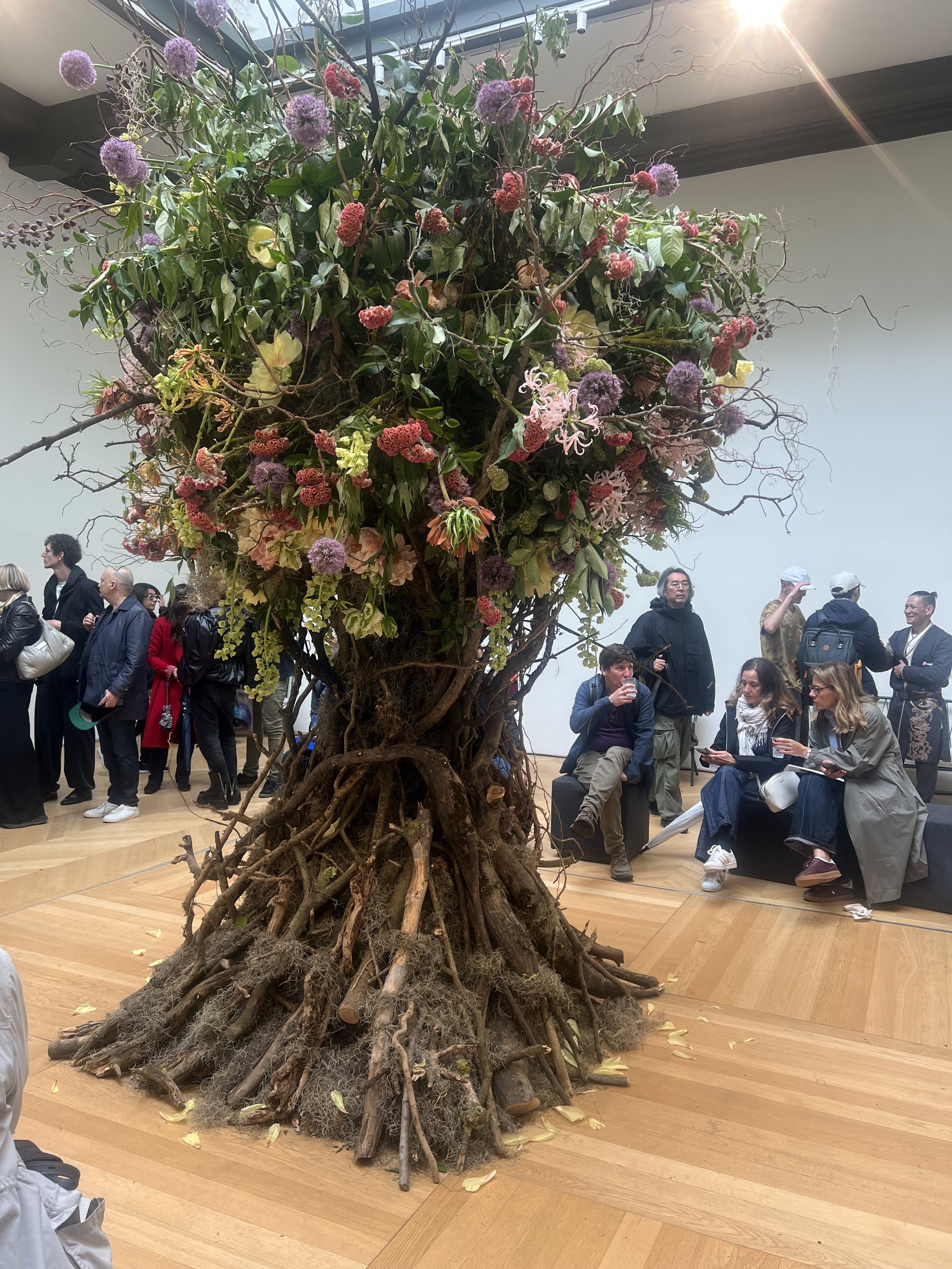
Russia Pavilion
Kouoh has done a masterful job, choosing artists and the theme for this Biennale. I would like to hope that, although she could not complete her mission, by passing it on to others in whom she had faith, that she created a greater community to honor the earth and all its people. By absorbing the lessons of the exhibitions in the Arsenale and the Giardini, I hope she and all of us, know that the world has become a better place. That is the lesson of the Biennale, and especially this one, to bring us together for a common goal, to care for the earth, the natural world, and all its living beings.
