
From Street to Catalogue: the Institutional Embrace of Graffiti
By Jillian Goss-Holmes
Each March and October, London’s leading auction houses host their flagship modern and contemporary sales. Blue-chip postwar names anchor the catalogues, estimates climb into the millions, and collectors from around the world fill the salerooms. But over the past two decades, another presence has become increasingly visible within these carefully curated spaces: Graffiti.
Once defined by its illegality, ephemerality, and radical form, ‘Street’ or ‘Urban Art’ now appears behind the exclusive doors of the world’s most established auction houses, including Sotheby’s and Christie’s. Its inclusion does more than expand sale categories; it signals absorption into the broader contemporary canon. When Graffiti is catalogued, estimated, and sold alongside postwar heavyweights, it legitimizes a movement that originated in defiance of institutional authority.
The UK has played a major role in this shift, largely through the market phenomenon of Banksy. His trajectory from anonymous stencil artist to headline-making auction figure cemented in 2018, when Girl with Balloon – which initially appeared in 2002 under Waterloo Bridge – partially self-destructed moments after selling at Sotheby’s London Contemporary Art Evening Auction. Renamed Love Is in the Bin, the work later resold in 2021 and achieved £18.6 million, nearly twenty times its original 2006 estimate. What might have once been labelled as vandalism had become a multi-million-pound work with realized resale growth.

Banksy, Love is in the Bin (2018). Photo Courtesy: Sotheby’s
That result did more than generate headlines. Not only did it help enforce Graffiti’s presence within the upper tier of the secondary market. It also created a price history. And this price history is crucial. Auction records create transparency and comparables, and comparables and transparency create confidence. For art market participants – such as collectors, advisors, and insurers – measurable price history helps reduce perceived risk and mitigates concerns in the frequently criticized murky and opaque art market.
While Banksy dominates headlines, other UK-associated artists, including Stik and Ben Eine, have established consistent secondary market traction. Bonhams even established a dedicated ‘Urban Art’ sales sector to formalize the category in the early 2010’s. Stik’s Riots (2011, graphite and marker on paper, 29.3 x 41.7cm (11½ x 16⅜in) achieved above its high estimate at Sotheby’s Contemporary Discoveries selling for $13,608 (without buyer’s premium), compared to its $8,165 – $10,886 estimate. My Dog Sighs, a UK-based artist also achieved success at Bonham’s ‘British. Cool. Auction’, recently selling above estimate for the piece, Reclaiming The Lost (Purple) (2023), at $6,994 (without buyer’s premium), following an estimate of $1,272 – $1,907. Reclaiming The Lost (Purple) (2023), acrylic and spray paint on canvas, and 120 x 80cm (47¼ x 31½in) is signed. Outside the UK, Ben Eine’s Letter M (Dark Blue Variant), from the Letter Series (2016), a signed screenprint in colors on paper, (55.2 x 69.8cm, 21¾ x 27½in) sold above its high estimate with a hammer price of $260, following an estimate of $160 – $240.
While many variables shape the value of works in the Street Art sector, this small sample of results suggest that scale, medium, and technical complexity do not always determine price as clearly as they might in more traditional contemporary categories. Instead, collector demand, recognizable visual style, and the artist’s market reputation may play a greater role in shaping auction outcomes. Although the examples above range from modest works on paper, painted canvases, and editioned prints – each exceed their estimates, signaling collector interest across formats.
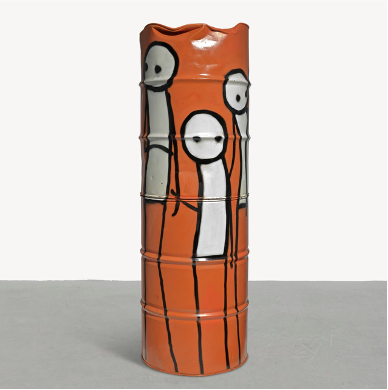
STIK, Untitled (1979). Photo Courtesy: Christie’s
Beyond auction houses, institutions have also played a critical role. Museums such as Tate and the Museum of London have incorporated Street Art into exhibitions and collections. Institutional acquisition tends to signal historical relevance beyond market momentum. Additionally, market galleries have also laid the groundwork. London-based dealers such as Lazarides Gallery (now closed) and Stolen Space Gallery cultivated early bases for street artists, transitioning them from walls to canvases to international fairs. Oftentimes, galleries provide what auction houses later amplify; by the time major works appeared at Sotheby’s or Christie’s, a collector ecosystem was already in place. The relationship is also symbiotic: strong primary market placement supports secondary results and strong auction results reinforce gallery credibility.
Yet institutional acceptance is not always without some friction. Graffiti’s modus operandi tends to resist commodification and rigid structure. Removing a mural from public space, or producing studio editions for sale, raises questions about authenticity and meaning. It begs the question: does a piece of Urban Art lose, or lessen, its meaning when framed and sold under chandelier light or on a 5K Retina display?
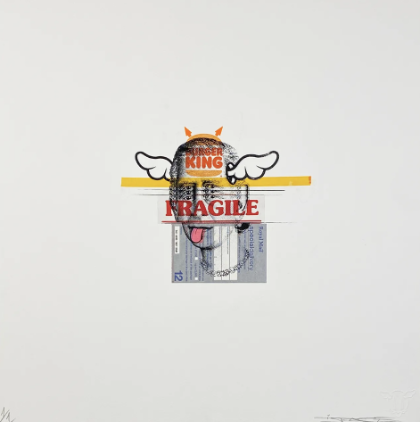
D*FACE, Framed Punk & Disorderly HPM 08 (2025). Photo Courtesy: StolenSpace Gallery
Auction houses navigate this tension through cataloguing and contextual essays, often emphasizing the political content, site specificity, or the artist’s continued engagement with public interventions. By doing so, they perhaps aim to reframe the pieces through an art historical lens.
There is also a legal dimension. Because many street works are created in unsanctioned environments, provenance verification and authentication are critical. Authentication bodies and Pest Control organizations (in Banksy’s case) have emerged to ensure legitimacy, underscoring how market infrastructure develops around demand. Further, there have been cases when Urban Art has been physically removed from its origin space to be auctioned off behind closed doors, as was the case with a collection of Street Art decorated doors, salvaged from Camden Market during its redevelopment in 2015.
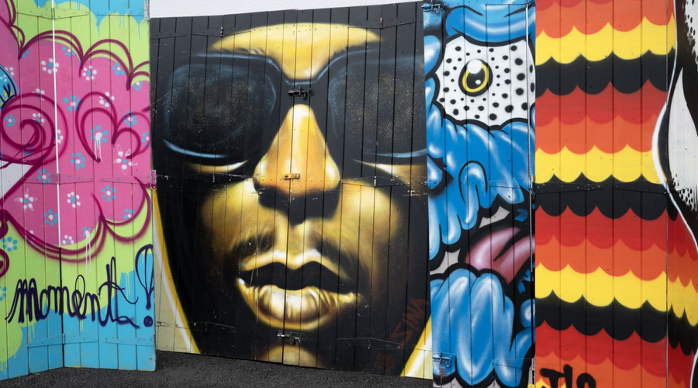
Photograph of the The Real Art Of Street Art project (2014). Photo Courtesy: RWB Auctions
It may be tempting to reduce Graffiti’s auction presence to shredded canvases and viral headlines, but the deeper story is structural. The secondary market has created measurable benchmarks, allowing art market participants to treat Graffiti as an asset class. At the same time, institutional acquisition and scholarly inclusion aims to ensure that the movement’s cultural significance is preserved beyond price tags.
The paradox is thought-provoking: a practice born in opposition to institutions now relies on them for permanence. But this trajectory is not unprecedented. Although the auction house, with its gavel and guarantees, may seem an unlikely venue for Graffiti art, this evolution mirrors patterns seen in other once-marginalized movements from Impressionism to Pop. Once created for brick and concrete, Graffiti now sprays itself throughout our art history books.
