
Shine On You Crazy Diamonds
By Richard Humann
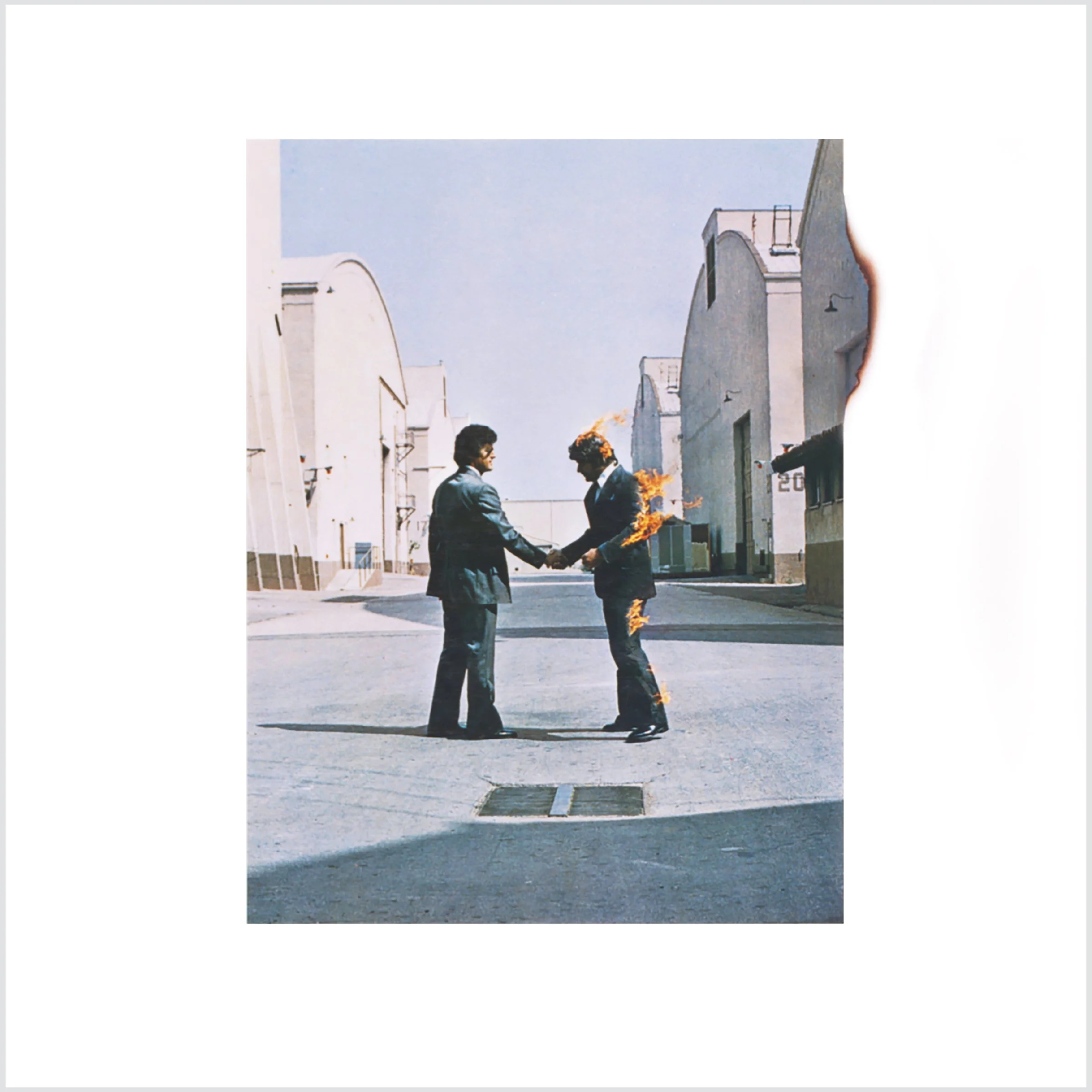
Pink Floyd, ‘Wish You Were Here.’ Released by Harvest Records, 1975. Album art by Hipgnosis.
I was 16-years-old the first time I dropped acid. It was a lime-green and lemon-yellow capsule about the size of a Flintstone’s vitamin. My childhood friends and I bought them from a wannabe suburban drug dealer during class one day back in high school. The bus dropped us off after school, and we dropped the acid soon after.
I wasn’t sure what to expect from taking LSD, but I definitely knew that I wanted to experience it. I had already been smoking pot for some time, and the next level up was to experiment with psychedelics. What I didn’t understand then though, is that the acid trip would last as long as it did, which was about twelve hours. When it kicked-in, forty-five minutes or so after taking it, the trip started with an hour of uncontrollable laughter, intermixed with a slow separation from reality. The next phase began the psychedelic journey. It was during this part of the acid odyssey that the tenor saxophone solo from Pink Floyd’s, Shine On You Crazy Diamond Part IV, the multipart rock suite off their ninth album Wish You Were Here, climbed into my brain, and with all Pink Floyd’s instruments, played that forty-three-second-long climactic part of the solo over and over again, for eight solid hours. To this day, whenever I hear Part IV of the suite, I am instantly transported back to the woods an hour north of New York City, on a school day afternoon, tripping out on acid.
The lyrics to Shine On You Crazy Diamond, penned by Roger Waters, one of the driving creative forces of the group, is about a former bandmate named Syd Barrett. Syd Barrett was a founding member, principal songwriter, and front man of the band who had a series of psychotic episodes following his own heavy acid use. Barrett first experimented with LSD in 1965 with friends of his, including Storm Thorgerson of the graphic art group Hipnosis that designed nearly all of Pink Floyd’s album covers, including Atom Heart Mother, Dark Side of the Moon, Wish You Were Here, and Animals. Barrett’s usage of acid steadily continued, and within three years, he became increasingly erratic, and developed a blank, dead-eyed stare. He no longer recognized his friends, and often didn’t know where he was. It wasn’t long after that he left the band to live in seclusion, and was replaced by guitarist/vocalist David Gilmour.
Waters writes of Barrett in the song:
Come on, you raver, you seer of visions
Come on, you painter, you piper, you prisoner, and shine
I believe that Waters acknowledges, in his enigmatic yet melancholic lyrics, an acquiescence of Syd Barrett’s psychotic breakdown, but also a love and embrace of him as a human being, his creativity—and his cry-for-the-moon lunacy.
There’s a certain cry-for-the-moon lunacy in everyone who has chosen a lifelong path of creativity and art. It’s an inexplicable wonder, not only to amateur behavioral analysts, such as family members, friends, accountants, and unsolicited life coaches, but often to the artists themselves.
An old adage states that ‘there’s a fine line between genius and insanity,’ but there’s a line—fine or otherwise—between average and insanity as well. Creative obsession is not judged by IQ points, test scores, or penmanship, nor is it graded on a bell curve. In fact, there is no numerical grading system at all, not even renumeration. Charlie “Bird” Parker died at the home of his friend from pneumonia, exacerbated by years of heroin and alcohol addiction. The coroner originally estimated his 34-year-old deteriorated body to be that of a 60-year-old. Mark Rothko opened his own barbiturate-filled veins—his heart full of self-doubt, his studio full of masterpieces. Beethoven was perpetually insolvent, not unaccustomed to sleeping on the street in his own piss. Charles Bukowski at his unflappable lowest, wiped his ass with newspaper. Too poor to buy anything but booze, but never too poor to write.
In the most expensive cities, New York, Los Angeles, London, Paris, Rome, Hong Kong, Seoul, Tokyo, and countless others around the world, where paying rent for an apartment is nearly impossible for legitimate career-minded professionals, the artist must have two spaces, one to live and one to work in. The artist trades fancy dinners at a restaurant for home-cooked fried eggs and toast, ramen noodles, or peanut butter and jelly sandwiches, but will never compromise on the quality of their oil paint, brushes, or workshop tools. The artist worries about money constantly, but gives away their work for free, just because somebody likes it and pays attention to it.
The artist is not envious of others’ financial success, or fancy cars, or designer handbags. We are not jealous of a relative’s vacation to their timeshare in Cancun, Disney World, or the Florida Keys, because we have lived at art residencies, and done exhibitions around the world. We desire financial stability only, not generational wealth, and then go to great lengths to destabilize it again, by purchasing anything and everything needed for art supplies, musical equipment, computer software, and anything else needed to complete the project at hand.
We do not brood when visiting a cousin’s big, brand-new home in the suburbs, but in fact revile against that comfortable and safe lifestyle. But we will mope for days, rocking back-and-forth in darkened rooms at not being invited to participate in even the most insignificant of exhibitions that has included one of our peers, and are inconsolable if one just happens to get a New York Times or Washington Post review, or is included in a major collection. We sacrifice relationships, girlfriends, boyfriends, husbands, and wives. We often sacrifice having children, as our work is our children.
But what anyone on the outside of this paradigm doesn’t understand, is that much like Camus’ reckoning of Sisyphus pushing the rock up the hill every day, only to have it roll back down, doomed to an eternity of this, is that the artist truly enjoys pushing that rock. Camus suggested that Sisyphus secretly relished his condemnation, and like Sisyphus, we are condemned to put our hearts and our souls, and every ounce of energy, money, emotion, as we face the insurmountable challenge every single day, to push that rock up the hill, knowing that it will roll back down again on us, and we must begin again the next day in the studio. It is not a condemnation at all, but is in fact, a privilege. And like his The Myth of Sisyphus, the torment, the pain, the repetition, and the prior knowledge does not affect the love of the labor, even knowing the results far in advance. We do enjoy the process and we embrace it. To use another cliché that defines insanity as ‘doing the same thing every day and expecting different results.’ Maybe it is insanity, or maybe it’s dedication and perseverance. Within a hyper-capitalist society’s definition of success, it might be considered insanity, because within that definition it is calculated by tangible and monetary outcomes. But maybe, like Sisyphus, the act itself, and the intangibility of that act, is in fact the successful outcome.
In June of 1975, Sid Barrett wandered unannounced into Abbey Road Studios in London during the final mix of Shine On You Crazy Diamond, the ballad about his own mental decline. He had gained weight, his head was shaved, as were his eyebrows, his pants were hiked up to mid-belly, and he was bedraggled looking. Waters, Gilmour and the rest of band didn’t even recognize him. A photo taken of the moment shows Barrett resembling what I can only describe as looking like Karl Childers, Billy Bob Thornton’s character in Sling Blade.
Ten years after that Pink Floyd/Sid Barrett incident at Abbey Road, I moved to New York City. I was young and out of college, and working at a typography studio in Manhattan’s Midtown East. I had an hour to kill during my lunch break, which I would often spend at the United Nations promenade eating a sandwich while staring across the East River at the massive Pepsi sign in Long Island City, just up from my newly rented apartment in Greenpoint, Brooklyn. But this day I was over on Lexington Avenue, looking in the window of one of the electronic stores that were there at the time. I was on the top step of the store, daydreaming about camera equipment or some other newly released item, when I realized in a panic that I was going to be late getting back to work. I jumped off the step onto the busy midtown, lunchtime sidewalk, and crashed directly into Kurt Vonnegut! He was one of my literary heroes growing up, as I had read all of his books in my teens. Vonnegut bounced and swayed a bit as I hit him, but he was otherwise unaffected by my unintentional body slam. He never even looked up at me as I offered him my sincerest apologies, as he was probably lost deep in thought plotting another Kilgore Trout cameo, or maybe an unstuck-in-time Billy Pilgrim resurrection. As I struck him, I was struck by his appearance. He was disheveled, his hair was wild, he was unshaven and unkempt. He continued slowly walking up Lexington Avenue, and as I raced across the street to rush back to my work, I glanced over at him and saw that he had a huge rip in the seat of his pants, through which I could see his red boxer shorts.
Like Vonnegut, or Barrett, our clothes are often tattered and torn. We have thick, dried paint marks on the thighs of our pants that resemble scars left behind from the attack of a wild, multicolor-clawed animal, and burn marks on our clothing and skin from cutting steel with a plasma cutter. Our hair is wild, unkempt, as if a hairbrush or comb weighed too much for us to lift. We dress for art openings, musical performances, and book readings only, being forced out of solitude to support our fellow artist friends, or to chase down the elusive art dealer or critic, hoping to catch them in their natural environment. We walk through the streets, ride on the subway, drive in our cars talking to ourselves, and yes, even answering ourselves back in lucky epiphanic moments or unlucky existential crises. But mostly we are quiet, lost in thought revisiting our last body of work, or meticulously planning a new one, removed from the outside world, with only a thin thread of reality tied around our fingers so that we may find our way back when and if needed.
For years now, it’s been a habit of mine to put my Bluetooth earbuds in, put on Shine On You Crazy Diamond, and walk around art fairs, museums, and gallery exhibitions listening to the melodic, cerebral musical crusade that’s punctuated by Gilmour’s famous four-note arpeggio. It’s more than just a melodic soundtrack to the work that surrounds me, but a way for me to cancel out the extraneous and distracting background noise, and focus my attention in the moment, and on the art in front of me. The nine-part adagio, if you will, takes me on a slow pilgrimage through the corridors of the fairs, and the halls of the museums, but unlike in the movies, there is no audience to hear it. This diegetic music soundtrack is heard by one solitary character only—me.
With the music playing in my ears, and with the simultaneous separation and convergence of audio and visual, I look around at the paintings on the walls, and I see thick oil paint that was painted on canvas in an emotional fervor, others delicately applied with an intense precision. I see slumped glass and steel sculptures resting on pedestals, graphite and charcoal rubbed into deckle edged cotton rag paper drawings. I also can see that each one of these artists has temporarily lost their delicate thread of reality. Each is like Syd Barrett left alone in the solitude of their minds.
So, to all of you—to all of us—I paraphrase Pink Floyd’s ode to their mislaid and moonstruck bandmate, and say:
And we’ll bask in the shadows of yesterday’s triumphs
And sail on the steel breeze
Come on, you children, you winners and losers
Come on, you miners for truth and delusion, and shine
Shine on you crazy diamonds!
