
A Broken Contract
By Jorge M. Benitez
Every society must eventually confront its mythology. If it avoids the mirror, the glass will shatter, and the shards will cut it to pieces.
On July 4, 2026, the United States will celebrate the 250th anniversary of its founding. On that day in 1776, the Founding Fathers signed the Declaration of Independence that severed the American colonies from the yet-to-be official British Empire. The aristocratic slaveowners and bourgeois-merchant-lawyers of the thirteen North American colonies longed to expand their holdings and increase their wealth without constraints from the metropolis. Years of Greek and Latin studies, combined with historical and political investigations, granted them the rhetorical skills to construct legal and philosophical arguments full of Enlightenment novelties about social contracts and the rule of law. Furthermore, their understanding of classical literature allowed them to write phrases with eloquent flourishes about “unalienable right” and “truths” that were “self-evident.” Sophistry had never been so sophisticated; who could argue against self-evident truths? As often happens with revolutionary propaganda, the true truth was more prosaic.
In 1776, tyranny and liberty peppered the discourse. But what did they mean? Despite their idealistic language, the revolutionaries loosely defined tyranny as anything that stood in the way of their ambitions. Liberty, of course, sounded better than profits, but profits were essential to their understanding of liberty; and profits meant property in the form of land, merchandise, and slaves. Profits were also part of a birthright that took westward expansion for granted. To paraphrase a common saloon scene, “This continent ain’t big enough for two empires.” A shootout would settle the issue. It would be known as The Revolutionary War, and it would complete the trinity of the national myth along with the founding of Jamestown and the landing on Plymouth Rock. Like the barons at Runnymede in 1215, the Founders fabricated an American Magna Carta that pointed toward liberty while rebranding the status quo through a collective monarchy hidden in a contingent and questionable representative democracy. The resulting cult of positivity upheld a system of endless signs pointing to a better future that could arrive under the right conditions for segments of the population. America would always be “new and improved,” and the millennium would always be around the corner.
Despite the contradictions of the American myth, it must be remembered that good societies have been built from worse materials. Bashing the United States is easy. It has been a favorite sport of fascists and anti-fascists for over a century. From Tojo to Stalin and Hitler to Khomeini, American decadence, greed, spiritual emptiness, and lack of national cohesion were predicted to be its demise. If capitalism did not destroy it, then miscegenation, bikinis, and atheism would surely do the job. Either way, America was cooked. Yet the prophecy has yet to be fulfilled, although at times it appears close.
As often happens with ideologues, anti-American critics did not grasp that the country functioned not because its foundational myths were legitimate, but because they inspired those who took them seriously enough to defy status quo. The quest for democracy, justice, and equality crept through the labyrinth of social biases, class differences, racial barriers, judicial traps, and legislative impediments to grant women the franchise and end Jim Crow, or so it seemed. The truth was far more nuanced and precarious, although many from among the marginalized groups did succeed here and there. Thus, one of the most fundamental dangers to the Republic may not stem from its foundational flaws as much as from the inability to remember them. Only a shared historical memory can reinvigorate the constant need for objective and informed criticality balanced with the subjective passion of lived experience. If the Founders overlooked such criticality, it is only because their transactional worldview could not transcend the limits of their imagination. Like their descendants in Silicon Valley, they could calculate the value of a human life while denying the humanity of the person to whom it belonged. The arts were beyond them, as they remain beyond the modern lords of ones and zeros, because they are excessively human. And, yes, the Founders had read the classics and admired their authors; but like their modern tech-world analogs, who view The Lord of the Rings as a sacred text, they valued literature not as art but as validation. The questions that art asked mattered only insofar as they supported their entitlements. How, then, did the United States become a cultural powerhouse?
The United States lacked the institutions that had supported the arts since antiquity. Aside from portraiture, history painting, commissioned monuments, and inoffensive landscapes, the visual arts remained a mostly private matter until the advent of World War II. Artists were suspect in a society that retained a Calvinist distrust of Old-World frivolities until the Gilded Age made them chic in the late 1800s. Throughout the 1800s there were great American illustrators along with painters and sculptors, but the notion that the visual arts could play a role in the critique of society would not gain credence until the invention of photojournalism forced newspaper readers to gaze into the underbelly of the American experience. Photography, a nineteenth century technological breakthrough, had the power to pierce the thick hide of American skepticism with something akin to scientific truth. It did not matter that even early photography was subject to manipulation. The results appeared real, and that was good enough.
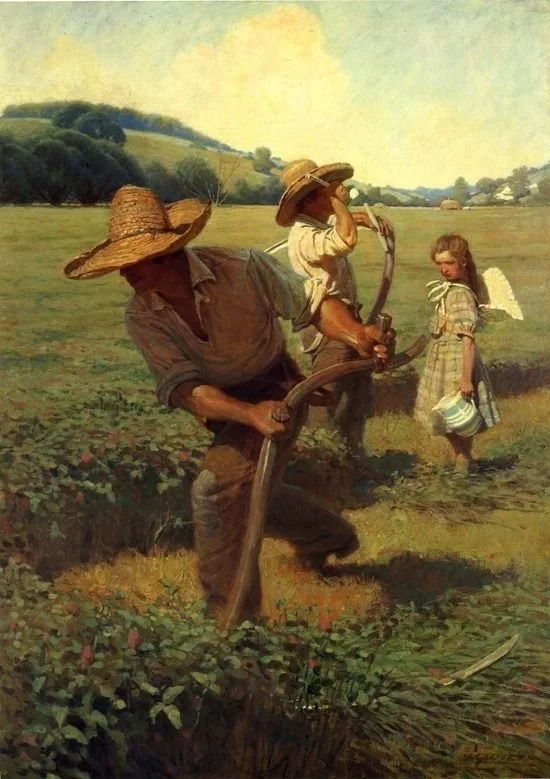
The Scythers by N.C. Wyeth, 1908
More importantly, photography was related to a host of photosensitive processes that informed and entertained and therefore had commercial value. The ability to convert continuous tone photographs into halftone printing plates paved the way for the modern advertising industry and made possible the Golden Age of Illustration that turned Howard Pyle, Maxfield Parrish, and N.C. Wyeth, into household names. Housewives and farmers in Iowa knew their names without necessarily knowing or caring about Matisse or Picasso. The Avant-Garde, with its cynical distortions and unhinged theories, was proof of European decadence. By contrast, America had solid artists who did solid work that appealed to real people. Commercial art would do for the United States what the Baroque did for the Roman Catholic Church; it would launch an American Cultural Counter-Reformation that would transform American soft power into a global hegemon. The arrival of Walt Disney would expand it into the first stage of an American Cultural Revolution. The next stages would reveal what America wanted to hide.
If Disney is about fun, optimism and sentimentality, then Jazz is about the depth of the American tragedy. It is graffiti for the ears, the heart, the soul, and the loins. It is the forbidden pleasure of sorrow and the clear-eyed stare of former slaves, Irish workers, and newly arrived Jews from Eastern European shtetls. It is the music of voluntary and involuntary immigrants who took the promise of freedom seriously until it proved to be transactional.
Like the tango, Jazz sings about sex and death without any possibility of justice. If Disney expresses the optimism of predestined entitlements, then Jazz laments broken contracts delivered with a smile. Jazz decries the falsity of 1776 in syncopated rhythms that mock the stiffness of military marches. Unlike the more overtly structured European approach, Jazz sounds disordered to listeners unaccustomed to African-inspired rhythmic fluctuations and seemingly discordant harmonies. Yet it is far from disordered to anyone who feels and hears the discipline within a genre that relies on collaboration and improvisation instead of a single will. That sense of freedom empowers both the individual musician and the ensemble. It gives voice to the group without subordinating each musician to the others. Of course, this should not be surprising to anyone who hears the overlaps between African and European traditions that are only antithetical to those who see the world through racist lenses. Such cross-cultural and cross-racial links suggest a universality that frightens any power structure built on segregation. From Porgy and Bess to Strange Fruit, Jazz speaks to our shared humanity. Therein lies its threat.
The world loved Jazz, but its country of origin had a conflicted relationship with a genre that was a little too African. What could a society that happily shared its eugenic expertise and racist legislation with the Nazis, from 1933 to 1941, do with artists it considered subhuman? Jazz held the miscegenated mirror a little too close to white America’s face. It could be fun on the surface, but its indictment of American crimes was never far below. Film, on the other hand, was easily sanitized. It lacked uncomfortable historical baggage. Film could sell the American myth.
Film could also project American faces, which is to say, white faces from respectable regions of Europe. It did not matter that many of the producers, directors, scriptwriters, and composers were Jewish and had German or Eastern European accents. If they went too far in their critique of their new home, then they could be purged and blacklisted for anti-American activities. In any case, the market would be the final arbiter. Under the circumstances, can any artform alter the arc of American history? It is not a rhetorical question.
The genius of the Founders lies in the cynicism of their infinite flexibility. Whether in the Declaration of Independence or the Constitution, the social contract is impossible to define. No one knows what these documents say, much less mean. That is their secret. Yes, there are constitutional scholars who dig through the arcane minutiae of a very clever document, but they either run into the truth of its untenability, or they become its apologists and preach the wonders of its magical powers. No, art cannot alter the arc of American history under such circumstances. Art can only express aspirations and frustrations destined to be co-opted by a system impervious to thought, feeling, or anything remotely human. It is not a new phenomenon. Henry David Thoreau and Mark Twain understood it as have tens of thousands of artists and intellectuals since the 1800s. The critique makes no difference, and it will continue to make no difference until such time as the American people experience enough pain to look into the mirror of the myth and discover what Black Americans, Native Americans, and countless immigrants already know, namely, that the sociopolitical talismans in the National Archives were never meant for them. Nor were they meant for women, the disabled, sexual minorities, the sick, or anyone else who cannot pay the bill for the illusion of liberty.
Cover Photo: Ecstasy by Maxfield Parrish, 1929
