
Biennale de Venezia, 2026 Trouble in Paradise
By Elga Wimmer
This year’s 61st edition of Biennale de Venezia got off to a shaky start. There were several issues. First, losing its curator, Koyo Kouoh, last year due to illness. Then in early May, the five-member jury resigned, amid a furor over the decision to exclude countries whose leaders were under investigation for crimes against humanity, by an international court.
After one excluded artist from Israel threatened legal action, a compromise was reached whereby the jury would be replaced by taking a popular vote among Biennial visitors, to determine who would be awarded prizes.
Then the European Union and Italian government challenged the decision to let Russia participate, while still pursuing its “special military operation” against neighboring Ukraine.
There was yet another complication, on the third press preview day, when I went back to the Giardini to visit the Pavilions I had not seen on the opening day (because of the heavy rain), to my surprise almost all of the Pavilions were closed due to a “strike for Palestine.”
While in the area, I followed the sound of mystical Sufi music and ended up in front of the Australian Pavilion where musicians were playing on the terrace, as part of the opening ceremonies. Finally, a welcome respite amidst all these setbacks!
After the announcement was made that the Russian Pavilion was going to be open only during the press preview, because the organizers of the Biennial worried about likely anti-Russian protests, the press and invited guests of course rushed to see the Pavilion while they could.
The Russian Pavilion held a beautiful, moving presentation, The Tree is Rooted in the Sky, whereby some fifty young musicians, poets and philosophers from Russia and other countries (Italy, Brazil, Cote d’Ivoire, China, France) performed classical, folk, and sacred music on historic Russian musical instruments. Mikhail Shvydkoy, the Russian delegate for international cultural exchanges and the country’s former culture minister underscored that this multilingual polyphony of cultures is further proof Russian culture is indeed European culture.
The joyous atmosphere, with vodka and champagne flowing, was marred however by an anti-Russian protest held by provocative, scantily clad Ukrainian artists outside of the Pavilion who held up banners that read, “Death in Venice,” while making crude middle finger gestures, screaming obscenities. One would think that a Biennial of this caliber would be the perfect setting to bring Ukrainian and Russian artists together, far removed from the battle lines. Here, Hakim Bey’s “poetic terrorism“ comes to mind, meaning protest for the purpose of peace.
Peter Lamborn Wilson, who worked under the pen name of Hakim Bey, lived in the Middle East in the 1970’s, worked at the Imperial Iranian Academy of Philosophy and explored Sufism, mysticism and Persian literature. Which brings us to the Australian Pavilion today.
Inspired by the 12th Century Tasawwuf (Sufi) poem, The Conference of the Birds, Khaled Sabsabi’s work places audiences at the center of the Australia Pavilion, curated by Michael Dagostino, inviting all to listen, breathe, and reflect on the collective human experience.
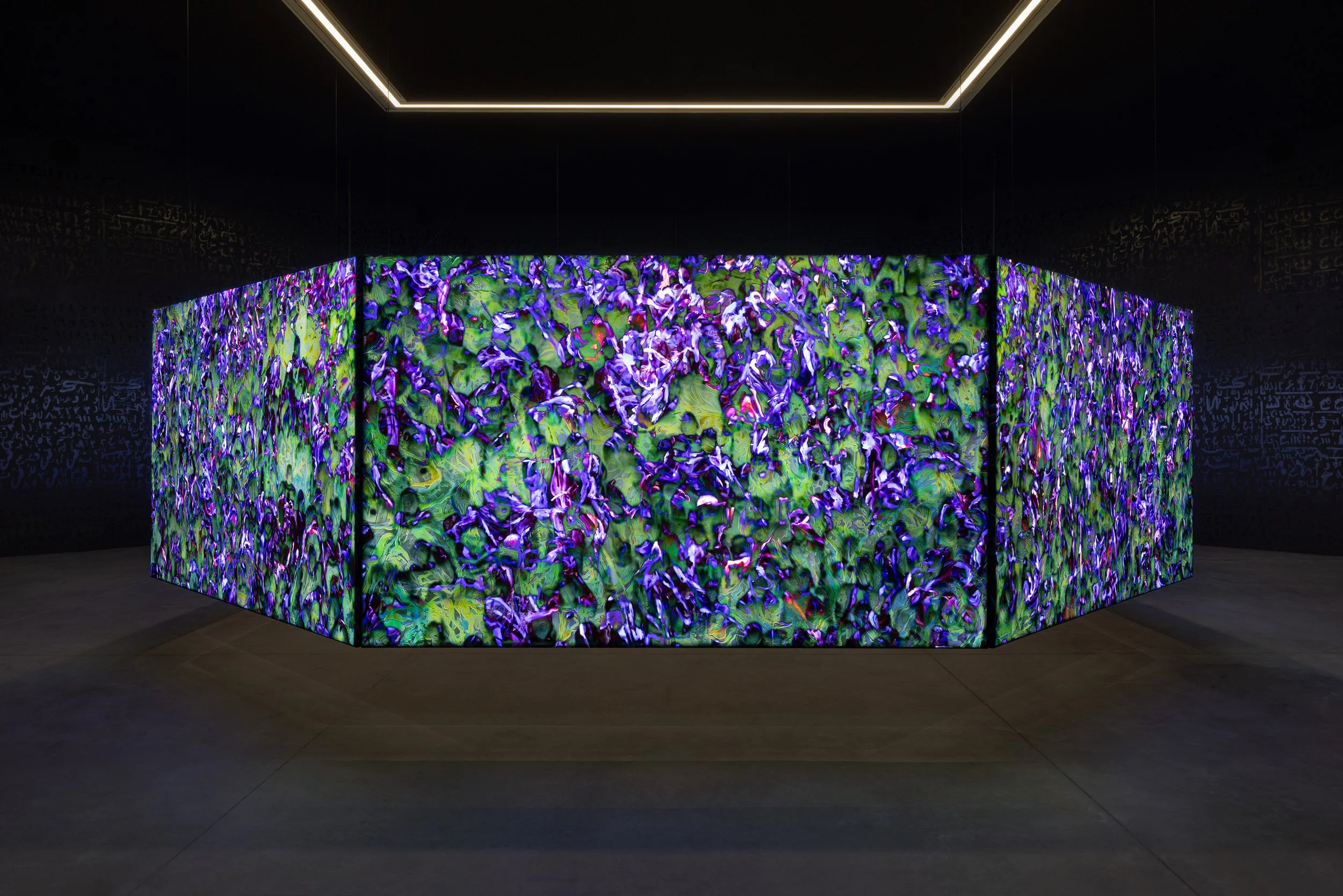
Khaled Sabsabi, “Conference of One's Self”, 2026, Australia Pavilion. Photo by Andrea Rossetti
Born in Lebanon, the artist took his philosophy and artistic work to Australia in 1976, and grounded his meditative experience in multicultural, multifaceted encounters. This exhibition, initially censured by the Australian authorities, was reinstated after important supporters of the Biennale de Venezia stepped up.
Among the most spiritually resonant presentations, both at the Australian Pavilion and the Arsenale’s In Minor Keys by the late curator Koyo Kouoh, artist Khaled Sabsabi and curator Michael Dagostino placed eight monumental paintings on an octagonal structure, projecting moving images with a meditative soundtrack that unfold across the paintings, creating an immersive environment that evokes spiritual passage, enlightenment, with the number eight functioning as a symbol of harmony and transcendence.
Outside on the terrace of the Australian Pavilion, the group of musicians I mentioned earlier enhanced this strong spiritual aspect by playing Sufi and mystical music. A film of the entire performance and installation is in the making.
The spiritual nature continues with Matina Abramovic’s Transforming Energy at Gallerie dell’ Accademia, Venice, from May 9 to October 19, 2026. The pioneering performance artist is the first living female artist in history to occupy this unique space with a major exhibition.

Marina Abramovic Transforming Energy Accademia Venice Dozing Consciousness (A)(Body) Eyes Open, 2026, Lightbox
Past artists who exhibited here include William de Kooning and Anish Kapoor. Abramovic’s quest for uniting the body, mind and spirit and her research on crystals transcending that unity, already began with Departture – Brasil Project, 1990-1992, under the auspice of Galerie Enrico Navarra, Paris. Aided by minors in the Amazonas in Brasil working in a tough climate, and her own sense of adventure, Abramovic started using crystal, rose quartz, amethyst, tourmaline, iron and copper in her work.
It is there that the artist created “helmets for departure” and “shoes for departure” with crystals, to use the body as transformer of the energy and enlightenment of this material.
Fast-forward 35 years, Transforming Energy is a continuation of the artist’s quest and research of the return to pure, raw energy, using objects for communicating with the divine. The viewer is taken on a journey of discovery, through the healing, spiritual power of crystal, containing water, which dates to 35 million years old, primordial water.
The artist sees these crystals as a gift of the Gods to humans. For Gallerie dell’ Accademia she created transient, performative devices that require the presence and active participation of the viewer. Triangles covered by crystals, crystal bars above benches, and chairs placed in front of crystals at the height of the forehead and chest demonstrate how raw energy can be channeled and transmitted, transforming the passive observer into a true co-creator of the artistic experience. Images of the artist’s own performance, the entire body covered in crystals, framed or at times in light boxes (by Swiss photographer Reto Guntli), complete the concept of the show visually.

Marina Abramovic Transforming Energy Accademia Venice Dozing Consciousness (A)(Body) Eyes Open(right (B)(Eyes Closed)2026, Lightbox.
Georg Baselitz’s Eroi d’Oro (Golden Heroes) at Fondazione Giorgio Cini, from May 6 to September 27, shows the last body of work by the master before passing away this year. Curator Luca Massimo Barbero introduced the exhibition at the preview opening as a poignant goodbye to Baselitz, not only in his work, but also with the artist’s statement recorded for the audience.
The artist explains how he started a new series two years ago that would be the summary of his life’s work. The title, Eroi d’Oro recalls his early work, the Heldenbilder (Hero’s Images). The presentation of the Avignon Series at the 51st Biennial (2015) marked the start of his debate with his own transience. The title refers to Picasso’s show in 1970 at the Pope’s Palace in Avignon, and announced Baselitz’s last phase of his creative work.
He describes this latest body of work as follows. “Since I am close to the end of my painting, I’d have to draw some kind of conclusion. In other words, a culmination of the paintings made in the course of many years.”
Baselitz paints the figures upside down, on an abstract golden yellow background. Sometimes one figure, a self-portrait, sometimes with a female figure, his wife, to which he adds splashes of colors as a homage to his painter friend, Willem de Kooning.
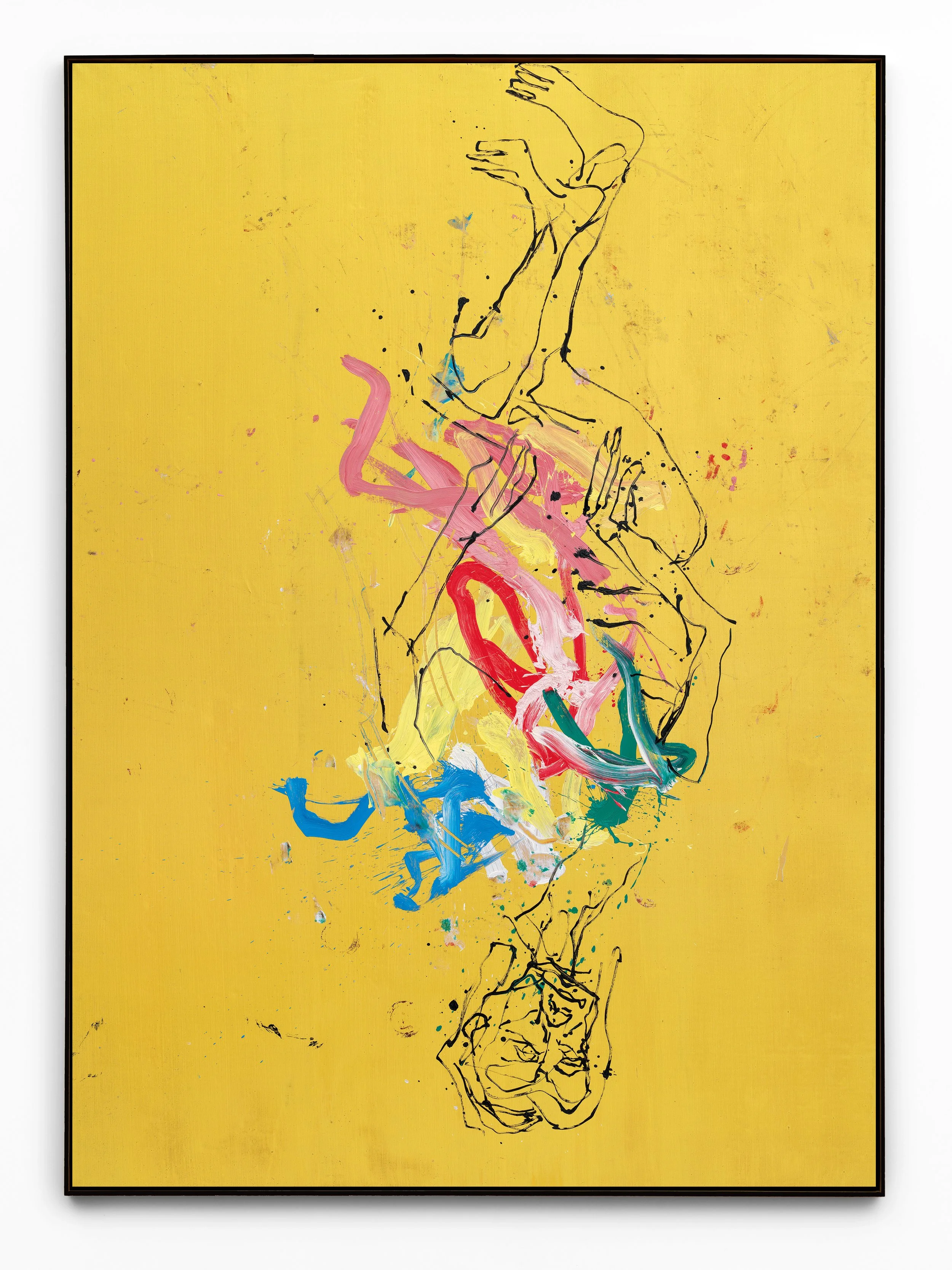
Georg Baselitz, “Elke drei Flächen,” 2025, Oil and gold paint on canvas, 118,11 x 84,65 in. © Georg Baselitz 2026. Photo: Stefan Altenburger, Courtesy Thaddaeus Ropac gallery, London · Paris · Salzburg · Milan · Seoul
The golden color in his paintings is for Baselitz a clin d’oeil to art history and his own, as he used gold color over forty years. In these large formats the master gives a last goodbye, combining monochromatic gold paintings with delicate and sensitive drawings and in some of them a deliberate splash of color, referencing his Abstract Expressionist artist friends.
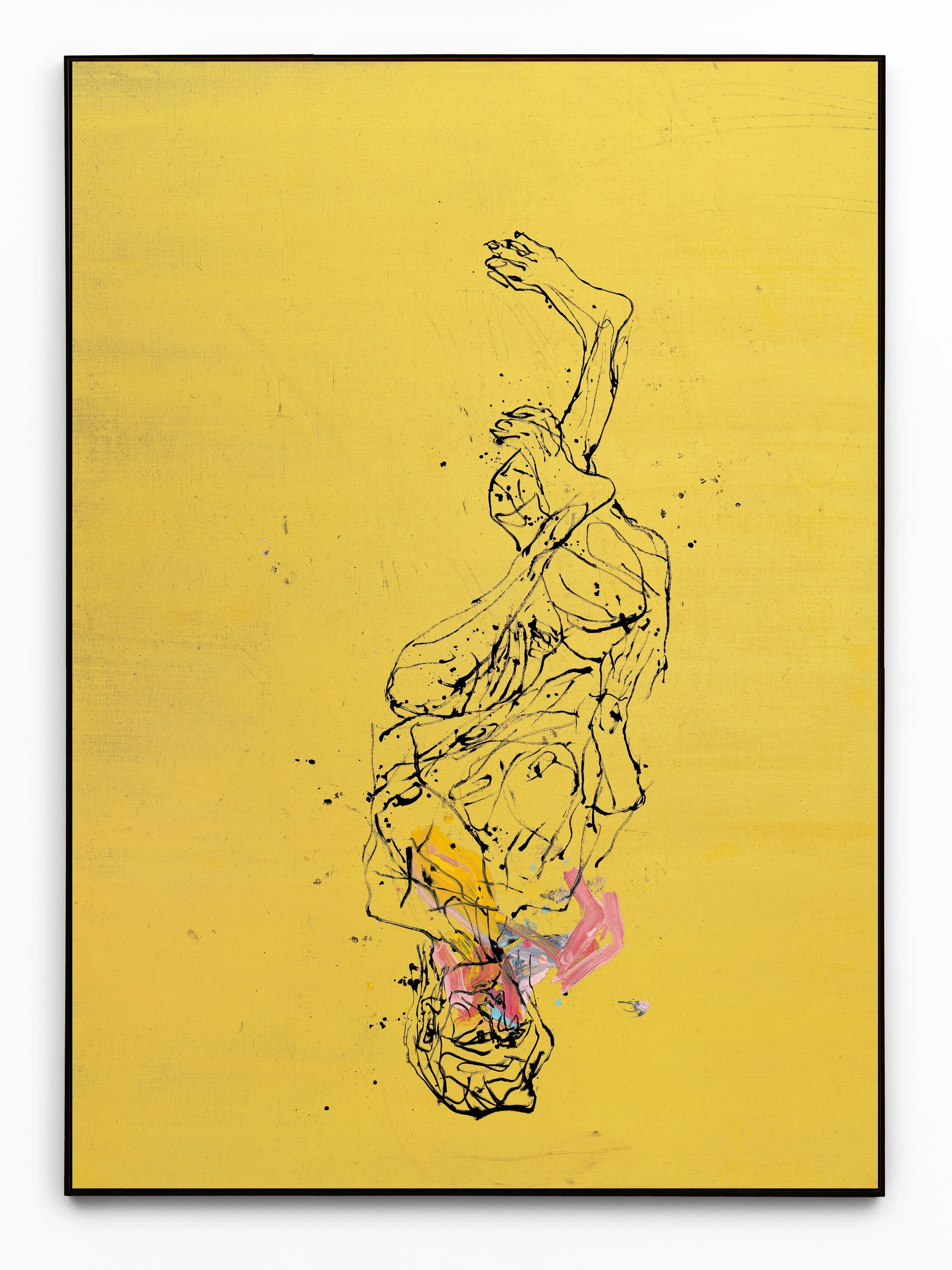
Georg Baselitz, “Die goldene Kittelschürze”, 2025, Oil and gold paint on canvas, 118,11 x 84,65 in. © Georg Baselitz 2026. Photo: Stefan Altenburger, Courtesy Thaddaeus Ropac gallery, London · Paris · Salzburg · Milan · Seoul
Mysticism, spirituality, and otherworldly awareness is a common element in the utopian vision of these artists presented here, in the 61st Venice Biennial, an antidote to the political and social unrest of our times. “Art is a form of nourishment of consciousness, the spirit,” a 31-year-old Susan Sonntag wrote in her diary in 1964.
Half a century earlier Russian painter and art theorist Wassily Kandinsky published Concerning the Spiritual in Art, which to this day serves as an exploration of the deepest and most authentic motives for making art, the “internal necessity” that impels artists to act on spiritual impulse, and audiences to admire art as the spiritual hunger it truly is.
