
Review, Biennale de Arte, Venezia 2026
By Nancy Nesvet
The title, “In Minor Keys” refers to the key that plays lightly underscoring the major and stronger melodic line. This biennale, by virtue of its theme, enables us all to be minor keys in a performance that all participate in, turning out a sound that all can hear above their own singular voice.
Koyo herself wrote: “Artists are channels to and between the minor keys and listening to, rather than speaking for them is at the core of the curatorial conceit.” Although controversy, as noted and discussed by Elga Wimmer, occurred the first few days of the Biennale, it was quite civilized with artists and viewers and the Biennale committee considering various ways to make sure all were heard, and finding mutually agreeable solutions, proving that creative solutions by artists and those involved in the arts can triumph.
Humanity was front and center, in the crowds, protests, pavilions and collateral and unofficial exhibitions at the Biennale de Arte, in Venice, The President of La Biennale di Venezia, Pietrangelo Buttafuoco wrote that “care reveals our active engagement with the world, …the intentionality of being there, of finding oneself in this world through relationships with others. Care was the premise from which this journey began.” He went on to write that the late Curator, Koyo Kouoh’s exhibition bears a “reconnection with life and the Earth” keeping the focus on the individual as part of a community, not only of people, but of plants, the land, the oceans and animal life, placing the person as the Curator, one who cares. Although Kouoh has now joined the world of the immaterial, the focus on the Biennale she developed is on the material world, where seeds she and the other curators sowed have come to life, as the people who nurtured continue to nurture those seeds, imbued with the waters of the earth. I would like to think that, that Kouoh herself in body and spirit is nurturing those seeds as well, and encouraging an emotional attachment with each other, with the earth and its waters that we and plants and animals all live on.
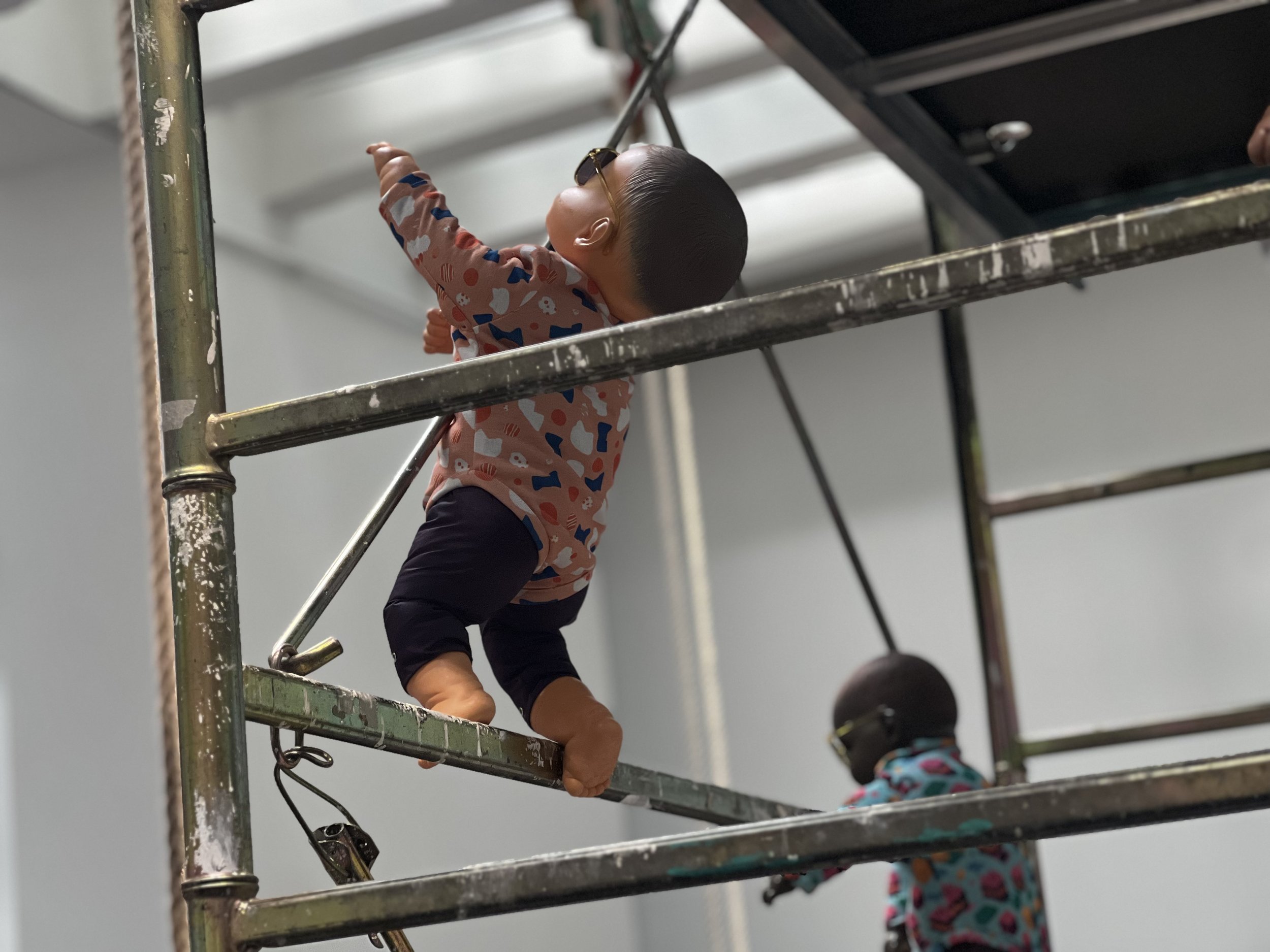
Such was not the case at Japan’s pavilion, where an assumed connection with non-emotional or expressive dolls led to their abandonment by their caretakers, perhaps realizing that these were mere objects not to have an emotional connection with as we do with each other. That is perhaps optimistic as we see Ai and other forms try to take on human expression, and failing on an emotional, human level.
Rina Oh, herself an Asian artist, curator, chef and writer felt a connection to the Asian-faced baby dolls at the Japanese pavilion, at the Biennale de Arte, Venezia 2026, where more than one hundred baby dolls were given out to those who waited for them, with instructions to hold them close, change their diapers, caress them, and then, before leaving, abandon them. However, for me, there no reason to change their diapers, as they did not defecate or pee, and caressing them and holding them close produced no satisfaction nor contentment from the babies, as they lacked emotion. It was difficult to find a place to abandon them once the tour of the pavilion was done, and indeed, Rina noticed and reported to the Pavilion curators that a few remained with their “parents” carried outside the pavilion, in effect kidnapped or saved from abandonment depending on your view. This total lack of emotion emitted from the dolls, though elicited from the parents could not satisfy any emotional bond as there is with human parents and babies, nor did the “babies” demand anything from the parents for a day, or register their contentment once satisfied.
Next door to the Japan pavilion, the Korean Pavilion sees its nation, and any nation in the process of becoming, as Goen Choi’s Liberation Space displays piercing, rupturing pipes that connect, mimicking the sounds of reconnection and healing after wars and devastation. No metaphor is more appropriate although we look forward to the healing phase. Although abstract in its sculptural form, not including any manifestations of humanity, the Korean Pavilion emphasized connection, for me, extending to peoples of the world. Next door to the Japan pavilion, the Korean Pavilion sees its nation, and any nation in the process of becoming, as Goen Choi’s Liberation Space displays piercing, rupturing pipes that connect, mimicking the sounds of reconnection and healing after wars and devastation.
Like the vegetative border between the Korea and Japan Pavilions, so many of the Pavilions in Venice are concerned with water, forests, and environment. That concern is entirely appropriate as this biennale is a compendium of efforts by the nations of the entire world to preserve our planet, questioning and proposing solutions. The Austrian pavilion, showing how recycled water can be used, seen by Elga Wimmer featured long lines showing immense interest in the processes used to preserve water collected from people’s biological processes of urination, and recycled.
This Biennale de Arte, Venezia, like those that have come before it, allows each country, in its own pavilion or curated space, to build a community of artists who contribute their own minor forms to a major, polyphonic composition, to come together to support our common world. The 2017 Biennale de Arte’s Curator, Christine Macel, refused to label the Arsenale’s rooms, removing the demarcation of borders at a time when border crossing over the seas, which realistically, had no borders, forced all to merge, exhibiting together.
Humanity was front and center, in the crowds, protests, pavilions and collateral and unofficial exhibitions. The President of La Biennale di Venezia, Pietrangelo Buttafuoco wrote that “care reveals our active engagement with the world, …the intentionality of being there, of finding oneself in this world through relationships with others. Care was the premise from which this journey began.” He went on to write that the late Curator, Koyo Kouoh’s exhibition bears a “reconnection with life and the Earth” keeping the focus on the individual as part of a community, not only of people, but of plants, the land, the oceans and animal life, placing the person as the Curator, one who cares for, from the Latin curare. Although Kouoh has now joined the world of the immaterial, the focus on the Biennale she developed is on the material world, where seeds she and the other curators sowed have come to life, as the people who nurtured continue to nurture those seeds, imbued with the waters of the earth. I would like to think that, that Kouoh herself in body and spirit is nurturing those seeds as well.
The collateral exhibit by Dia Art Foundation at the San Marco Art Centre features the work of Lee Ufan, a longtime favorite of mine, who exhibits rocks and stones, alone or in multiples, often with water features that corroborate the beauty and steadfastness of these marks of time and earthly presence, local to everywhere, and like the granite at the Egyptian Pavilion, attesting to the beauty of natural stone.
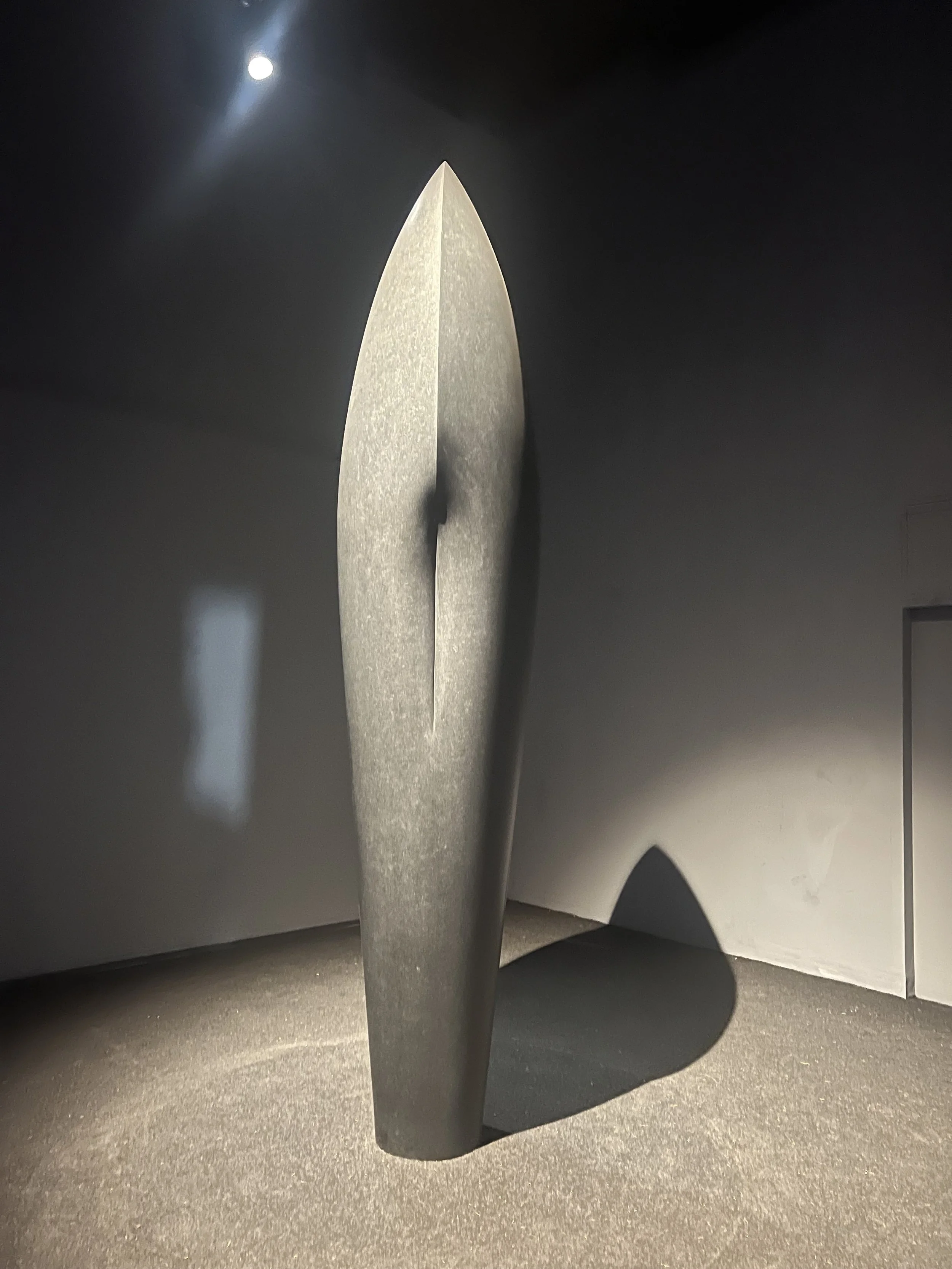
Egyptian Silence Pavillion
There was more at the Biennale with an emphasis on water, as a trajectory for commerce from ancient times to the present, and a liquid that we depend on for life, for love, for existence, as a connection between nations and civilizations. Water, worldwide, wild and calm, was the subject of the Romanian Pavilion that presented a history of Black Sea surrounding nations, proving both beautiful and challenging. We learned how the Black Sea no longer supported life in its depths, but also saw a beautiful woman being overtaken, and emerging from the sea, indicative of our submerging cultures and civilizations overtaken but bravely standing again as the waves of controversy wash over but do not submerge her.
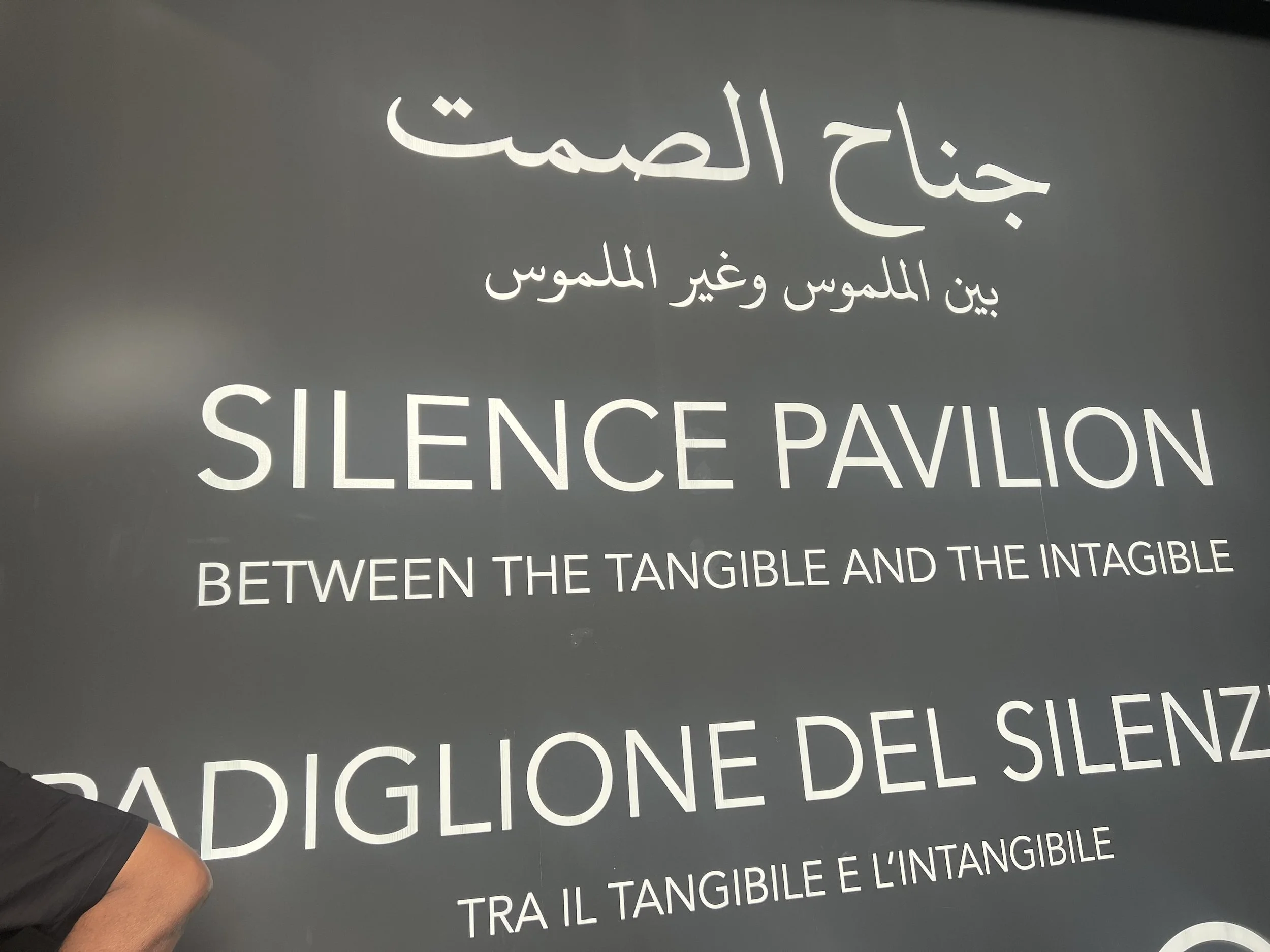
At the Egypt Pavilion, we were urged to be quiet, to listen to our own heartbeats, the stirring of each of our souls, and to touch the cool stone monolithic, six- foot-tall arrow points, curved as a bow, created and polished by the artist, the cool stone challenging our hot tempers dominating the international news in a dark and silent space. Photographs accompanying the sculpture, on black grounds, showed singular threads, vertical lines of color that when I turned, formed an edge, showing that when viewed from a different point, a hard line became an entrance.
The artist featured at the Egyptian pavilion, Arman Agop, directed visitors to “Please touch” his granite curvilinear columns, like bodies bent backwards to look at the stars, to be quiet so we could listen to our own thoughts and emotions. He emphasized in his opening remarks that we must listen to ourselves before we can hear and interact with others. The dark room of the Egyptian pavilion encouraged the visitor to walk carefully, to look carefully, to listen to our own breath and heartbeat and note our own emotional response to the work, to be above conflict in the world, to listen not to politics or technology but to our own bodies, to know thyself before others. There were photographs on black ground, showing a thin blue line, that became colored, rainbow-like at the edge, when one turned away, like noticing the varied shades of multiple people and trees and water when you turn rather than look straight on, noticing only one, or only oneself. That listening to oneself becomes listening to oneself within the multitude. In a darkened room, Egyptian artist, Armen Agop’s pillars and photographs at Egypt’s Pavilion, named by the artist, Silence Pavilion: Between the Tangible and the Intangible featured granite monoliths, curved, sail-like or enveloping, like a nurturing breast, The placard attached ,“Please touch” invited me to feel the smooth, cool, polished, curved rock. That touch, something only humans and animals can intentionally do, was shared by so many. I listened, as directed by the artist, to listen to my inner thoughts, mark my inner emotions, not allow others to intrude on the pavilion’s silence. Only then, knowing thyself, noted the artist in his opening remarks, can one interact with others. This was a world devoted to human and animal life, devoid of technology. Like Beethoven’s last symphony, where the first stanza recorded the beats of his heart, a heart damaged by disease, the sounds of my body, of my blood streaming and my heart beating, then was able to join with others’ rhythms in a world that we all must care for. Like the work of the artist Rafael Lozano Hemmer, who merges 300 heartbeats in a chandelier-like cascade of blinking heartbeats, the community of beating hearts, feeling emotions, seemed the theme of this Biennale.
That humanity extended to handcrafted art, shown throughout that demanded touch, including the hand-tufted tapestries of Isabel Nolan, the exhibited artist at the Irish Pavilion who also employed materials as varied as steel in her sculptures and renditions of dust. Curator Georgina Jackson writes that Nolan’s work is haunted by the question of “how to love a tumultuous world, an indifferent universe and humans that are often so awful to each other” finding part of the answer in these touchable sculptures and paintings. Within the Arsenale exhibit including work by artists handpicked by Koyo, dividers were made of indigo cloth, dark blue, like the night sky, in a darkened room, to be opened, set aside so the art could be seen and cherished, like Egyptian artist, Armen Agop’s pillars and photographs at Egypt’s Pavilion, named by the artist, Silence Pavilion: Between the Tangible and the Intangible. Like the Shrines, the second section named by Koyo, in the Central Pavilion of the Giardini, the natural environment was valued and attention drawn to it as trees and forms of living architecture prevailed, as in the “Forest”, in the Pavilion of the Republic of Equatorial Guinea, subtitled The Forest of the Undergrowth, calling attention to, in the Curator’s words, “what is controlled and what escapes human order” Similarly, Aeolian Suite at the Finnish Pavilion enlists wind, transforming the pavilion into a windscape, noting that “wind is unpredictable, a “source of true randomness, It is incomputable” addressing environmental questions with scenes of the lagoon, listening to the winds singing the weather.
Human rights as well as the earth’s rights and our rights and responsibility to cherish our earth was a central theme. Water, the color of the indigo cloth forming the wavelike entrances to the exhibits at the Arsenale, as an element covering the earth was featured at many exhibitions at this Biennale. At Romania’s exploration of all aspects of the Black Sea, water was seen again, this time the Black Sea was as a unifier, an oxygen starved body of water culminating from other streams and rivers. The video featured a swimmer, overtaken by the waves of the Black Sea, then quieting to a peaceable waterway, and reaching a crescendo again, evoking the history of Romania and the nations surrounding and sharing the Black Sea.
The naming of the sections of the exhibition, Kouoh’s naming, Shrines,Schools encouraged us to learn from, to worship, the earth and all its inhabitants, the waters that envelop us, that flow from one to another, and the sky that shields us, that turns from dark to light. This is a biennale that celebrates life, that asks us to together protect it.
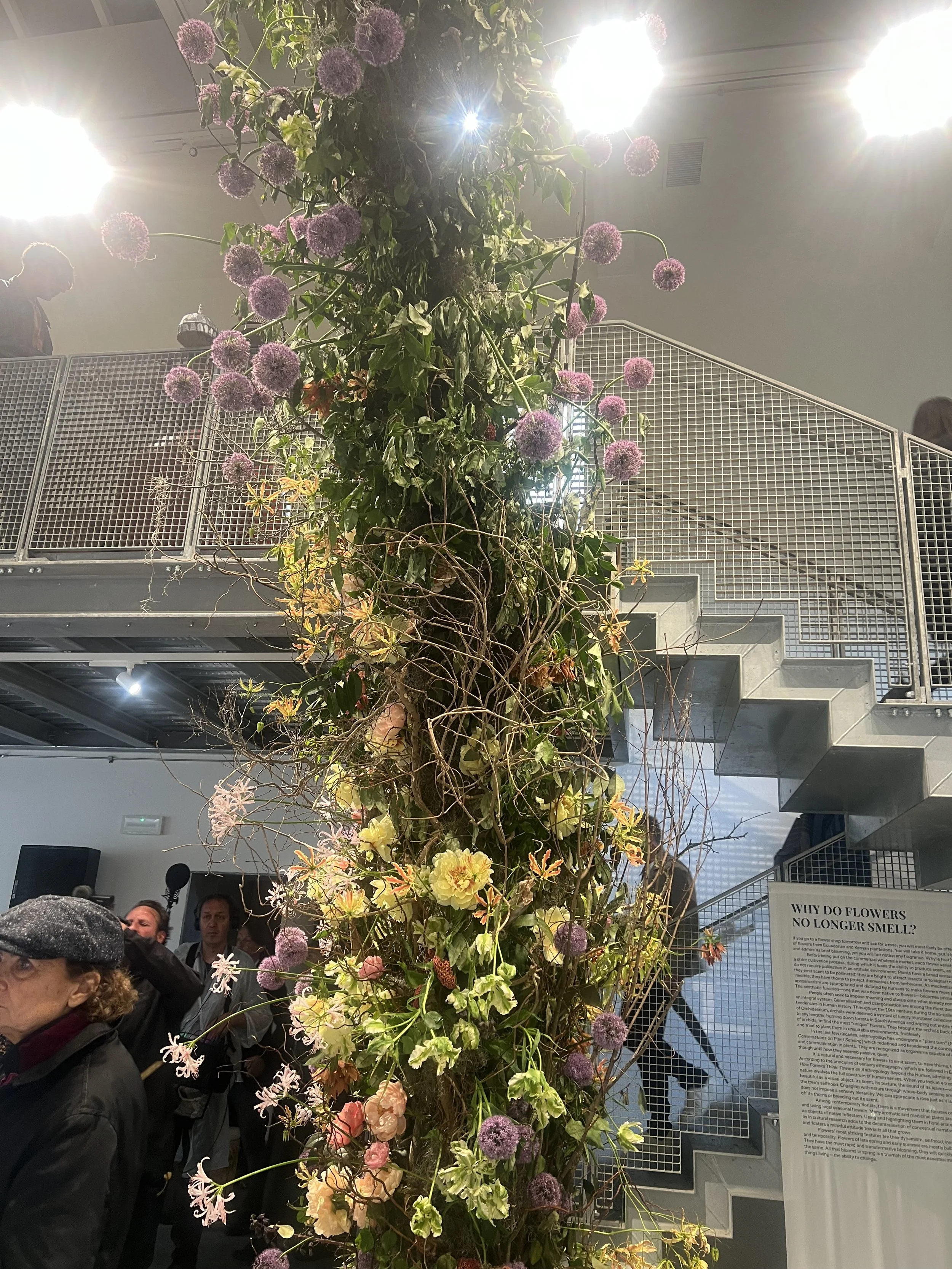
Peaceful demonstrations threatened the Biennale. Protest was the order of the first two days, as numerous pavilions closed temporarily to the public and press. The five judges of the Golden Lion prize for best national pavilion resigned in protest of the inclusion in the competition for the prize of Russia and Israel, due to their citing by the International Criminal Court of human rights abuses. Demonstrators believed that abusers of human rights should not be considered for the prize, and numerous artists and curators of pavilions agreed, shutting down for the first two days, as Pussy Riot blew pink smoke into the air, seen across the Biennale sites, and numerous discussions were had. I wonder that Kouoh would have agreed with banning Israel and Russia, as she was from Capetown, South Africa, once the nation of the most human rights abuse. At the Russia pavilion, a beautiful and fragrant display of flowers in tall vases throughout created a garden of sweet-smelling, beautiful foliage, but I wondered if this space was created intentionally to steer attention away from, to evade the harm and abuse Russia was perpetrating toward Ukraine, destroying towns and gardens and forests and people. Can the display of natural beauty negate the politics of destruction? This display of propaganda, of creating a garden whereas Russia has recently created a nation ruined by destruction and death, looked like a mass of vases of flowers left after a funeral. Russia closed the floral display after the first three days, leaving only photographs of arctic winter at its pavilion. I wondered if they closed it before the flowers could die, to become a dead, barren landscape.
In perhaps the best incorporation of science and art, the Giardini Mistico, at the Pavilion of the Holy See contributes to a shared sonic composition of sound and music formed in a shared collaboration of new commissions by composers, musicians and poets, the garden supplying an instrument translating plant bioelectric activity into sound. Like so many other exhibits at this Biennale, it begs us to listen to ourselves and to others.
Having met Rudy Zygadio and his pregnant wife, carrier of a new generation, on the Vaporetto, the crowded boat filled with Biennale viewers, he spoke of his visit to the Pavilion of the Holy See, later writing: “We stumbled across a sign for the pavilion of The Holy See (Vatican City) at the off-site Giardino Mistico, a garden nestled within the walls of a 17th-century convent, which produces its own wine and olive oil. Curated by Ben Vickers and the ubiquitous Hans Ulrich Obrist, the exhibit was a sound installation featuring original works by Holly Herndon, Meredith Monk, Brian Eno, Terry Riley, Jim Jarmusch, Pattie Smith, FKA Twigs and others, taking as their inspiration the 12th century benedictine nun Hildegarde von Bingen. (It was a supergroup perhaps only the most well-connected man in art was able to assemble.) Headphones on, we wandered through different zones of the garden, ambient music shifting in a seamless, harmonious cross fade— from ambient synths to choir, musique-concrète, spoken word and sparse guitar drowned in reverb. I wasn’t sure if it was deliberate, but there was an olfactory bonus too; each musical zone coincided with a different herb patch. Eno was lavender, Jim Jarmusch was rosemary, Devonte Hynes was mint. I took a deep breath, exhaled, dropped my shoulders and closed my eyes. It was a subtle, enveloping, multi-sensory experience. “
It was that multi-sensory experience that dominated the Biennale, instructing us to listen, imploring us to notice, with our eyes, our ears, our hearts. At the Pavilion of the Holy See, like the Pavilion of Silence, Egypt’s Pavilion, we listened. In the Pavilion of the Holy See’s Mystical Garden of the Discaled Carmelites’ walls, there was a stillness and a tranquility, a slowing down as in the Vatican’s Santa Maria Ausoliatrice Complex, a former oratory on Venice’s other side. Between this garden and the Santa Maria Ausoliatrice Complex, the Pavilion of the Holy See’s The Ear is the Eye of the Soul invites visitors to listen not to themselves as at the Egypt Pavilion but rather to the music and sound of the Soundwalk Collective Project. Inviting contemplation and listening, the sound installations and new musical compositions by composers and performers was inspired by the thought of Hildegard Von Bingen, a Benedictine Nun who regarded body, nature and spirit as interconnected and sound a means of understanding creation.
Linking body and mind, medicinal herbs are cultivated in the garden and the garden itself is tended by the community, bringing people together to listen and participate in growing herbs and their inner, mystical thoughts. In this garden, vocal and instrumental sounds are heard, both musical and spoken word, inspired by Hildegard Von Bingen’s writings. Within the garden, environmental signals become sound through a device created from plant’s bioelectrical activity, as wind and water enter the device, activating the landscape, changing over time, dependent on visitors’ presence. The Ear is the Eye of the Soul then progresses into the Santa Maria Ausiliatrice Complex, an archive of research adding to the Open Work project exhibited at the 2025 Architecture Biennale by Tatiana Bilbao Estudio and MAIO Architects. The cumulative project, the Pavilion of the Holy See then becomes a garden for contemplation and listening and an archive which continues the listening experience to an archive of ongoing and cumulative research stemming from that listening experience. As the garden grows and becomes, so sound reverberates and takes new forms as it is listened to by various people, and like the garden, becomes a community project. Perhaps this is how we learn to exist in the world, together.
Believing as Hildegarde Von Bingen did that listening is a way of being in the world, as noted by Rosalba Cignetti in Intesa San Paolo, a print publication distributed at the Biennale de Arte, Venezia 2026, this two location exhibit contains no visual information, but for the flowers and herbs in the garden, putting listening above visual informing, with sound and the smells of the garden on a higher plane than only visual information can provide. Who said Music is the eye of the soul? Here art, music and nature come together within a community of souls interacting within a beautiful, natural, sound-infused space.
It is not surprising that the Holy See, and Cardinal Jose Talentino de Mendonca has conceived this space of contemplation, awareness and inclusion because that is what the present Church does; brings people together to contemplate the beauty of nature and the sounds of prayer, for mankind, for the earth and for all we hear, speak and listen to.
Several exhibits in the Biennale use sound and video to emphasize people’s connection to the environment, particular to their surroundings. Again and again, the processional, the pilgrimage is recalled. Those encounters noted by the curatorial group that progressed Koyo Kouoh’s Biennale project, each minor, but together, united in a harmony that united to produce a major thesis, that we can come together to communally, harness nature and music and art to instill community. I am reminded that early hymns are in minor keys, that they are sung together, acknowledging a higher author, one acknowledged by Hildegarde Von Bingen. I see the gardens in England of Jim Jarmush, as beautiful and changing as his films.
Later, I saw at the Italian Pavilion a work in progress, showing process, bringing together the work of many artists and showing how the clay work integrates natural materials and artificial sign to show the studio, the birthplace, as the artist, Chiara Camoni, writes, “When I make a vase, I make a whole world”. Yes, as in the music and words of the Pavilion of the Holy See, in the process of creating and perfecting and pouring emotion, the vase and the music becomes a whole world. All distraction is devoid from that world during the vase’s and the music’s creation. The minor becomes the major. Koyo Kouoh has created the impossible, showing how we may all come together, the minor, the insignificant to together make a larger world, to show that each of us matters, to show that we all, in our small ways, influence the environment, our world.
At this Biennale de Arte, 2026, Kouoh has done a masterful job, choosing artists and the theme for this Biennale. I would like to hope that, although she could not complete her mission, by passing it on to others in whom she had faith, that she created a greater community to honor the earth and all its people. Although Kouoh has now joined the world of the immaterial, the focus on the Biennale she developed is on the material world, where seeds she and the other curators sowed have come to life, as the people who nurtured continue to nurture those seeds, imbued with the waters of the earth. I would like to think that, that Kouoh herself in body and spirit is nurturing those seeds as well.
By absorbing the lessons of the exhibitions in the Arsenale and the Giardini, I hope she and all of us, know that the world has become a better place. That is the lesson of the Biennale, and especially this one, to bring us together, to enable discussion, to reach a common goal, to care for the earth, the natural world, and all its living beings. Although Kouoh did not live to see her work consummated, she has spread an important message and created a legacy that hopefully will bring further peaceful communication to our common world, protecting it for all.
