
John Zieman: Weaponized Beauty
February 20 – March 7, 2026
Leonovich Gallery, New York City
Curated by Elga Wimmer
By Mark Bloch
John Zieman uses the word “lensing” as a verb, as opposed to “shooting” his video works, signifying that he personally looks through the camera first—on his way to constructing the elaborate video productions shown at Leonovich Gallery (New York). In the solo exhibition, John Zieman: Weaponized Beauty, Zieman directs, edits, shoots, color-corrects; as well as composing lyrics and music for his multimedia creations.
His process involves layering visual and aural designs that invite deep engagement with his projections. On his website we are instructed, “Please don’t watch it on your phone…watch it on your biggest screen.” Zieman is reaching out to us to get everything just right.
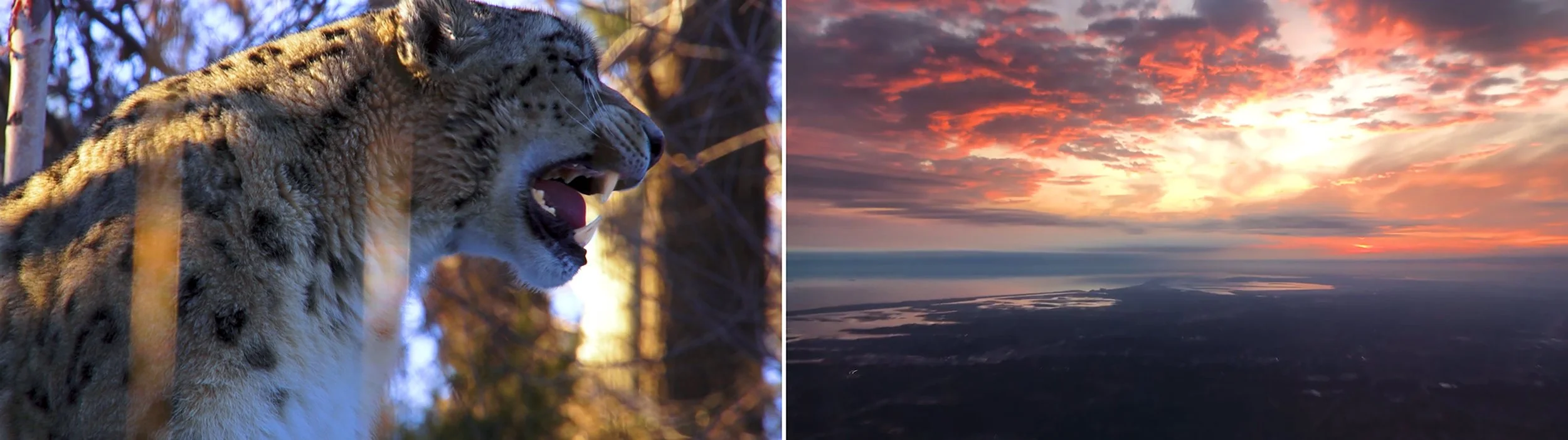
John Zieman, OTOH On the One Hand: Leopard Arial, 60” x 16.83”
This veteran of the audio-visual process since the late 1970’s has collaborated with legendary figures including video superstars Nam June Paik and the late Dara Birnbaum. For decades, he has worked with multiple corporate powerhouses, as well as arts television: New York’s public TV Channel 13, Lincoln Center concerts and dance programs, with Clive Davis on Whitney Houston and Nine Inch Nails videos, always pushing the boundaries of the video art form since his early days, when his custom-designed video synthesizer attracted Paik, who was always on the lookout for new and untried electronic tools and strategies.
Zieman’s work predates MTV’s mainstream imagery, later married to music, taking cues from pioneering combos of experimental and abstract techniques in early video art and in experimental cinema. Zieman still draws his inspiration and signature style from “musique concrète” and the “electronic cinema,” while juxtaposing it against the necessary foreboding corporate hierarchies in an expensive medium. His artistically grounded career stretches from the earliest black and white Sony Portapaks to today’s highest resolution 4K premium digital imagery, scurrying through HDMI cables to giant consumer screens and beyond.
This exhibition’s title Weaponized Beauty, references his concept of video as a self-described “content injection system” to confront viewers where they live within a somnambulant obedient, narcotic society. Deft combinations of images and sounds from nature with scenes of arc welding and cops in riot gear, create a surprising immersive environment that echoes consumer-friendly internet strategies-in-progress to re-examine how beauty can function as both armor “against”and a tool “for”resistance.
In an age dominated by late capitalism—a time when even the most vibrant art scenes still struggle to sustain themselves in a quaint and traditional gallery system—many artists face the stark reality of what “art as capital” does to art careers indicative of our society at large: all art workers are stripped of their creative souls, relegated to poorly-compensated or even well-compensated wage slaves or worker bees in support of an oppressive art structure that leaves everybody wanting, somehow, with art itself an endangered species.
But as always, the Art World, centered on the idealistic promise of individual creators and their work, pretends to be something else. Art is overshadowed by mega-galleries, mega-tech, market forces, potential collectors, and an emphasis on pricing rather than content or execution. In the past fifty years this system has become increasingly untenable. Yet Zieman’s recent exhibition can represent a solution: not an artist supporting other artists in a top-heavy art pile-on with money and little sustenance at the top but a bold refusal to become a “shill” for anything or a means to any end, or a dutiful background worker. Instead Zieman presents as an artist positioned firmly in the director’s chair, a creator with his own concerns, putting his unique wares front and center to see if art world forces and/or a world at large will appreciate what it sees when an artist circumvents his day job and dares to do what he does.
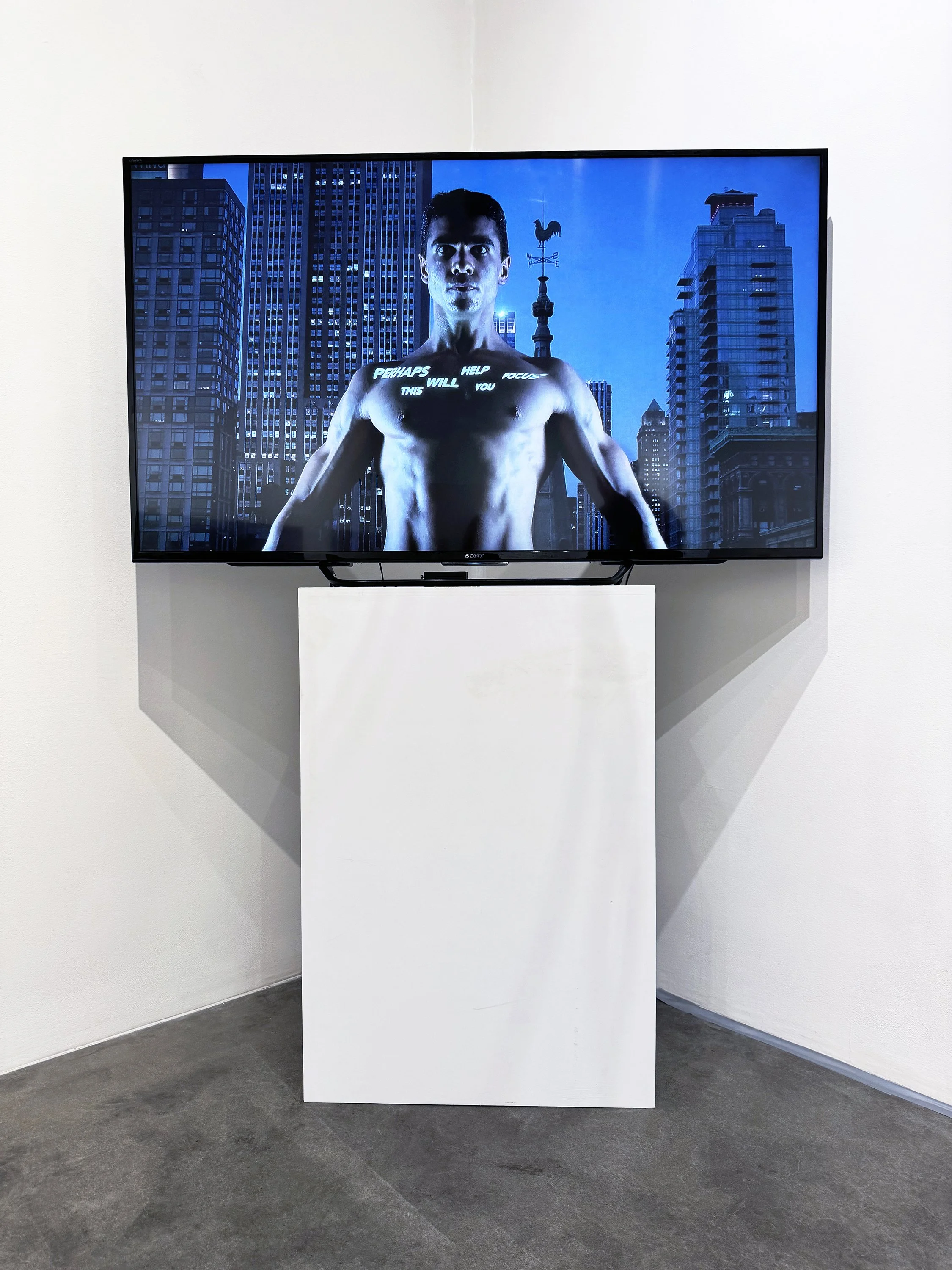
John Zieman, TS3 (Time Suite 3), 2010, 3 min 57 sec
Zieman, a remarkably talented video and electronic journeyman, transcends repressive forces with this show at Leonovich Gallery, New York. Having worked his craft since the late 1970s often in supporting roles for other video creators, Zieman here steps into the spotlight with a powerful assertion of his own vision and artistry. It is not the first time we have had a chance to appreciate his unique contribution, but this is a good opportunity to witness his heart’s desire first hand with impressive results.
Curated with the help of Elga Wimmer, Weaponized Beauty posits meticulously wielded strategies in three video installations of four videos, supplemented by six triptychs and five diptychs of high-resolution still images printed on aluminum. The collective result, like those shiny stills, are a polished, professional presentation of Zieman’s state-of-the-art video chops that captivate and challenge.
Before any video is seen, walking into the gallery, visitors are greeted by these aluminum-mounted stills from Zieman’s videos, setting a contemplative mood against an anticipatory edge. Further in, one group of stills employs electronically-generated video feedback imagery with typefaces superimposed—from real time video hybrids, creating images of reds, purples and blues that weaponize beauty as well as ambiguity.
Word fragments and hypnotic looped images intersect in Zieman’s SPTE(Serenely Precise Target Extraction), a three-panel video still that invites measured reflection. Zieman’s locked and loaded arsenal is in play everywhere we turn in the gallery.
Monuments in the Eye of the Storm (2025) is a looping three-and-a-half-minute video that was shot as a menacing storm was approaching—an extremely foreboding threat—but it turned the solid Greek sculptures (or copies) into a sun bleached, sensuous landscape in the face of a perilous hazard. All was enhanced by Zieman’s mounting musical accompaniment. His TS3 (The Times Suite 3, 2010) is a nearly four-minute piece combining highly controlled rhythmic gestures that border on robotic dance moves with moving text projected onto human skin, blurring the lines between language, body, and art. The director collaborated with the dancer-subjects and musicians, culminating in a video, shown in an installation under glass that uses sound positioning to aurally focus the viewer’s attention.
Meanwhile, he pushes language into the foreground, much like the feedback stills, and as an added screen will do with lyrics later on. In TS3 we see human bodies, mostly women but sometimes men, sometimes couples, sexy and undulating—setting words as protagonists in motion—with a severe urban setting as backdrop. The city becomes stage set, a place for projection as language is literally projected by Zieman directly onto the dancers’ skin as it moves, and not added in post-production. Filmed in New York with the help of director of photography, Manfred Reiff and music by John Petersen, this piece is Zieman’s ode to the collaborative spirit. But when the projections utter, “Your work lacks depth” or “Perhaps this will help you focus” one cannot help but think of a single auteur musing his own personal creative demons.
The exhibition then culminates in the gallery’s back room, where one major video installation features two works played back-to-back—three very elegantly arranged screens where two sound channels draw the audience into Zieman’s colorful and meticulously designed visual world. A third screen highlights Zieman’s poetic lyrics. A 14-year gap between Zieman’s 2012 video Weaponized Beauty and his latest work OTOH (On The Other Hand) (2026), highlight their complementary points of view and rich explorations of nature and humanity to highlight tensions between the natural environment, a constantly encroaching urban environment and the vulnerable individual selves of viewer and the artist.
Set against dramatic skies in both urban and natural settings, we witness disappearing animals—be they peacock, squirrel, centipede, stork, tortoise, seal, or cardinal as images vie for our attention as they frolic in environments familiar and foreign to us, perhaps acting as stand-ins for our imperiled disembodied desires and dreams. A tension manifests itself between self-expression, real or imagined and the two screens of magnificent imagery.
OTOH emphasizes “on the one hand,” “on the other hand” visually as Zieman’s rap lyrics, poetry and admonitions, his sculpting of music from environmental sources, not instruments, create a rich audio-visual tapestry that reflects both life’s clashes and hopes. This high-resolution dual-screen installation immerses viewers in a sensory overload governed by Zieman’s inner rhythms.
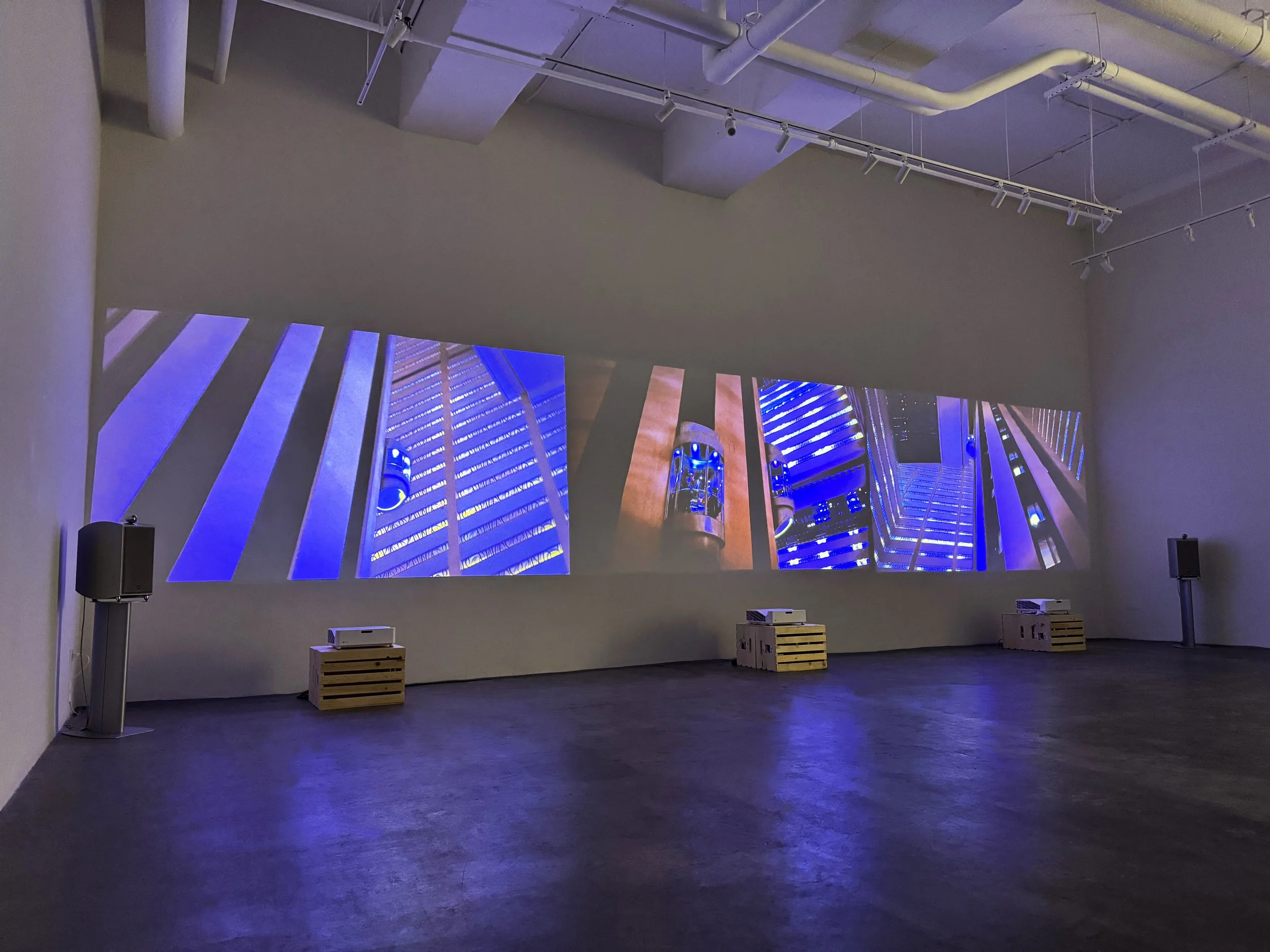
John Zieman, “OTOH (On The Other Hand)”, Installation view at Leonovich Gallery, New York City, 2026. Courtesy of the artist and Leonovich Gallery.
Zieman highlights the role of the artist in a commodified world, asserting the power of beauty as a tool and weaving together technology, nature, and human expression into a linear sensory experience surrounding the viewer. Weaponized Beauty is a manifesto of artistic resilience in a deadened world. It is personal innovative assertiveness in the face of an environment that invites complacency and surrender while paying lip service to courage and triumph.
Zieman indirectly asks us to reconsider not just the nature of art but all conditions artists face today. His work invites reflection on the fragile balance between expression, technology, capitalism, and reverence for the natural world. We experience this exploration firsthand by stepping into the artists shoes, peeking through his lens. John Zieman has weaponized beauty to present to us a chance to witness the striking power of his vision.
