
Argonautica and the Golden Lion
By Richard Humann
“To mortal men the gods allot woes which cannot be foreseen.”
— Apollonius of Rhodes, Jason and the Golden Fleece
A full generation before Odysseus there was Jason. According to Appolonius of Rhodes, writing about it in the 3rd century BC, Jason, Heracles, Orpheus, Castor, Pollux, Atalanta, and the other four-dozen-or-so thrill-seeking argonauts set off a thousand years earlier to retrieve the Golden Fleece from remote Colchis, what is now Georgia, on the eastern coast of the Black Sea. He and his crew sailed off in the Argo, a classic Greek 50-oar galley ship equipped with a single mast, and a lone red square sail.
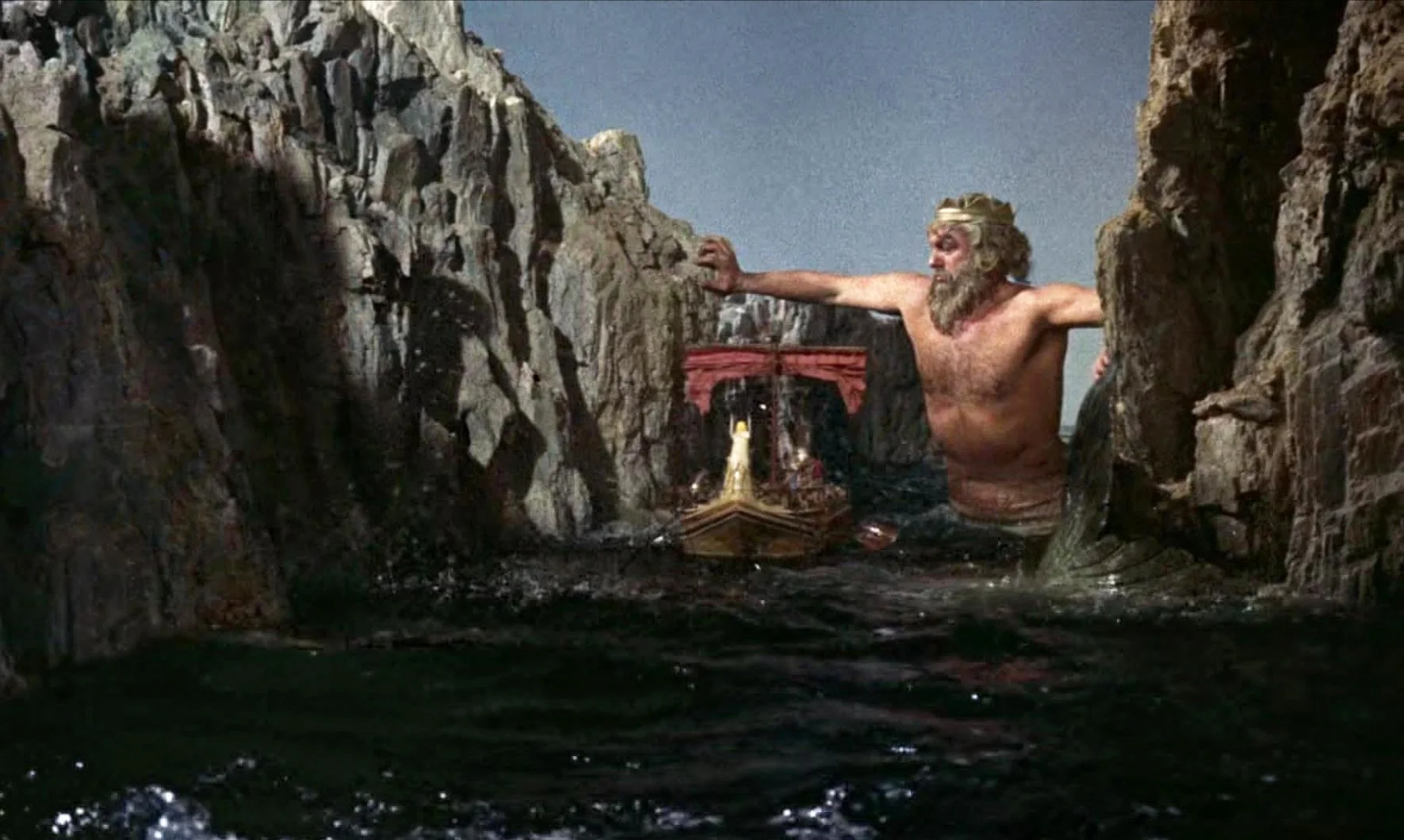
Film still from the movie, “Jason and the Argonauts”, 1963.
On their quest for the Golden Fleece, the epic journey of Jason and the Argonauts was filled with harrowing trials and mythical encounters. Along the way, they navigated through the deadly clashing rocks, fought fire-beathing bulls, battled armies of skeletons, faced a towering bronze automaton, and defeated a sleepless dragon that guarded the Golden Fleece itself. They sailed from the port of Iolcos, in modern day Greece, to the Black Sea, the Aegean Sea, the Dardanelles, the perilous Bosporus Strait, and the Adriatic Sea, near to what some 1,800 years later was to become Venice, Italy.
The voyage of the Argonauts brought them near the five mouths of the Po River, past a grouping of separate, marshy islands in the Venetian Lagoon as they sailed down the coast to Aeaea. The Venetian islands at this time were uninhabited, save for the occasional fisherman or salt worker. Many years later, after the collapse of the Roman Empire, mainlanders began to take refuge on the islands, as the marshy, shallow waters of the lagoon provided a natural defense against barbarian invasions by the likes of the Visigoths and the dreaded Attila the Hun. Just a few decades later, the Lombard invasion forced a massive, permanent relocation of Romanized mainlanders to the lagoon islets. This was the birth of Venice in 421 AD.
Venice is now comprised of 118 small islands that are stapled together by 435 bridges made of stone, iron, or wood and span the intricate canal network. The entire city sits upon millions of wooden logs that were pounded into the soft, muddy floor of the lagoon and deep into underlying clay. Because the submerged mud was oxygen-free, the logs mineralized and hardened rather than rotted. There are 12,000 mineralized logs supporting the Rialto Bridge alone. The timber was brought in from Italian, Slovenian, and Croatian forests, and Istrian limestone was used to protect the building façades from the corrosive, salty water. Because of its immense beauty, and cultural and economic power over the centuries, Venice has earned the sobriquet “The Queen of the Adriatic.”
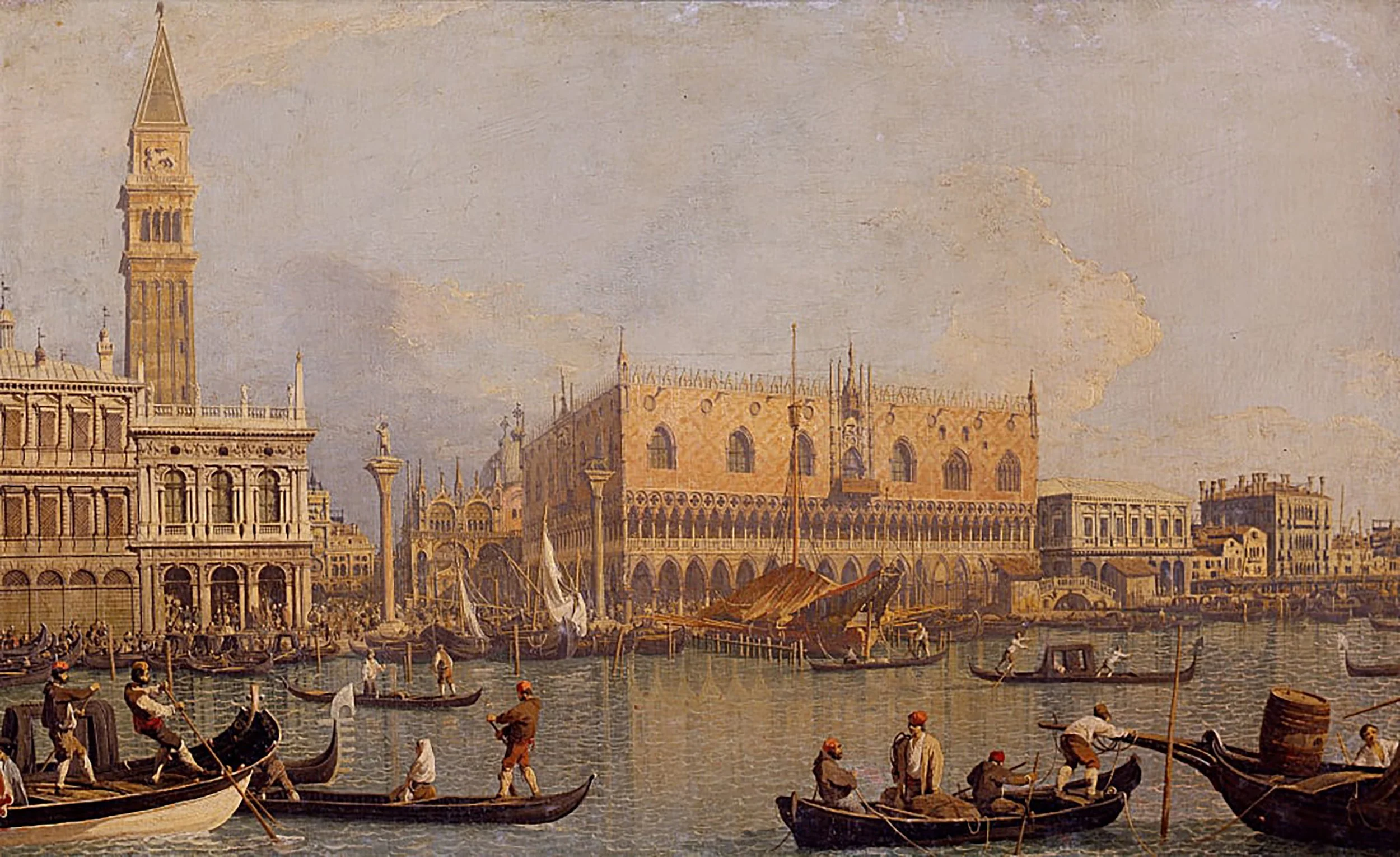
Canaletto, “View of the Ducal Palace in Venice,” before 1755, oil on canvas, 20.1 x 32.7 in.
If the Argo and its fearless crew were to enter the Venetian Lagoon today, sail past the northern tip of Lido, turn south at Le Vignole, and then moor near the Giardini della Biennale in Castello on the Riva dei Sette Martiri (the Bank of the Seven Martyrs), the argonauts would encounter a myriad of wonders as astonishing and mystifying as any marvel of the fabled ancient world. After tying off their lines near the Monument to the Partisan Woman, a bronze sentinel watching over the lagoon, and a reminder of their earlier encounter with Talos the bronze giant, the crew, save a few that would remain behind on the ship as sentries, would go ashore onto the quarried volcanic rock promenade. They would then march toward the cooler shade of the mysterious Giardini, or what they might call, Ο Κήπος των Επίγειων Απολαύσεων (The Garden of Unearthly Delights). But now, rather than the quest for the Golden Fleece, they are on a crusade in search of the famed and ever-elusive, Golden Lion.
The Golden Lion (Leone d’Oro) is a golden-plated statuette. It is the highest honor awarded to artists and national pavilions at the Venice Biennale (La Biennale di Venezia). It was originally called the “Golden Lion of Saint Mark” and is modeled after the famous winged lion that sits atop the marble column in the Piazzetta di San Marco. The lion became Venice’s symbol through the city's patron saint, Mark the Evangelist, who in Christian tradition is represented as a winged lion. The relic body of Saint Mark made it to Venice through a medieval holy heist. Two Venetian merchants stole the saint’s body in 828 AD from a church in Alexandria, Egypt and smuggled it past Muslim officials inside a shipment of pork. They placed the body at the bottom of a large wicker basket that was covered in pigmeat, cabbage, and salt. Recoiling from the impure pork, the customs officials waved the basket, and unknowingly, the 700-year-old dead body through. A Mediterranean tempest plagued the month-long journey home, but according to legend, an apparition of Saint Mark appeared on deck, and guided the ship back to the safety of the Venetian port.
In our current adventure saga, the Argonauts now enter the Giardini. The enomotia of men, a diverse group of demigods and champions, have their traditional and mythical tools of war at the ready. With the confidence and prowess of skilled marauders, they somehow make it past the registration booth and ticket collectors, and then slip into the Giardini di Castello. The loose gravel paths that line the grounds crunch under their bovine leather sandals. For Jason, the gravel paths crunch under just one sandal, having famously lost one while carrying the disguised goddess Hera across the muddy, fast-flowing River Anauros. The Argonauts scout the area, and see pavilions, 29 of them in all, scattered throughout the dense foliage under the canopy of the garden. The buildings are of many different sizes, shapes, and architectural styles—most unknown to the men. Surrounding the buildings, and up and down the main pathway are many people of all sizes, shapes, and colors as well. The people are milling about, and speaking in a multitude of languages the men can’t understand. The Argonauts take cover.
This year marks a change in tradition for the judging of the Golden Lion. The jury-awarded system was entirely scrapped due to political wartime and war crime pressures. Change in tradition and nation exclusion is not unprecedented in other global events such as the Olympic games. Historically, the International Olympic Committee has used exclusion as a tool of punishment to aggressor nations. It’s happened throughout the last century in the Antwerp, Paris, and London Games to name a few. It’s also not unprecedented at the Venice Biennale either, as most notable South Africa and Russia have either been banned or withdrawn from this international exhibition in the past. Usually, the biennale operates under the strict diplomatic rule that states that any nation officially recognized by the Italian government has the right to exhibit. This makes formal bans very rare, and instead, nations are typically excluded through self-boycotts, artist withdrawals, or outside diplomatic pressures. Up until this year though, in the 131-year history of the biennale, it has never changed its jury system in the judgment of the Golden Lion award. Due to an en masse resignation earlier this year for the 61st edition of the exhibition, the award will not be judged by an expert jury, but will instead be replaced by a public popular vote called the “Visitor Lions.” To complicate things further, because of the reinstatement of Russia and Israel to the balloting competition, 80 high-profile artists have withdrawn from consideration for the prize. Morality and politics aside, using a popular public voting method can come with its own set of foibles.
In 2016, the UK’s Natural Environment Research Council (NERC) launched an online public poll to name its brand new, £200 million polar research vessel. Officials suggested names such as Endeavour, Shackleton, or Falcon. However, a wildcard option was thrown in by a former BBC presenter. His naming option was: Boaty McBoatface. When the voting officially closed, Boaty McBoatface won by a massive landslide garnering over four times the votes of the second-place option.
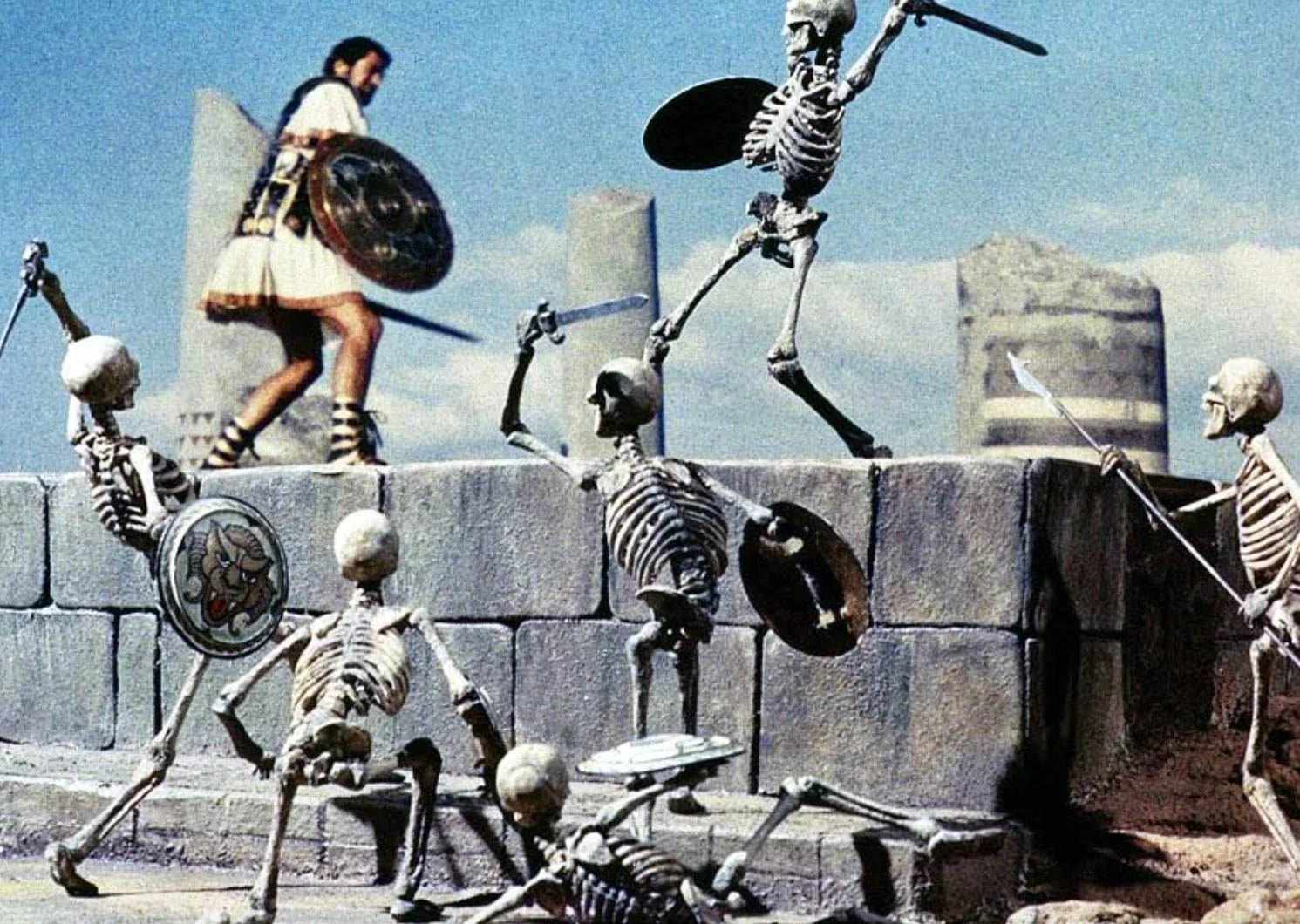
Film still from the movie, “Jason and the Argonauts”, 1963.
Back in the Giardini, Jason and the Argonauts split up into small groups and advance to different corners of the compound. One group sees a naked woman clearly being tortured as she is suspended 20 podes in the air, and hung upside down inside a giant golden bell. Her body swings back and forth, acting as the clapper, and enduring this punishment as she smashes against the inside of the bell casing. She twists and turns but, stoically she does not cry out in pain. A crowd has gathered around her to revel in her elevated pillory. Another group works its way into a northern pavilion where they encounter giant beasts covered fully, from frizzy head to mechanical toe, in snowy gray hair. Some of the snow creatures have enormous spikes and horns jutting out of their heads. A third group encounters a mermaid-like being, fully submerged in a tank. She is resting a fathom deep on a bed, seemingly asleep, open and vulnerable to the surrounding people and elements. The fourth group clandestinely slips into a castle structure to find an enormous giant lying on their back. The giant has been turned into a tree, with crows and other critters using the wooden body to rest upon it. Having faced many adventures and dangers, the men decide to regroup and strategize.
Together again in a corner of the grounds nearest the lagoon, the Argonauts attempt to formulate an exit strategy with Jason taking the lead. As they devise a plan, people begin to walk over to them, then surround them on all sides. The men form a cluster, back-to-back, and reach for their weaponry. At first, it’s a small group that encircles them, but the number grows quickly, and what began as a dozen or so, has turned into a hundred or more. The men draw their swords, ready for battle—and then the crowd erupts into a loud applause. The ovation is prolonged, and cheers and words of appreciation are uttered. As the crowd disperses, a voice can be heard saying, “This performance has my vote!”
Jason and the Argonauts might just fulfill their quest, and take home the Golden Lion after all. Stranger things have happened, especially in Venice.
