
Bellmer Nauman Pondick: Material Desire
Nunu Fine Art, New York [in collaboration with Sonnabend, NY, and Ubu Gallery, NY] March 6th through May 30, 2026
By Elaine A. King
Independent Art Critic and Curator
Against a backdrop of global conflict, urban violence, rising dictators and the surging influence of AI, the Bellmer Nauman Pondick exhibition arrives as a timely provocation. The show features vintage photographs from Hans Bellmer’s 1930s La Poupée series, Bruce Nauman’s 1970s body videos and hologram studies, and the artist Rona Pondick’s fragmented sculptures.
This astutely curated exhibition brings together three generations of artists whose work centers on the human body as both material and a site of psychological inquiry. Although their origins differ, they are bound by a shared debt to transgressive literature. Hans Bellmer mirrors Marquis de Sade’s uncompromising, often obsessive exploration of extreme sexuality and violent cruelty; Bruce Nauman echoes Samuel Beckett’s bleak, tragicomic absurdity and literary nonsense; and, Rona Pondick draws from Kafka’s liminal spaces—a labyrinthine, uncanny realm that she describes existing uncomfortably between reality and the unfamiliar. As the gallery notes, “For all these artists, the body is a vehicle for the exploration of psychological impulses, grounded in the materiality and color of their work, and in the spaces that the work occupies.”
According to Albert Godetzky who wrote the essay for the illustrated catalogue, the pieces were “Guided by Rona Pondick’s selection of the artists’ works, her own practice, and her deep, career-long engagement with the body. We are encouraged to look differently, a historically, and creatively at the juxtaposition of these artists, despite their temporal and geographical remove from one another.”[i]
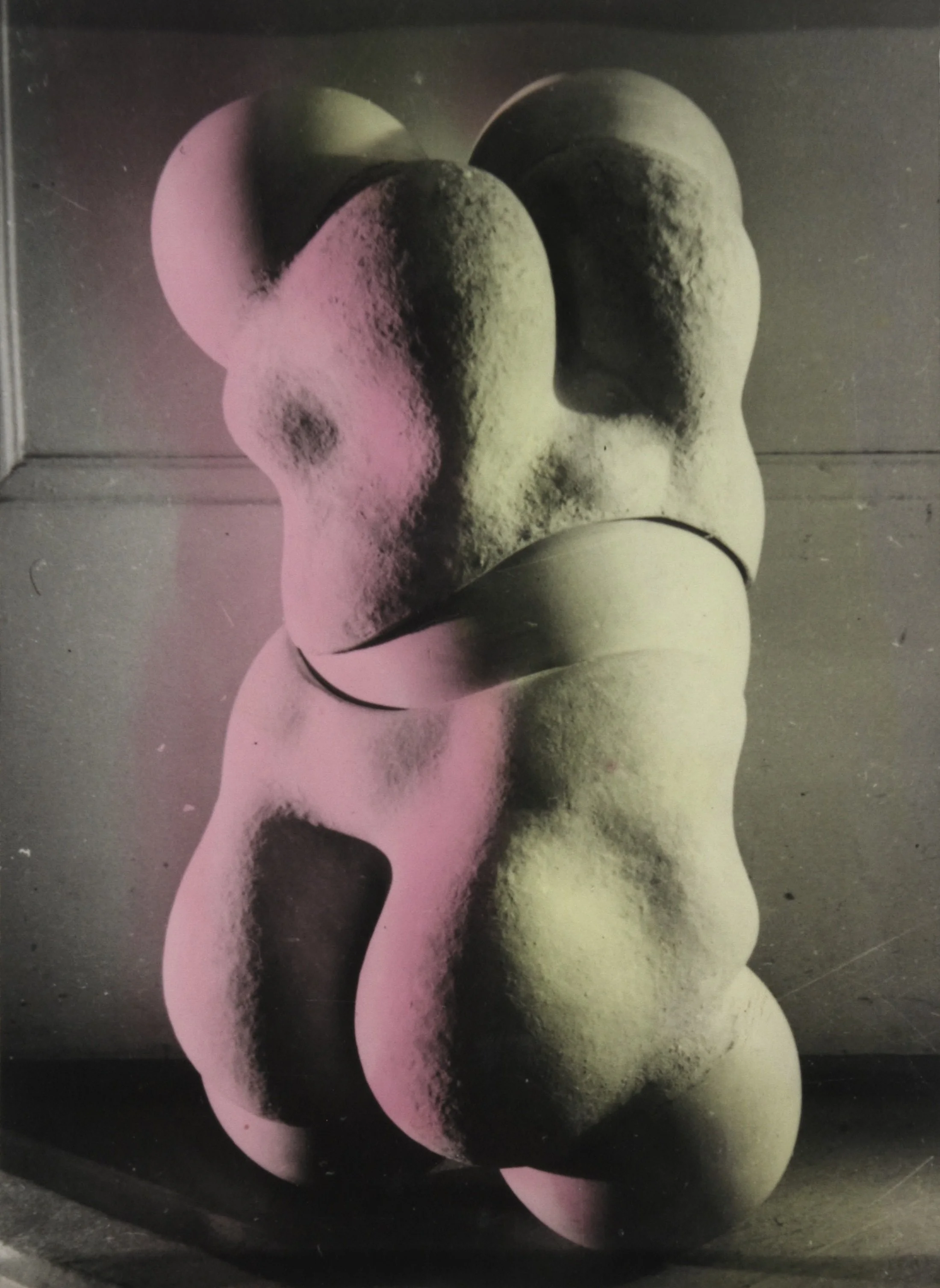
“La Poupée [The Doll]” By Hans Bellmer, 1935
Entering the gallery, the viewer traverses a corridor lined with Hans Bellmer’s small-scale photographs, revealing a nightmarish tableau of mutilated, reassembled dolls staged within unsettling domestic interiors. This tension is further heightened by the gallery's dimly lit space, which forces the viewer to navigate a narrow, atmospheric passage that reflects the psychological confinement and complex narratives found in the work itself. Like many German Surrealists, Bellmer used disjointed anatomy to probe the Freudian subconscious—a reservoir of repressed impulses and primal drives. His fascination with fragmentation was also a visceral response to the trauma of World War I and the ascending shadow of Hitler’s regime. By constructing deformed, fractured figures, he presented a deliberate aesthetic rejection of Aryan supremacy and the rigid, idealized body standards of Nazi ideology. His work also functioned as an attack against his father. In Bellmer’s creation of "artificial girls," he defied both patriarchal authority and the inflexible Nazi morality his father exemplified.
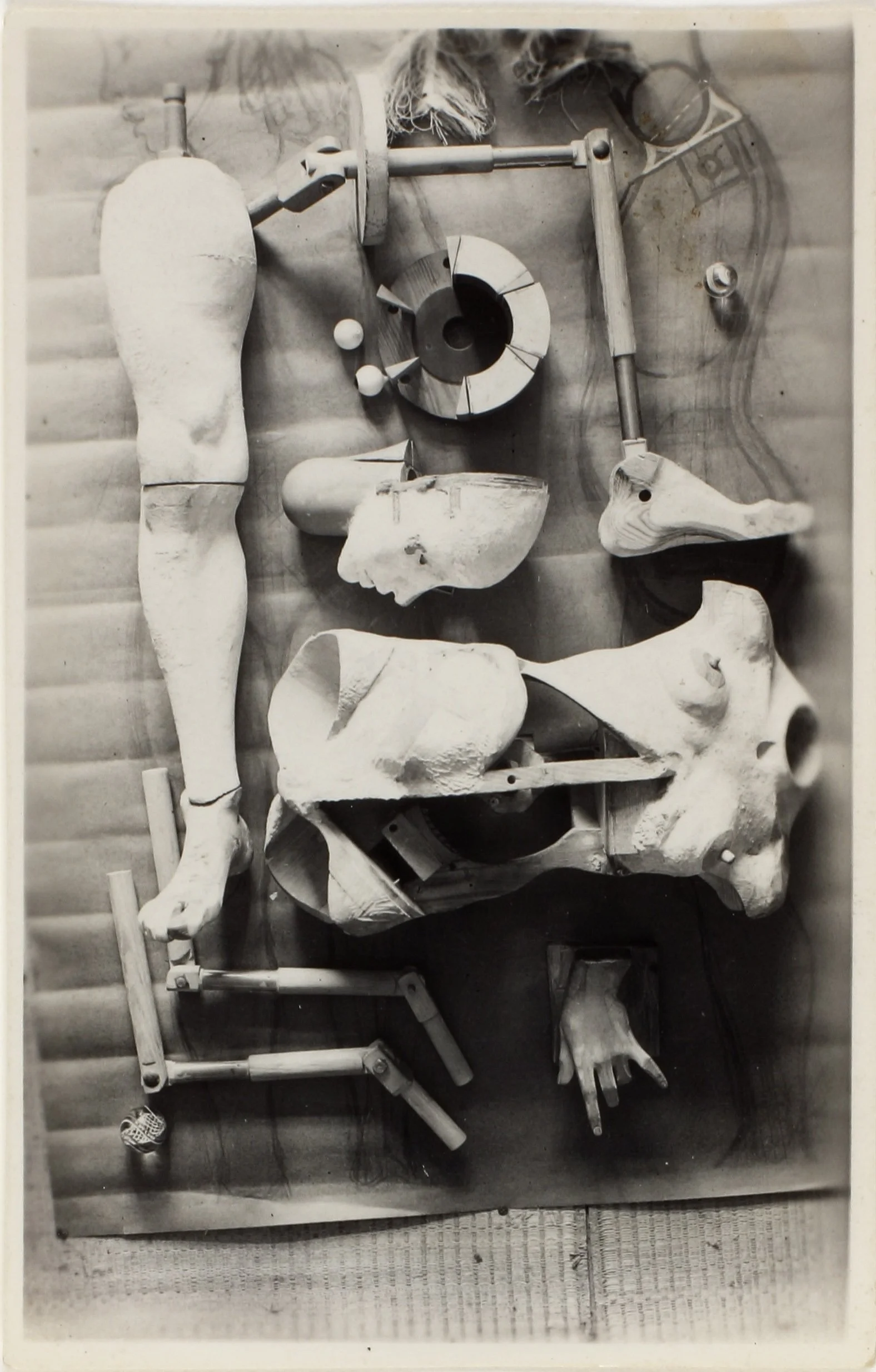
“La Poupée [The Doll]” By Hans Bellmer, 1934
Bellmer’s work reimagined the body not as a whole, but as a site of radical, surrealist deconstruction. By blending sculptural forms with photography, he created images of fragmented dolls that elicit a profound sense of the uncanny. In the striking 1936 photograph La Bouche, a headless figure—built from a metal skeleton and papier-mâché—is splayed across a chair in a distorted, multi-limbed pose. This fascination with the disassembled body echoes the intimate yet disquieting atmosphere of E. J. Bellocq’s, Storyville photographs, where the gaze similarly transforms the human subject into a fractured, enigmatic object.
Another compelling image is Nous la suivons à pas lents [“We Follow Her with Slow Steps”] 1937, a hand-colored vintage gelatin silver print overpainted with white gouache. The photograph depicts a manipulated, incorporeal female character comprising a head, with a mask-like face and shoulders that spout numerous breasts. It evinces Bellmer’s fixation with the physical unconscious and the thought of the body as a phrase that can be pulled apart and reassembled. The title and image align with the Surrealist ideal of the femme-enfant, a figure representing both desire and a revolt against rationalism.
In the main gallery the viewer encounters both the work of Bruce Nauman and Rona Pondick. Bruce Nauman’s seminal screen-prints, Studies for Holograms (1970) anchor an exploration of the body as pliable sculpture that represents a critical moment in his career where he integrated performance art with new technologies. Rejecting traditional painting, Nauman treats his face as raw material, using his hands to pull, squeeze and distort his features. The close-up shots of his face are not flattering depictions but instead tense, unsettling and eerie portrayals. These green-tinted, disquieting representations challenge conventional portraiture and stable identity, utilizing the "non-tangible" nature of holography to turn the face into a "light trap."
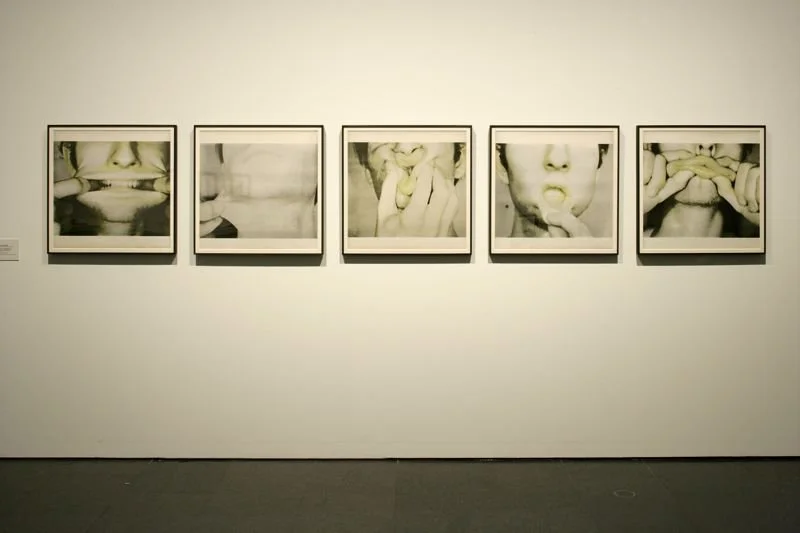
‘Studies for Holograms’ By Bruce Nauman, 1970
In the lower cavernous, dark gallery are two videos that further demonstrate Nauman’s shift toward the body-as-medium and the camera-as-witness. In Thighing (Blue) (1967), the artist manipulates his own flesh to the sound of his breathing, stripping away total facial identity to focus on physical action.
Bouncing Balls (1969) similarly captures a repetitive, absurd act in extreme slow motion. Nauman uses his testicles as the subject, bouncing them with one hand until the movement becomes so distorted it is barely recognizable. While a sense of the erotic may pervades in this video, it was not the artist’s intent; rather, the work reveals Nauman’s evolving view of the studio as a laboratory and the body as a sculptural object. Influenced by the minimalist prose of Samuel Beckett, these pieces present the studio not as a stage for drama, but as a workspace where the body is documented as raw, objective data.
At the core of Rona Pondick’s practice is the process of metamorphosis. At the gallery’s entrance, Pondick’s Baby Legs (1990) hangs suspended, featuring elongated, spindly black limbs stuffed into unlaced shoes. These small shoes serve as symbolic extensions of the body, creating a disorienting interplay of scale that sets an eerie tone for the exhibition. This hybrid form is at once darkly humorous and psychologically weighted, bridging the gap between the psychic and the physical; meanwhile, its ghostly shadow stretches across the floor and wall, heightening the sculpture's mysterious presence.
In the interior gallery an assortment of Pondick’s works mostly from the 1990s are displayed. However, highlighted among Pondick’s work and centrally placed, is Encased Orange with Pink Teeth (2019–23), which suspends a cast of the artist’s head in an acrylic block, evoking a sense of embryonic fluids.
Back to Back(1991–92) is a provocative sculpture that investigates the intersection of domestic furniture and the human body. It discloses Pondick’s awareness of Freudian concepts, childhood development, and prohibited subjects. By grafting female and male shoes onto the legs of a chair-like stool upholstered in black lace and pink, she invents an unsettling presence that links physical and psychic realities. The work accentuates her attention on body fragments demonstrating how isolated parts like feet can become thought provoking and impressive when separated from a complete torso.
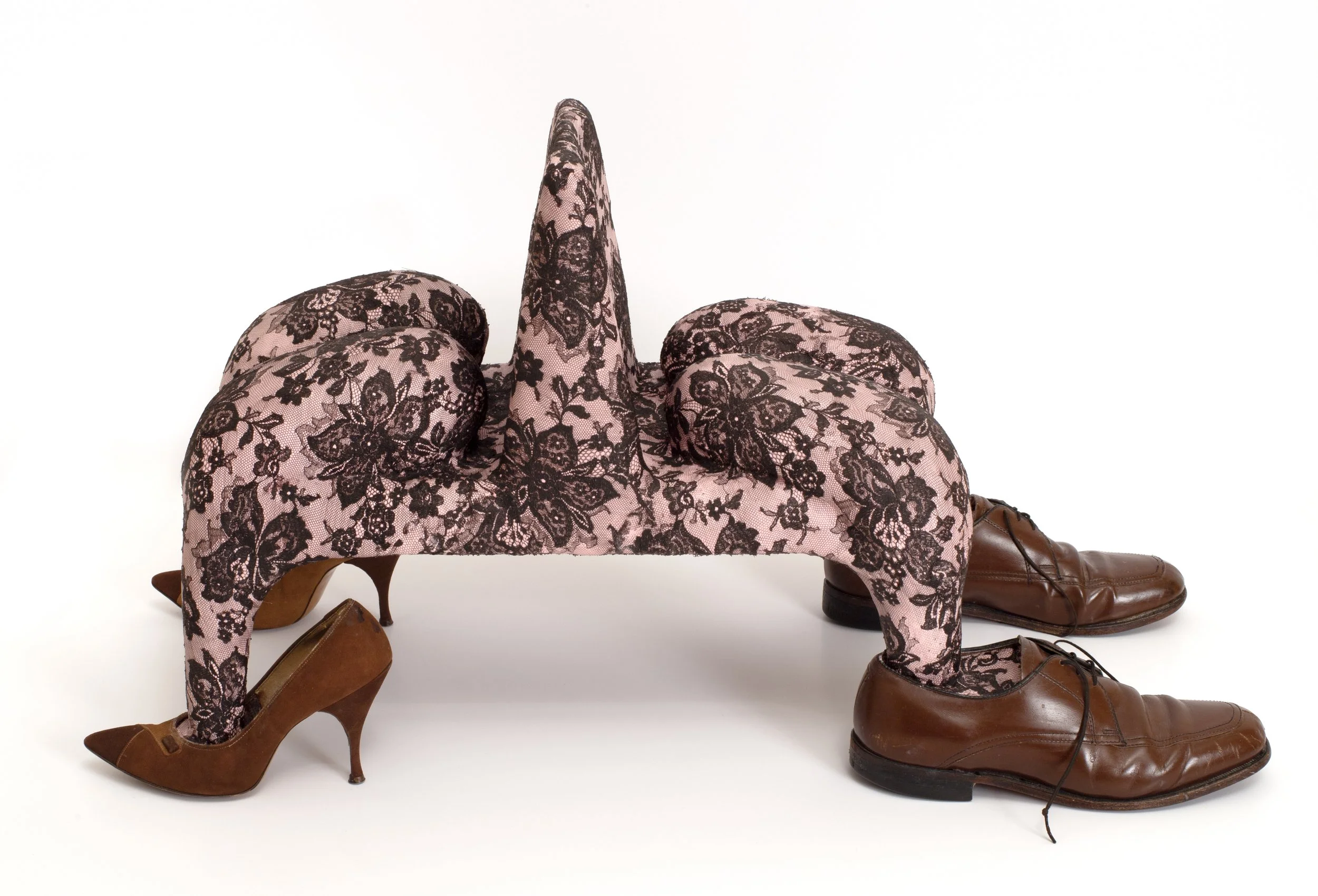
‘Back to Back’ By Rona Pondick, 1991-1992
Rona Pondick’s, Pink Balls and Brown Pump, 1991 suspends on a wire near Nauman’s grimacing faces, Studies for Holograms. It is a fitting juxtaposition, captured by the sculpture’s scowl and gnashing teeth. A brown woman’s high-heeled pump floats near an upside down phantom like head made from baseball-sized spheres of pink epoxy modeling compound. Each form is implanted with a pair of yellowish rubber teeth. By uniting flesh-colored pink with aggressive anatomical features like teeth, the work creates a disquieting effect suggesting both attraction and repulsion. This uncanny piece appears to explore the intersection of consumer culture, gender, and the human body.
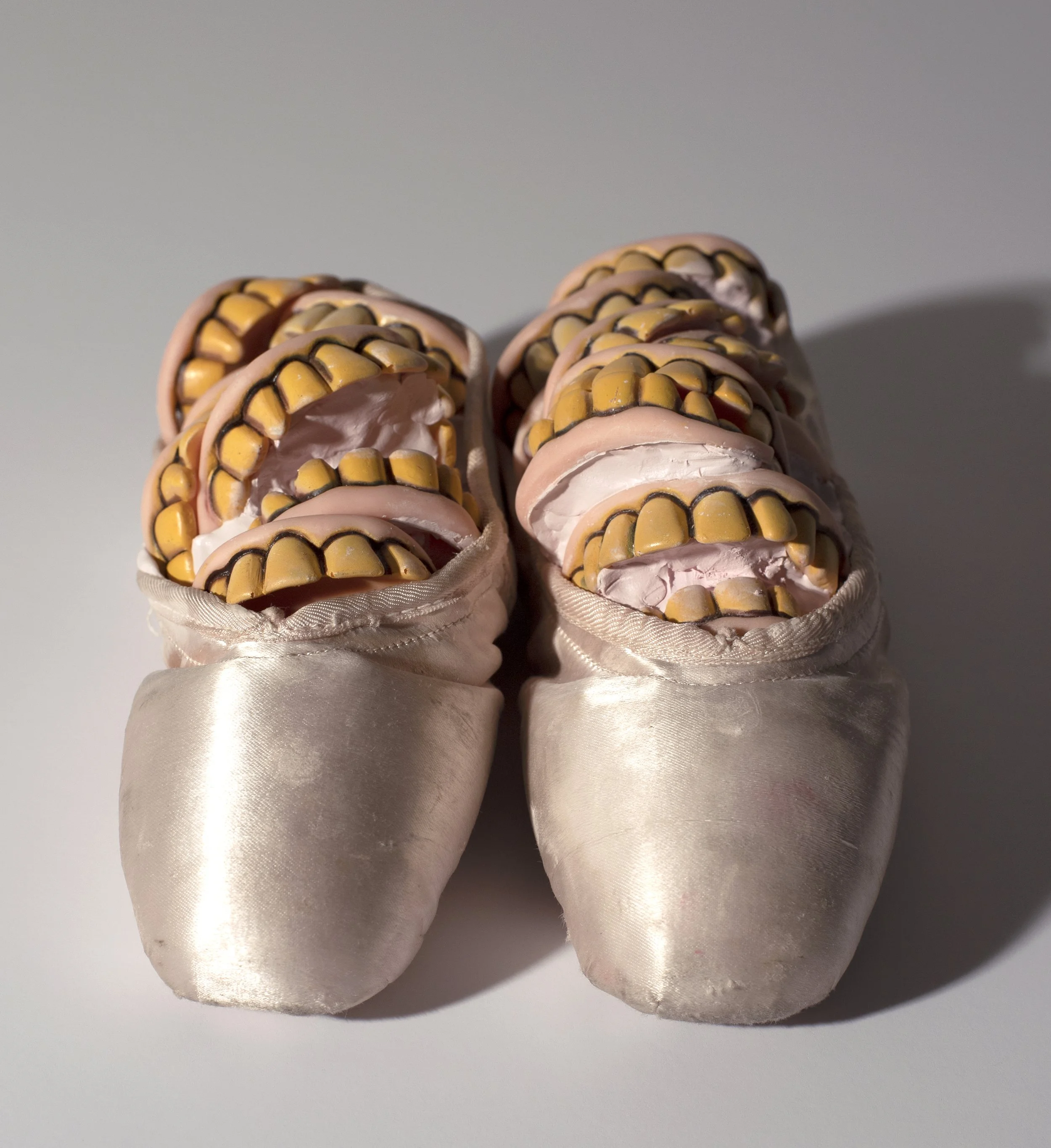
‘Ballerina Teeth’ By Rona Pondick, 1991
The placement of these works by Pondick and Nauman is particularly apt, as both artists reject the body as a unified whole, instead treating it as an assortment of fragments to explore psychological impulses and mental unraveling. This is most striking in Pondick’s use of decaying rubber, teeth, and in Nauman’s facial manipulations, which create grotesque, mask-like contortions. While Pondick’s sculpture echoes a Kafkaesque metamorphosis, Nauman’s piece evokes a trapped performance of physical endurance.
Throughout the 20th century, the human figure served as a primal site for artists to map the fractured realities of trauma and alienation. Through the raw physicality of performance and the tactile distortions of sculpture, the body became a vessel for probing the mind-body connection. While once met with controversy, the works of these three avant-garde artists now seem prophetically natural precursors to our AI-driven landscape—a world where the digital manipulation of appearance is total. Yet, this seamless alterability comes at a steep cost. By flooding our visual culture with idealized, exclusionary imagery, AI reinforces restrictive aesthetic norms that fuel body dissatisfaction and dysmorphia.
The recent debate over the digital preservation of celebrity likenesses vividly illustrates the tension between the authentic human form and its algorithmic double.[ii] In Hollywood, apprehension about AI centers on job displacement, the unauthorized use of persona, and the erosion of human creativity. Historically, studios manufactured 'star quality' through stage names, physical transformations, and curated personas. Today, we must ask: will AI radically redefine the celebrity aura, or simply dress 21st-century stars in a new digital encoded veneer? While concerns persist that an influx of AI-generated content may devalue original artwork, these outputs often lack the intentionality and lived experience that define true artistry. As evidenced by this exhibition, it is these uniquely human qualities that ensure our creative contributions remain distinct and irreplaceable.
[i] Albert Godetzky. “Fleshing Out” in Bellmer Nauman Pondick: Material Desire (Nunu Fine Art, 2025), pp. 13-14.
[ii] Brigid Delaney, “Hollywood’s Idea of Beauty Once Meant Polished and Slim, Not Altered and Gaunt: This New Look Is Unsettling,” Guardian, March 12, 2026, (https://www.theguardian.com/commentisfree/2026/mar/12/hollywood-beauty-ideal-altered-gaunt-face-ozempic-glp-1-drugs).
