
Art for the Environment
By Pāg Black
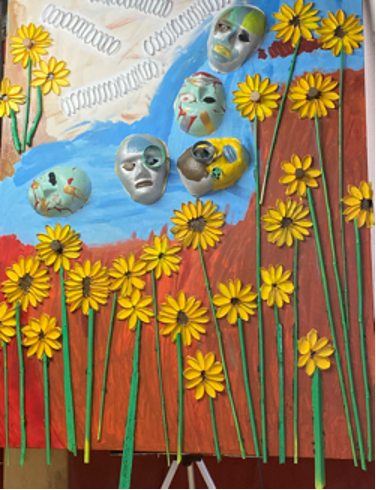
“Sunflowers on My Mind Floating in a River under Clear Skies”
“Metaverse Dreams”
Copper, computer chips, wood, canvas, crystals, cork, plastic and rubber, spray and acrylic paint
(5’ x 4’, 2025)
Four of my assemblage works were installed at the Sagamore Hotel for Miami Art Week. While I was hosting a supporter of my foundation and his son, I observed a hotel custodian approach Sunflowers on My Mind Floating in a River under Clear Skies. I watched as he took in my art; walking closer to the assemblage, as though it was calling him in. As I approached him, he began to walk away, so I asked, “Do you like this piece?”, and he responded, “si yo quiero mucho, yo quiero mucho”. Then he pointed at another assemblage on the wall and repeated himself. That piece was also mine; “Tear in the Technoverse”. Just then my husband approached with the foundation patron and his son, and the patron remarked, “Is this one of yours? It is wonderful! Are those representing the five senses?”. The conversation continued, the custodian walked away, and I realized that I found the universal language. Sunflowers on My Mind Floating in a River under Clear Skies is assembled with several elements and various materials, and most prominently presents the rarest element in the galaxy. I selected this element to provoke a conversation about value and worth.
My sunflowers assemblage communicated across five generations, diverse abilities – (I am dyslexic), three socioeconomic classes, three first languages and four unique cultures. As a material scientist I write papers for my fellow scientists. As a developer I design homes. My art democratizes the conversation about sustainable solutions for the built and natural environment.
Sunflowers on My Mind While Floating in a River under Clear Skies was developed from vibration at a time when I was open to listening. Often my art is the product of obsessive pressure building up that needs to come out. When I work as a scientist, I find it challenging to shift between my left brain and right brain thought processes. A deep work trance is required for both, but through very different processes. I learned over the years not to fight either process, and to express myself when the inspiration hits. My inspiration for Sunflowers came the day my husband and I learned we would be parents for the first time.
As an indigenous earthling and scientist, I collect elements, materials and minerals. When I collect these “things” I do not know their intended purpose. I am simply struck by their beauty and properties, and I endeavor to connect them to like energy to tell a story. I began Sunflowers with a blank canvas and created the first impression with a base coat of house paint as a nod to my development background, and to my trash to treasure ideology. Left over paint from a project is the best!
Sunflowers is an assemblage requiring deep exploration to uncover all the elements. It features a diamond, onyx, amethyst, quartz, steel, copper, tin, gold, aluminum, computer chips, and more. While searching for elements, the observer may miss the most prominent material that happens to be the rarest material in the known galaxy. It isn’t the diamond. Diamonds are plentiful in the galaxy. The message of Sunflowers is to rewire our understanding of value and expand our consciousness to a galactic perspective. Most humans think in household perspectives, maybe neighborhoods or cities. Our global consciousness has not yet accepted we are only one species in the vast galaxy. Luckily, we are maturing, and the message of Sunflowers is the message handed to me from my fore-parents. The rarest material in the known galaxy is wood. Value can be missed and misunderstood depending on your reference point. The meanings were only clear to me as each layer dried with every layer, over 220 of them revealed new meanings. The five faces represent the five senses.
Sunflowers took nine months to complete, after years of collecting the elements it brings together. Once I began, I couldn’t stop. I found myself waiting impatiently for one layer to dry so I could begin another, as I prepared for my son’s arrival into this world.
The textures and materials used in the assemblage create a layered narrative, challenging the viewer to embrace the juxtaposition of human ingenuity and natural harmony. From the shimmering metals to the tactile wood and acrylics, every element invites reflection on the interconnectedness of humanity's past, present, and future.
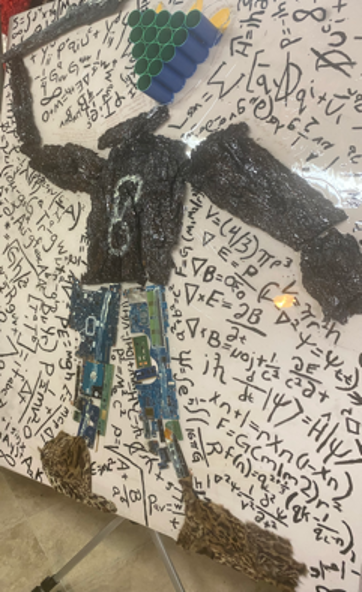
“Tear in the Technoverse”
“The WORLD is ENERGY: Universal Equations”
“Bark & Core”
(5ft x 4 ft., 2025)
Every time I look up at the surrounding lights, I think of my grandmother and her sister. They worked on the Manhattan Project, leading to the discovery and harnessing of atomic energy. My roots derive from scientists who believed and proved that innovators solve the world’s problems, and the best scientists are also artists. As scientists in the 1930s and 40s, I can only imagine the daily pressures my grandmother and great-aunt faced communicating their world of interest to others—it was luckily they had each other.
Tear in the Technoverse started from a blocked place. As a millennial woman, developer and scientist, I spend most of my time with men. I have not lived in a home with a television for over two decades, and have no streaming subscriptions or Facebook page, so I am lost during most popular culture discussions. I have been on the creation side of technology, not the consumption side; making me a bit of an alien amongst humans. The canvas sat blank for four months and was the source of serious frustration. I began most mornings with a walk in nature to center my day. One day I noticed a tree had been cut down. The bark was loosely attached. It was such a sad but beautiful sight. I returned with supplies to meticulously separate the entire round of the bark from the tree. Wood is the most valuable material in the known galaxy, and for this assemblage I began to send a message to all sentient life about value.
Technoverse became the answer to the question, “what language would humans use to communicate with aliens and what would we share about the human experience?”. The art delves into themes of transformation and resilience, speaking to the evolution of humanity as it melds with technology and ventures into the vast unknown of space. Tear in the Technoverse encapsulates the poetry of innovation, with universal equations anchoring its message—a language meant to bridge species and dimensions. The centerpiece, a striking human form rendered from the rarest materials known to science, stands as a tribute to strength and ingenuity. The shoes crafted from my grandmother’s fur coat, the computer cores salvaged from my graduate studies, and a club symbolizing trade and history along the Mississippi River all interlace personal legacy with collective progress. A bamboo-framed crown, evoking both simplicity and groundbreaking innovation, completes the vision. This piece questions the trajectory of labor as artificial intelligence reshapes industries, heralding a shift from blue-collar to green-collar paradigms while reminding us of the enduring force of human creativity. Technoverse also captures the human argument of purpose; are we victims of violence created by survival of the fittest legions, or are we a species driven by maturation?
