
Can Art Shake Power? Creative Confrontation and the Role of Protest Art
By Lanita Brooks-Colbert
Across the ages, art has been a rallying cry for protest, surfacing wherever people have yearned for change. Some works have sparked new freedoms, while others have given voice to defiance against those in power. Protest, by definition, asks no one's permission. Time and again, bold, unsanctioned art has ignited movements and shifted the course of history. Protest art wields a rare force: it can confront authority, unite communities, and spark transformation in ways that words alone often cannot.
Protest art raises awareness of social and political issues and amplifies the voices of marginalized groups, challenging authority in ways that verbal communication cannot. It motivates collective action and fosters a sense of community. A mural painted on the wall of a neglected apartment building depicts clasped hands breaking free from heavy chains beneath a banner reading "We Rise Together." After the mural’s unveiling, residents gathered at its base, first discussing the artwork, then sharing their own stories of struggle with unfair housing conditions. Within weeks, the mural became the meeting ground for a newly formed neighborhood committee, whose members organized meetings, circulated petitions, successfully pressing local officials to complete overdue repairs, shifting passive frustration into solidarity and action.
Protest art has shaped beliefs and sparked creativity across continents. In the past, artists made do with whatever tools they had, spreading their messages through the use of paint, whispers, and small gatherings. Today, a single image can travel the world in seconds, amplified by social media algorithms. Yet, these digital megaphones can also be silenced, as platforms filter and censor what is posted. Greater reach brings greater scrutiny, but also a wider stage for bold ideas. The protest art of yesterday now stands as a visual archive, chronicling the battles and hopes of generations, and serving current graffiti artists with their forebears’ history of successful messaging and courage.
Artistic expression fosters personal engagement, leading to a deeper understanding and emotional connection to environmental challenges. Artists play a significant role in social and political movements by using their work to express perspectives on contemporary issues. In an increasingly visual era, art acts as a catalyst for collective action and protest. Artists and art organizations can integrate and unite diverse approaches to address critical issues. Artists for the Earth® is a global campaign that connects arts organizations and artists worldwide to engage the public on environmental concerns. The campaign's mission includes exhibiting environmentally focused artworks, collaborating with educators to incorporate environmental themes into arts curricula, utilizing social media to broaden audiences, and facilitating global dialogue on climate change. By supporting the broader community, Artists for the Earth helps build consensus, effect community change, and inspire action to protect the planet.
Over millennia, art has evolved from a utilitarian craft to a recognized creative pursuit, with the term 'artisan' expanding beyond its original association with tradespeople. Islamic art and earlier traditions responded to cultural shifts, motivating artists to produce works that were contextual, opinionated, and self-reflective. During the Renaissance, protest art often reflected the perspectives of both commissioners and artists, as artists including Leonardo da Vinci inspired transformative change.
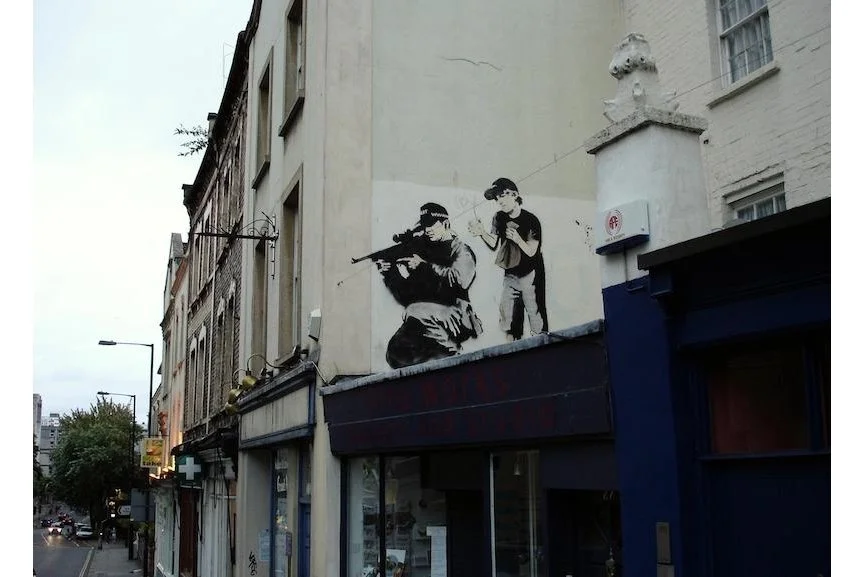
Banksy – The Guerilla Street Artist
Today, Banksy, a renowned street artist, is recognized for politically charged, satirical, and often humorous works displayed worldwide. Employing art as political commentary, his pieces engage with global issues and demonstrate the potential of protest art. Banksy has described graffiti as an underclass 'revenge' that enables individuals to reclaim power, territory, and recognition from the privileged. His work proves to be anti-war, anti-consumerist, anti-fascist, anti-imperialist, anti-authoritarian. Importantly, Banksy's art emerges from, and is closely connected to, broader street art networks and grassroots movements. His methods echo the tactics of countless anonymous artists who use urban space for creative resistance, highlighting how protest art gains strength from collective practices and shared community efforts that extend far beyond any single individual.
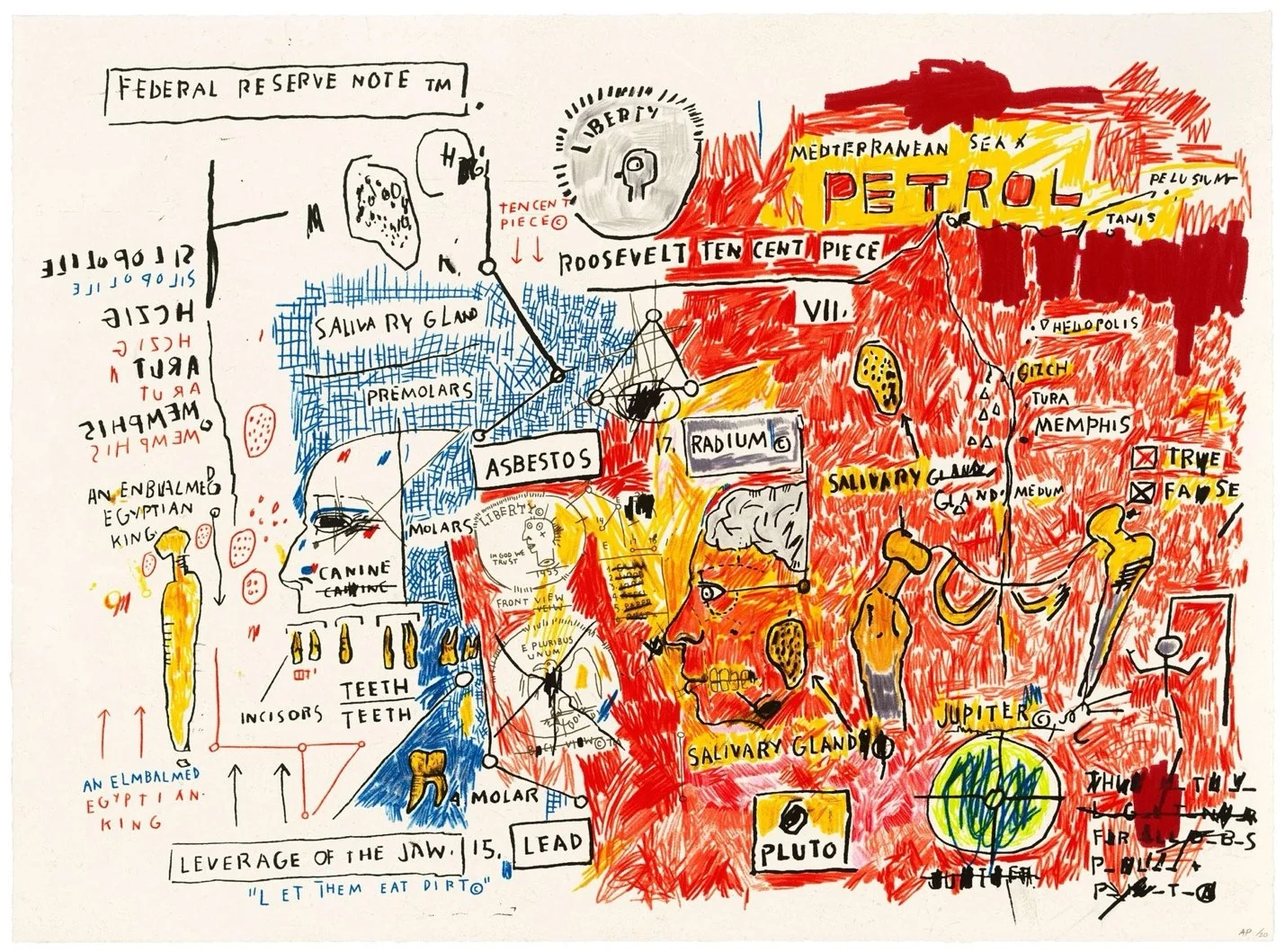
Liberty © Jean-Michel Basquiat 2017
Jean-Michel Basquiat burst onto the 1980’s art scene with graffiti-inspired paintings that confronted racism and inequality head-on. His art shattered social norms and gave voice to those silenced by mainstream culture. Among Basquiat’s most powerful works is Defacement (The Death of Michael Stewart), a tribute to a young Black artist lost to police violence in 1983. The haunting image of Stewart’s face beneath the words 'It Could Happen to Anybody' captures the fear and reality faced by many. Basquiat’s art has become a beacon, inspiring generations to use creativity as a form of protest and to confront issues of race, inequality, and justice worldwide.
When art and activism intertwine, creativity becomes a form of resistance. Through daring images and sharp commentary, artists rebel against oppression and challenge the status quo. The goal is to provoke, to shock, and ultimately, to spark change.
Artivism, a term used first in 1997 referring to Chicano artists and Zapatistas, is often defined as an artistic practice with an activist nature, blending art and activism, is sometimes called social artivism and can be considered a modern form of protest art. It often evolves to become a movement when a group of artists or artworks shares a common element and the shared moral compass of the art community. Visual artists including Banksy practice artivism as do artists creating land art, including the Red Rebel Brigade, whose performers dressed in bright red with painted faces, fight for the planet’s rights. Tania Bruguera (born 1968) is a Cuban visual artist whose work centers on power and control, and their abuse by authoritative figures, such as the government, and politicians.
Bruguera presents installations and performances, which directly confront Cuban history and contemporary issues, examining how power structures exist. Bruguera questions the use of borders and the migrants who defy these confines.
In 2018, Bruguera occupied the Tate Modern’s Turbine Hall with a series of interventions, which called for the public to participate.The work’s title was 10,148,451; a number which continued to change as it referenced “the number of people who migrated from one country to another last year added to the number of migrant deaths recorded so far this year – to indicate the sheer scale of mass migration and the risks involved”.
Kriss Salmanis’s You Reap What You Sow loomed over the Medicine History Museum in Riga, facing the Russian Embassy—a haunting image of Putin with skeleton teeth. This striking work stands as both a form of resistance and a reflection, exposing injustice and repression. It is artivism in action: giving voice to the marginalized, challenging dominant stories, and demanding change.
Ammar Abo Bakr, Arab Spring (2011-2014): Graffiti artist, created murals that served as a powerful and dangerous form of activist political expression. His works became the voice of the street, blending humor with tragedy to protest government corruption and demand regime change, turning city walls in Cairo, Tunis, and Tripoli into canvases of protest and defiance. Anti-authoritarian art of the Arab Spring documented the revolution’s evolution from hope to disillusionment. The artwork addressed military brutality, government corruption, and the innate desire for freedom for all. As local activist Layla M., who participated in the 2011 demonstrations in Cairo, explained, "Walking past the murals on Mohamed Mahmoud Street reminded us we were not alone. The images captured both our pain and our dreams and gave courage to keep going even when hope was fading." Similarly, Tunis-based organizer Youssef Ben Amar recalled, "The art on our walls became a gathering point—a meeting place for discussions, grief, and inspiration. It reminded us, each day, why we chose to speak out." These on-the-ground testimonies underscore how protest art was not simply decoration, but a shared language through which the collective authorship of the revolution took shape.
Dread Scott’s 1989 What is a Proper Way to Display a U.S. Flag is one of his best-known and most controversial works. It features an American flag placed on the ground, allowing viewers to stand on it. During the exhibition, police raided the show and arrested the artists on charges of flag desecration. They were convicted and each fined $100, a decision that was later overturned with help from the New York Civil Liberties Union. Varied responses to the performance became an integral part of the work, transforming viewers from passive observers into participants who had to reflect on their own beliefs and the symbolic meaning of national icons. This work, created under the George H. W. Administration, became a flashpoint in the Culture Wars, prompting the U.S. Congress to pass the Flag Protection Act of 1989.
In Houston, Texas, supported by the U.N. organization for Sustainable development, seventeen graffiti artists’ projects were painted high on buildings throughout the city. Topics including environmentalism, women’s rights, animal rights, quality education for all, implications of climate change, ending gun violence, ending human trafficking, lifting people out of poverty were addressed by artists including Ricky Lee Gordon who painted Our Ocean/Our Teacher; Lady Justice by Victor Ash; Assiduity by Smug; Gonzo 247’s Reducing Violence, Aim for change; Harmony by Mr. Super A; John Biggers’ The Return; Betz’s When Tomorrow Comes; and more.
And now we are here. Protest art in 2026 is a dynamic, fast-paced medium focusing on digital, street-level, and interactive works to combat social injustice, environmental crises, political and inequality issues, aimed at immediate and often viral social change.
Today’s contemporary artists are facing censorship as a form of political repression that has remodeled the creative milieu. Two typical legal tactics used against artists today include vague "obscenity" or "public morality" laws to justify the removal of artworks, and the threat of defamation lawsuits aimed at silencing controversial viewpoints. In addition, funding cuts are sometimes targeted specifically at projects that address contentious social themes. To respond, creative workarounds continue to emerge. Artists use pop-up exhibitions in unconventional public spaces or encrypted online galleries to bypass institutional gatekeeping and censorship. Artists who address identity politics and other "hot-button" social issues in their works now face administrative consequences in the political climate. Arts institutions, art funders, and the collective art community must find a way to amplify the voices of radical dissenting artists and withstand the legal attacks that follow. Artists across the country who are creating work that expresses their views on feminism, LGBTQ+ issues, pro-immigrant stances, and racial justice have had their exhibitions delayed or cancelled.
"The times are tough these days with the leader of the free world spewing hate and misogyny. Racism is on the rise and what we need from artists is a way to visualize and vocalize a counter narrative, one about love and compassion, inclusion and diversity. In “Not Normal,” the artists’ righteous energy calls out these criminals in power and demand the public hold them accountable." Justin Hoover, Director of Collective Action Studio and independent curator, review of Not Normal: Art in the Age of Trump, (2020) curated by Karen M. Gutfreund, artist and activist, a visual protest featuring 147 artists with over 350 works and accompanying book. (Click Youtube video link below to watch).
Graffiti protest art in cities like New York, often seen as the birthplace of modern graffiti art, serves as a social lens on cultural conflict. While the subject matter is serious, the art is alive with color and details that deliver with irreverent sense of humor, the narcissism that puts our entire country and world at risk. Protest art’s visibility, rebellious nature, and controversial status make it a cultural phenomenon that provides insight into race, class, and cultural expression. The power of protest art does not lie solely in the problems it may resolve or the change it might initiate, but rather in its capacity to define pressing questions, compelling us to consider the full scope of necessary political action, and sustain a persistent countercultural discourse.
For the sake of humanity, we must rise, raise our voices, lift our cans of spray paint, and act. As forces try to rewrite our cultural stories and silence artivism, it is vital to defend creative freedom and the lives of our brothers and sisters in solidarity—the lifeblood of community and progress.
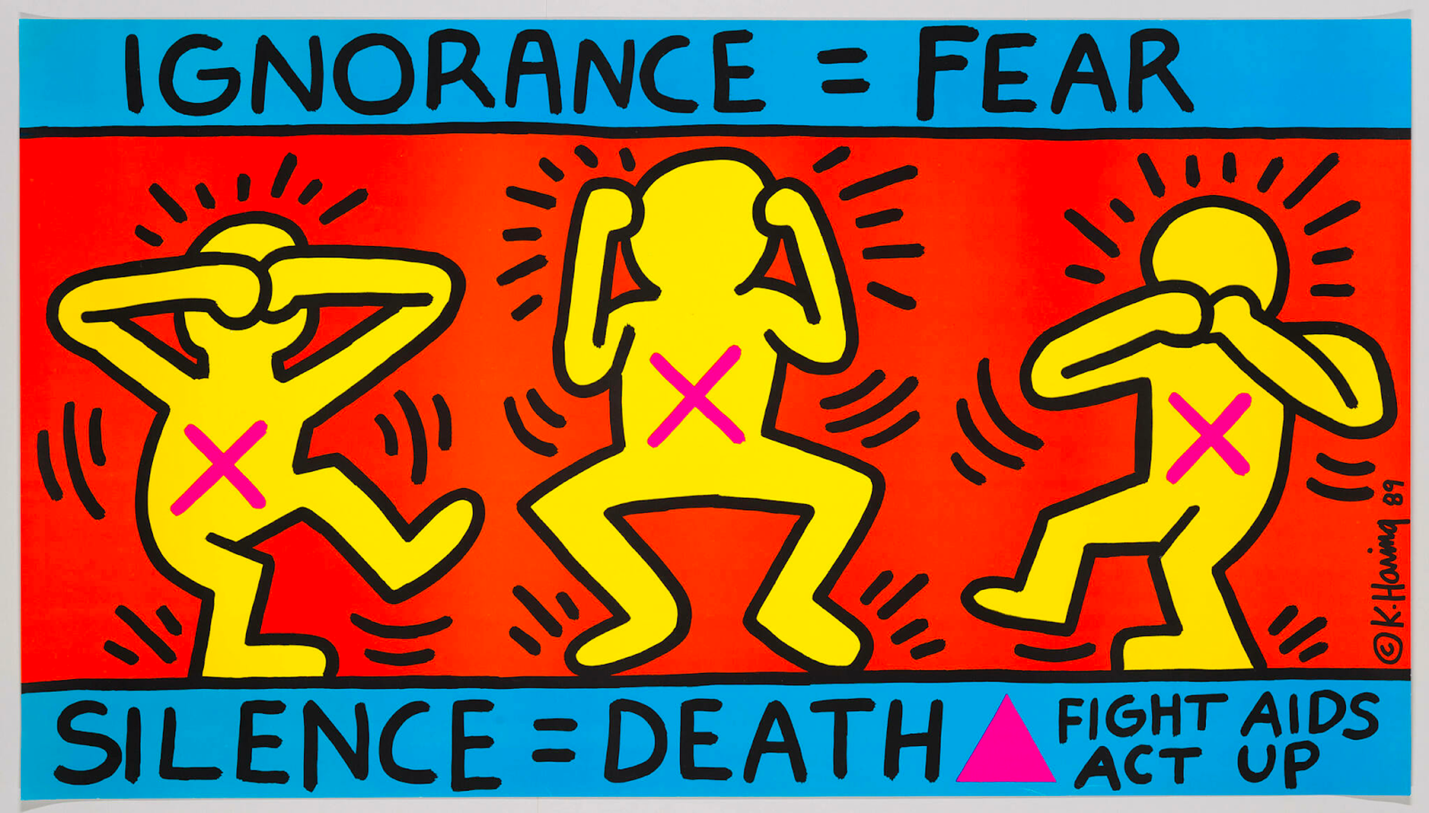
Image © Whitney / Ignorance = Fear / Silence = Death © Keith Haring 1989
