
By Jorge Benítez
A bad liar hides the truth. A good liar crafts the truth. A great liar tells a story full of hope.
“The avant-garde will save us.” Of course it will; and humanity will progress toward the end of history. And, as an added bonus, modern art will cure the proletariat of its philistine tastes. Throw in a little twelve-tone music and, voilà, utopia soon arrives. Such was the promise of modernism even after the horrors of World War II. The truth, if such a word can be uttered without irony in 2026, had other plans.
On Tuesday, November 3, 2026, the American people appeared to have rejected an increasingly authoritarian administration and its rubber stamp Congress. The Republic appeared to have been saved. Optimism and decency appeared to have triumphed over nihilism and hate. The reality is altogether different; and it is ill-advised to celebrate prematurely, especially in the arts. The underlying issues that plague American society remain intact. Those voters who still support the administration and voted for the current president three times have not altered their convictions. They resent the cost of food and fuel; but they have not given up their racism, misogyny, xenophobia, anti-Semitism, Islamophobia, or Christian Nationalism. Nor will they surrender their consumerism, guns, anti-science views, or climate change denial. Their temporary despondency over the cost of living does not imply the possibility of ideological change. Consequently, those Americans who see themselves as the torch bearers of an Enlightenment legacy of toleration and personal liberty need to be more alert than ever. Despite the midterm election results, the United States is far from safe from the dangers of autocracy. Artists, in particular, should beware.
Art poses few dangers to a liberal democracy. Aside from fights at the old Cedar Bar and an occasional succès de scandale, the avant-garde seldom bites anyone. The system defangs it with exhibitions, fame, money, awards, and a condescending smile. Eventually, the edgiest art is rewarded with entombment in a museum, where, like Lenin in Red Square, it remains as dead as the revolution it launched.
In an autocracy, every work of art poses a threat. The artist is a potential terrorist, if only metaphorically. Dangerous questions abound in the paranoid world of authoritarianism. Does the artist mock the dictator or the enemies of the state? Does the work reflect or defy the official ideology? A simple still life could carry a death sentence if the flower in the vase were denounced as counterrevolutionary. An apple could be a symbol of capitalism. Abstraction is a “degenerate” insult to the Volk. Rock and Roll is anti-Soviet, decadent, and bourgeois. Jazz is un-Chinese. The list is endless and endlessly mutable. “What shall we do with the artists?” asked the Gestapo, the NKVD, and the Red Guards. Fortunately for Americans, the FBI would never ask such a question. Such things could never happen in the United States, or so we are told since birth.
Stalin, Mao, Hitler, Khomeini, Putin, and scores of great and petty autocrats have always understood that the arts must be kept on a tight leash. Dictators often project ironclad personalities that protect their thin skins. Their armor relies on surveillance, censorship, and threats of arrest, torture, and execution. Their regimes cannot survive criticism, and their feelings are easily bruised. Feeling is the lifeblood of every autocracy no matter what it professes ideologically. It can claim to be built upon scientific or even divine truths, but sooner or later the feelings of the party and its leaders become the only truth that matters, and whoever offends them will pay a heavy price.
Words hurt. Images hurt. Songs hurt. Bullets hurt more and have the added benefit of cancelling the artist permanently. Such is the autocratic logic that has been creeping into American society since the days of the House Un-American Activities Committee (HUAC) and into the era of Title IX investigations for intellectual offenses against feelings. Contrary to partisan assumptions, the authoritarian impulses behind contemporary censorship are bipartisan. Writers such as William Shakespeare are often targeted by all sides for different reasons. The Right focuses on the defiance of parents, religion, and the state while also condemning accurate presentations of historical injustices. For its part, the Left objects to perceived sexism, racism, homophobia, and other slights against identity. The absurdities often overlap. Thus, white nationalists condemn Othello because it features a mixed-race marriage, and progressives condemn it because the main character is a fatally flawed man of color. Othello’s tragic complexity disappears under ideological agendas that reduce him to a stereotype and infantilize the audience by depriving it of the confrontation with life that informs great art.
Although it is tempting to blame one side or the other as being more prone to censorship, the reality is far more nuanced because they all share a common culture of moral absolutism. From Prohibition to the counterculture of the 1960s and into the neo-puritanism of so-called cancel culture, the United States is vulnerable to bouts of moral panic and libertinism, often at the same time. The Great Gatsby, a novel set in the 1920s, portrays how Prohibition and the Jazz Age intersected to feed the thrills of privileged transgression. One century later, its main themes resonate in an American administration that combines graft, corruption, sexual depravity, incompetence, blackmail, extortion, racism, misogyny, xenophobia, extra-judicial killings, and collusion with an authoritarian country called the Russian Federation. Washington in the 2020s dwarfs Caligula and reduces The Great Gatsby to a children’s story.
Aside from the disruptive effects of fluctuations between periods of moral absolutism and escapist dissolution, the United States suffers from what outsiders often see as excessive compartmentalization. Every field protects its purity through isolation from every other field. In academia, cross-disciplinary exchanges are promoted but usually left unrealized. Writers seldom speak with engineers who in turn seldom speak with historians. At the popular level, events are viewed in isolation from a larger whole. Consequently, many Americans, including the press, could not understand why Osama bin Laden mixed historical references with contemporary issues to justify the terrorist attacks on September 11, 2001. This lack of interest in the cultures, ideas, and motivations of friends and enemies alike has historically contributed to an American reluctance to face reality even when it is obvious. From the Japanese attack on Pearl Harbor on December 7, 1941, to the 2022 Russian invasion of Ukraine, and the 2024 MAGA presidential victory, the reaction always seems to be, “I don’t get it. How did this happen? It doesn’t make sense.” It makes perfect sense to anyone who is awake, aware, and engaged. Sadly, artists and intellectuals, the very people who should know better, are often the worst offenders in the crime of selective disinterest and skepticism.
American artists have a responsibility to liberal democracy; especially, if they wish to work without the fear of censorship and persecution by the state. Where does this leave the lesser threat posed by individuals and institutions who neither censor overtly nor persecute openly? Until recently, the First Amendment to the United States Constitution seemed to protect artists from the government. It never protected them from galleries, museums, universities, critics, theoreticians, ideologues, reformers, and zealots. It could never protect them from the cruelty of changing tastes or the moralistic fits that plague the extremes of the two main political parties. As for the political center; it pays lip service to the arts while thriving on the principle of “go along to get along.” The logic behind such enlightened fecklessness is straightforward. It posits: “If it doesn’t affect me directly, why should I care? I can always virtue signal my way into projecting an illusion of solidarity until the cause is forgotten. May I return to my gin and tonic, please?”
To be fair, such Americans are not exceptional in their fecklessness and hypocrisy. Such traits are universal, and the issue would be trivial were it not for the American fetishization of free expression. Few societies have touted freedom of expression with such fervor while simultaneously invalidating it. The arts are no exception. The tyranny of Clement Greenberg demonstrates how one man could make and break careers based on a spurious understanding of art history and theory and an obsession with progress. Abstract expressionism survived in American visual arts long after it had passed through New York and into the tomb of the museum thanks to the quasi-religious fervor of one man who, like Lenin, applied his intellect to a revolution that would take no prisoners. Greenberg, the State Department, the galleries, and the museum industry promoted freedom in the service of conformity. The revolution itself was short-lived, but the shattered careers of those artists who stood outside the Salon of academic modernism never recovered. One accusation of “philistinism” was enough to wreck an artist by invalidating a lifetime of work. It is no accident that Greenberg was a contemporary of Senator Joseph McCarthy or that they shared an unhinged patriotism built on their respective interpretations of Manifest Destiny and American purity.
Like Walt Disney or Norman Vincent Peale, Greenberg was part of a machine that served national interests that were inseparable from the private sector and conveniently oblivious to ideological contradictions. Thus, the State Department could promote Left-wing non-representational painters as paragons of American liberty precisely because they were seen as non-conforming weirdos. It was an elegant counterpoint to the Soviet Union’s state-mandated social realism. Furthermore, the paintings posed no threat to the status quo; they were mostly invisible to the general public. Words were more challenging.
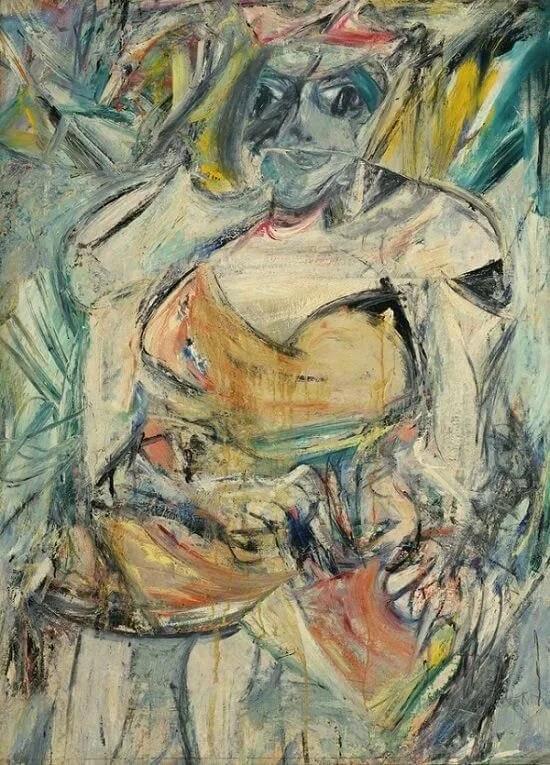
Willem de Kooning, Woman, II, 1952. Oil on canvas. 59 x 43 in. Collection of the Museum of Modern Art, New York.
Aside from Willem de Kooning’s scandalously representational Women paintings, abstract expressionism revealed nothing that anyone outside the artworld could see as political or obscene. By contrast, words were dangerous; they started revolutions. Alan Ginsberg was a subversive Jewish homosexual and self-identified communist. If non-representational paintings were politically harmless, then Ginsberg transgressed and shocked through poetry, an artform that was accessible to anyone who could read. A farm boy in Iowa and a housewife in Dallas could read Howl as easily as any beatnik in New York. Worse still, what would they do under its influence? Would the housewife leave her family and join a collective in Vermont? Would the farm boy abandon football and run off to San Francisco to smoke pot and sleep with men? What horrors could a syncopated poem full of references to mental illness, sex, racial injustice, and anti-capitalist sentiments unleash? The questions have remained open since the 1950s. They inform the Culture Wars, and they hold open the door to autocracy.
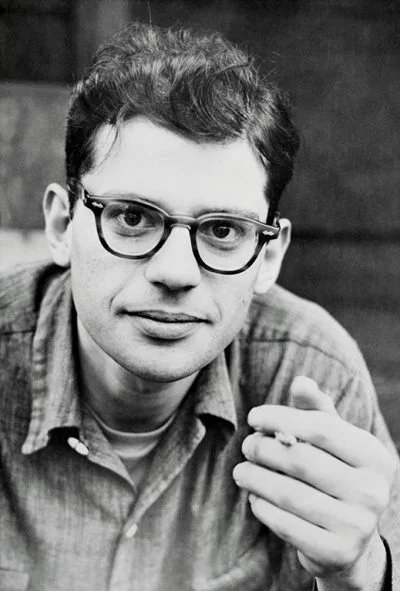
Allen Ginsberg
The cultural, moral, and ideological rot that empowered the current administration has not gone away. It will never go away. In fact, it has always been part of the national fabric. Nor does it belong exclusively to one side or one society. Its names and faces are as varied as the Inquisition, Bolshevism, and Nazism. The constant in all cases is the imposition of a totalitarian will. As Albert Camus and Hannah Arendt understood, that constant, that danger is inseparable from humanity. If the United States has any chance of surviving it, then the American people, beginning with artists and intellectuals, need to look in the mirror and gaze upon their will to resentment and intolerance lest they become the thing they appear to have defeated; lest they fall prey to the tyranny of hope.
