
Emotional Awareness in Giovanni Agostino da Lodi: Between Leonardo and Caravaggio
By Franco Moro
We have known since the philosophical treatises of ancient Greece how the attention of the most perceptive interpreters was directed toward the search for the mimesis of nature, through the differing reflections that, from Plato to Aristotle to Socrates, shaped artistic orientations - toward that expressive interpretation of truth which centuries later flowed into Florentine humanistic culture and was summarized in the breadth of subjects addressed in the works of Leon Battista Alberti.[1]
Within that crucible of fervent minds that shaped the “Renaissance,” inspiring Brunelleschi, Donatello, and Masaccio, Filippo Lippi and Verrocchio, and, through the interpretations of Piero della Francesca and Bramante, soon fermenting in Leonardo the many facets surrounding this specific theme, meticulous attention to the observation of nature was present in all its aspects.[2]
The research carried out in the figurative arts by the young Leonardo indicates how highly sought after and decisive emotional capacities - understood as sensitivity - were at that time in order to express oneself most effectively and achieve such results. It was a vision of nature closely read and interpreted through the perception of states of mind and human feelings.[3]
The expressive capacity of such actions, gestures, and sensations is exemplified in the protagonists of the youthful Adoration of the Magi (Florence, Galleria degli Uffizi), begun for the high altar of San Donato a Scopeto, a church outside the walls of Florence, and left unfinished upon his departure for Milan (late 1481).[4]
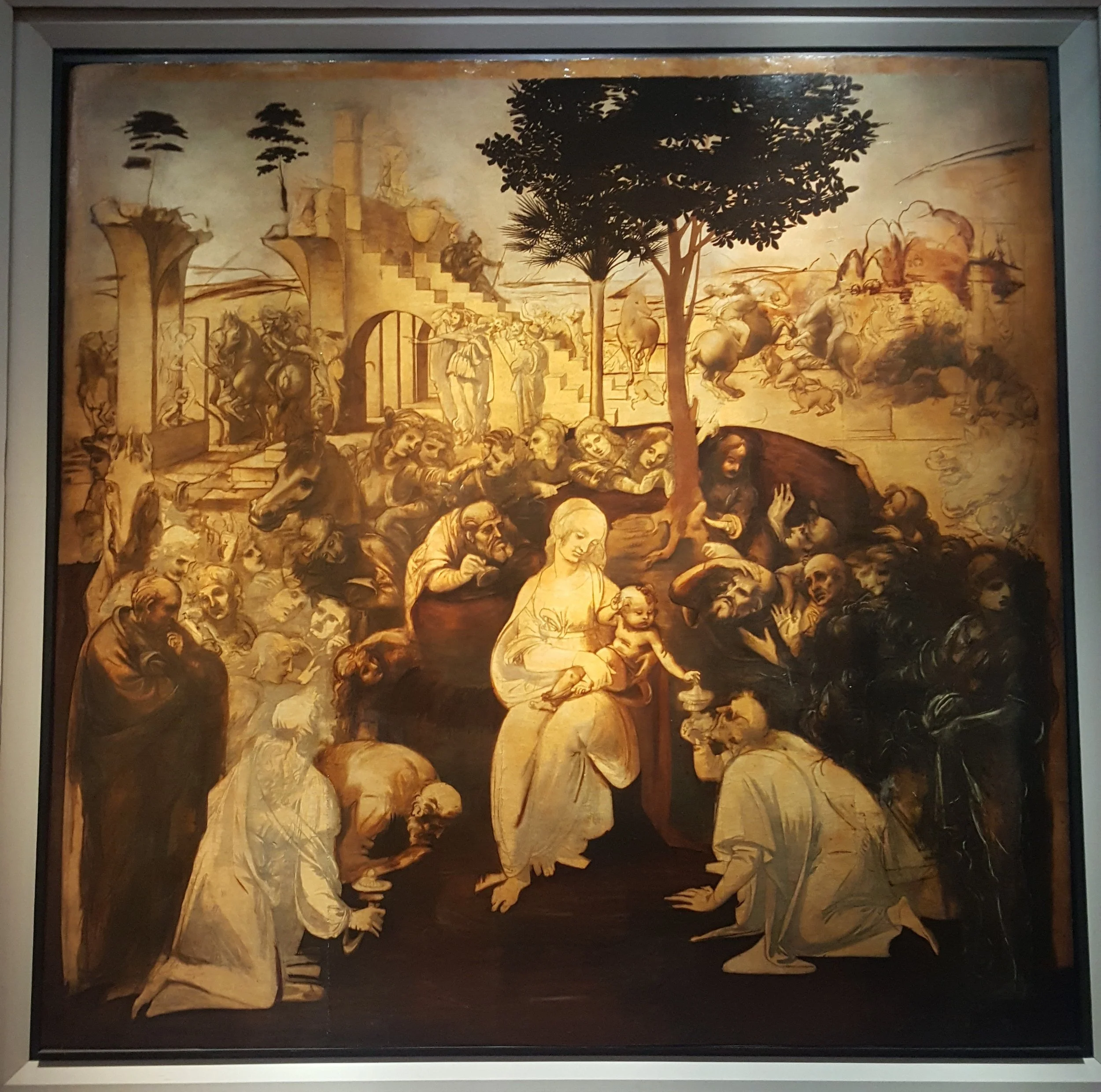
Leonardo Da Vici, “Adoration the Magi” (Unfinished, 1481), Florance.
These values were later exhibited by the mature Leonardo in the succession of faces - of differing personalities - represented in Leonardo’s The Last Supper in the Milanese convent of Santa Maria delle Grazie and lyrically conveyed through several Studies of Heads (Windsor Castle, Royal Library /pl. 2/, and Budapest, Szépművészeti Múzeum). These explicit intentions are also present in the Portrait of a Musician (Milan, Pinacoteca Ambrosiana), the Portrait of Cecilia Gallerani with an Ermine (Kraków, Czartoryski Museum) /pl. 3/, and the Belle Ferronnière (Paris, Musée du Louvre), the ultimate goals of a journey oriented toward cultivating the capacity to understand and communicate the profound mysteries of human psychology. While Michelangelo Buonarroti devoted his attention to a more radical reading of the forms of the human body, Leonardo drew from the expressive soul the sensations of shifting inner states, which only the face can capture and convey.
Such an awareness of outcomes logically led the artist to focus on multiple variations of the theme and its different interpretations leading to the exaggerated characterization of faces, even to the point of playful caricature, as in the Five Grotesque Heads (Windsor Castle, Royal Library, The Royal Collection no. 12495).
Studies of Heads (Windsor Castle, Royal Library).
Research and reflections addressed not only the depiction of emotional states but also the expressive responses to discomfort and shielding from light, the impact of pain, and the display of anger or strength - attitudes vividly captured in the whirling combatants of the lost Battle of Anghiari at Palazzo Vecchio in Florence.
These subjects were masterfully conveyed by Leonardo’s most sensitive Milanese followers, Giovanni Antonio Boltraffio and Giovanni Agostino da Lodi, seen in their painted and drawn portraits. Among the pupils who, during Leonardo’s nearly two decades in the capital of the Sforza duchy, were able to apprehend his defining values, undertaking a journey from the Vincian sensibility to the depths of our own experience, Boltraffio was influenced by the master’s teachings, while Giovanni Antonio was inspired by Leonardo’s illuminating experiments. Likely beginning with the Portrait with a Fur-Trimmed Coat (Milan, Pinacoteca di Brera),[5] Boltraffio quickly proved the keenest talent among the small group of devoted adepts, assiduous followers of the innovative genius, whereas Giovanni Antonio showed the greatest predisposition to pursue the path of sensitivity, as evidenced by the silverpoint sheets with white highlights in the Musée du Louvre (Département des Arts Graphiques), including the Study of a Frowning Head (inv. no. 2416).
Reaching the absolute heights in the use of colored pastels, as demonstrated by the Portrait of a Young Woman Seen from the Front, the Portrait of a Young Boy with a Hat Seen in Three-Quarter View (plates 4–5), and the Portrait of a Man Crowned with Ivy Leaves (Milan, Biblioteca Ambrosiana), the latter entirely in harmony of intent with one of his paintings, the Portrait of a Young Man with His Hand Resting on a Skull (Milan, Pinacoteca di Brera), these works may well have caught the eye of the young Merisi, serving as inspiration for his graphic work, which reached examples of at least equal quality.[6] A similar attentiveness is evident in the study for the Portrait of a Woman of the Pandolfi Family (Florence, Gabinetto Disegni e Stampe degli Uffizi, inv. no. 17184), closely related to the profile effigies of Francesco Pandolfi and Gerolamo Casio, at the margins of the Casio Altarpiece (Paris, Musée du Louvre).
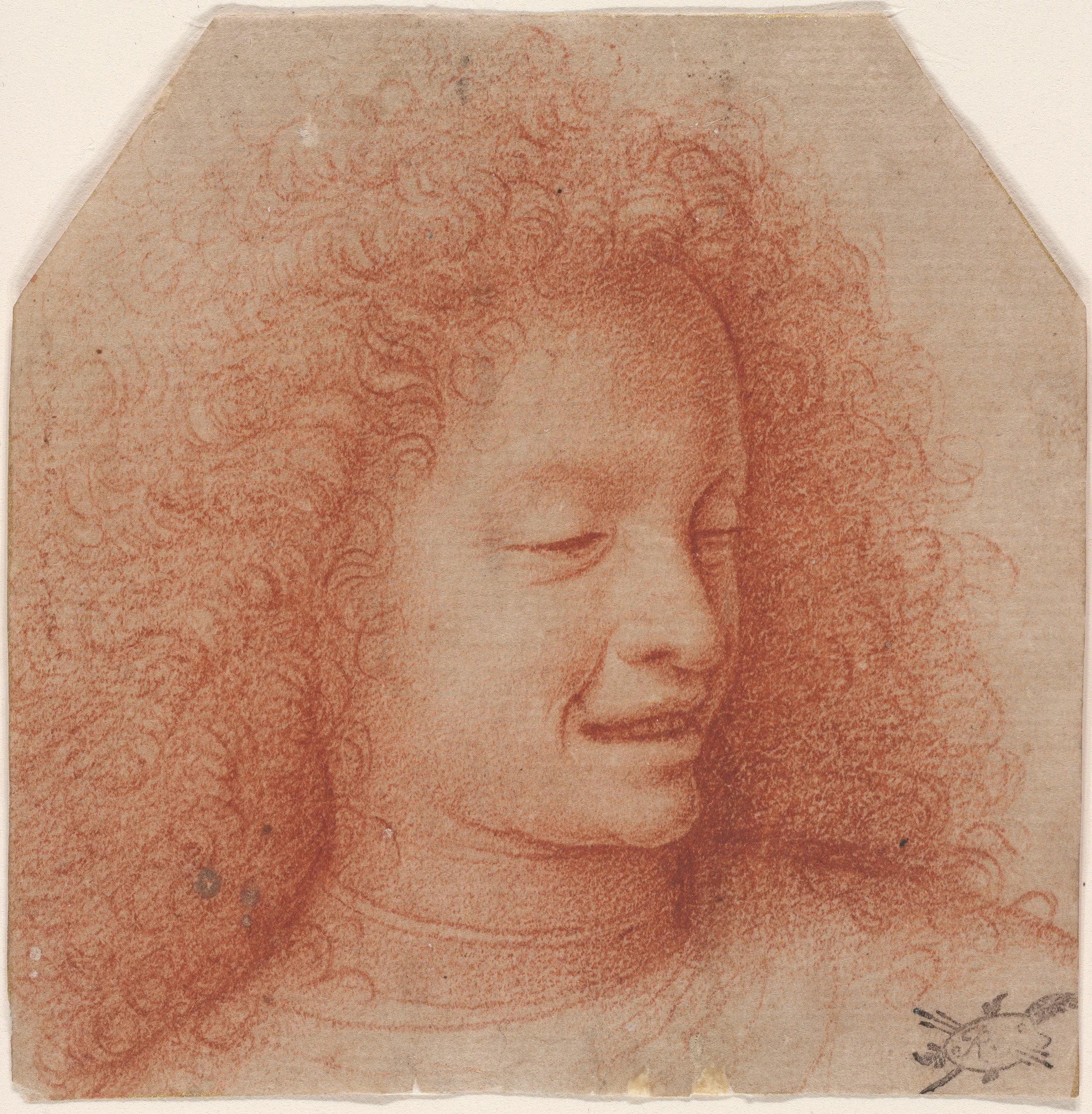
A different approach is evident in the mysterious painter who, through the study of his drawings and the interpretation of his reconstructed trajectory, will shortly be the subject of a systematic study by this author, summing up his significance. Likely originally from Lodi, but active between Milan and Venice, Giovanni Agostino mostly directs his attention, toward aspects that are more unusual, acute, and incisive,[7] mostly but not exclusively in small-format studies in red chalk, aimed at reproducing ideas and suggestions useful for pictorial application. Subtle and ethereal emotions of a varied panorama of faces, distinguished by the whimsicality of their hair, as in the case of the Study of a Smiling Young Head with Curls (Cambridge, MA, Harvard Art Museums, Fogg Art Museum, inv. 1965.393) (plate 6), or the Portrait of a Young Man Turned Three-Quarters to the Right with Disheveled and Flowing Hair (Paris, Musée du Louvre, Cabinet des Dessins, inv. no. 2252) the dense cloud of hair framing the face characterizes both studies of an extremely expressive visage. Like a bristly, thorny bush, the voluminous hair serves to best highlight chromatic and tonal values that would otherwise remain elusive. The meticulous, precise, and incisive analysis demonstrates, with singular frankness, adherence to the narrative approach established by Leonardo in Milan, carried out through the use of red chalk to a degree of naturalism that becomes even clearer when compared to the northern European approach to expression. The drawing stands as a significant precursor to the investigative process culminating in the larger sheet depicting the Study of a Facial Expression Contorted in a Grimace (London, British Museum, 1895, 0915.481) (plate 7),[8] attributed for decades to Giovanni Agostino.
The physiognomic investigation represents a personal response to the character heads derived from the Last Supper and Leonardo’s graphic studies,[9] and the expression shows significant points of contact with those of the Men-at-Arms of the Panigarola household, particularly with the furrowed face of the weeping Heraclitus, reflecting the formative references of the Lodi painter’s early education, Bramantino and Leonardo.
The London sheet is by no means isolated within the context of the Lodi painter’s artistic production, relating to the sequence of expressive faces painted in the Washing of the Feet (Venice, Galleria dell’Accademia) of 1500, particularly the two younger Apostles and the bearded one in profile, all on the right side of the painting. The same applies to the intense physiognomies of the figures in the Supper at Emmaus (private collection), which are likewise the result of an interpretative transposition of direct observation of nature. A common denominator links this repertoire of character’s expressions with Leonardo’s innovative proposals, as the portrait in the British Museum reflects that type of personal reading of the sitter characteristic of Giovanni Agostino. Relevant examples of small-format works in this regard include the Portrait of a Young Girl Seen from the Front (Milan, Biblioteca Ambrosiana, Cod. F. 274 inf. 4) and the two studies, Bearded Male Head in Profile Turned to the Right and Young Male Head in Profile Turned to the Left (New York, The Pierpont Morgan Library, 1973.35.1 and 1973.35.2).[10]
The outline of the face, for the most part perforated for the transfer of the profile, is a logical indication of its function as a preparatory study for the head of a figure squinting due to a strong light source or a sudden ray of sunlight. This expressive investigation is analogous to that undertaken by Giovanni Agostino himself, with a playful gaze and lively, spirited irony, in the sheet depicting the Profile of a Man with Windblown Hair (Paris, Fondation Custodia, inv. no. 471) (plate 1).[11] This is yet another example by the Lodi - born artist, a testament to his keen and curious eye for unusual natural details - such as a sudden gust of wind lifting the hair at the nape of the neck. Giovanni Agostino goes beyond portraying a grotesque face, as earlier cataloguers assumed; he captures in a single instant a naturalistic depiction of an event truly witnessed. Here, we are confronted with the birth of the photographic idea: the snapshot of a real moment, genuinely observed, striking in its uniqueness and chosen precisely for that reason.
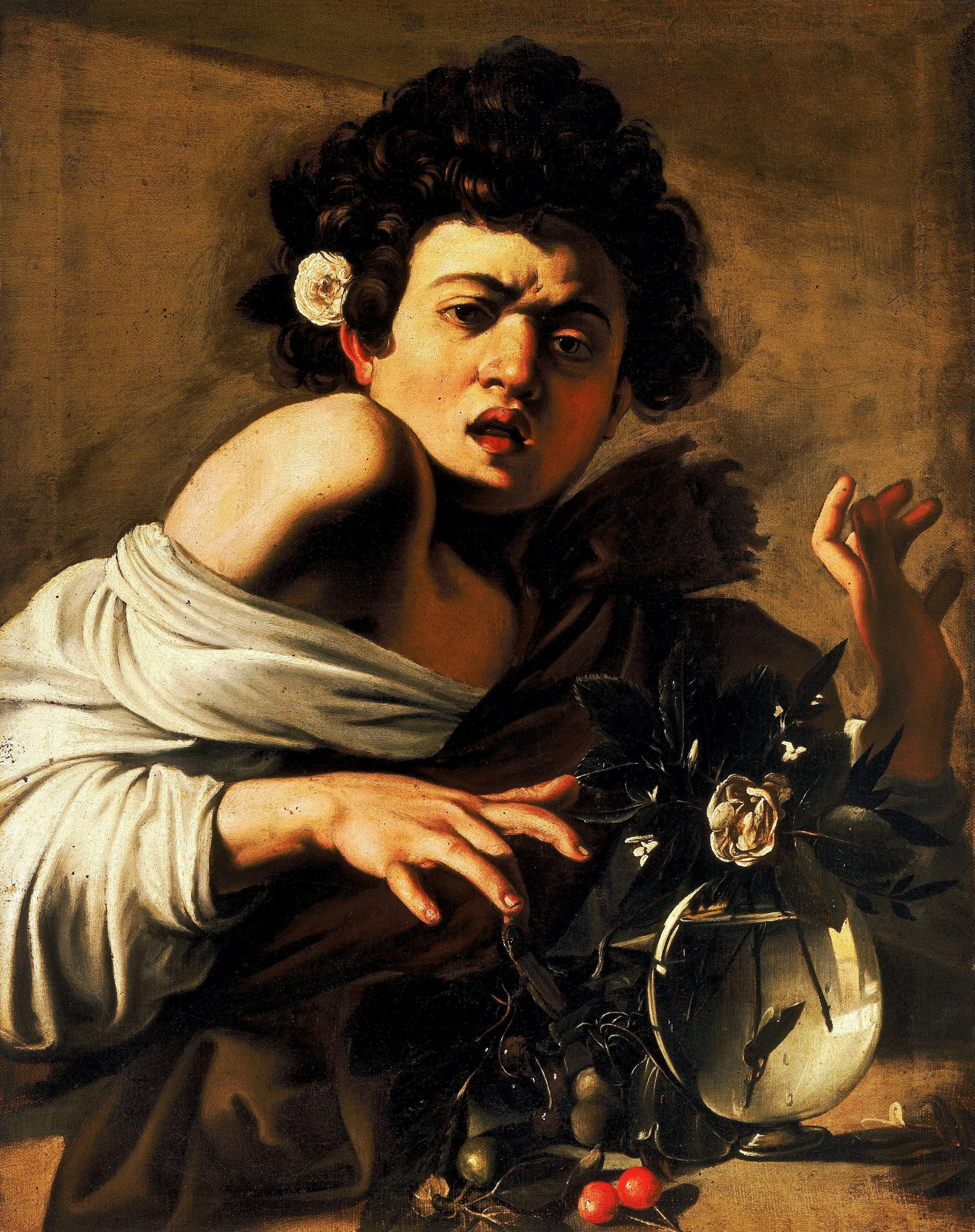
Caravaggio, “The Boy Bitten By a Lizard”, 1594, National Gallery London.
Shared interests that foreshadow what captivated Michelangelo Merisi can be seen in the experiments documented in his early Roman works, such as The Boy Bitten by a Lizard (Florence, Fondazione Longhi / plate 8 / and London, National Gallery) and the so-called Boy with a Vase of Roses (known through copies in Atlanta, High Museum of Art, and a private collection). We will soon have the opportunity to appreciate the autograph version in a far more insightful reading, as in The Boy Pricked by the Thorn of an Artichoke,[12] continuing in a vision focused on a single protagonist, leading up to the Shield with the Head of Medusa (Florence, Uffizi Gallery).[13] This reflects the exploration of expressive states linked to human reactions to embarrassing situations, equally present in the more complex compositions of the Bari (Fort Worth, Kimbell Art Museum) and in the two versions of The Good Fortune (Paris, Musée du Louvre, and Rome, Capitoline Gallery), aimed at highlighting surprise, naivety, and deceit.
It is highly plausible that, beyond Leonardo’s Treatise on Painting, this stimulating line of inquiry surfaced in the debates and recollections of Milanese artists, encompassing the variety of lively examples circulating among members of the so-called ‘Carbonara’ association of irreverent creators, inspired by the memory of Leonardo’s works, which took the singular name of Accademia dei Facchini della Val di Blenio.[14] This is confirmed, in a sense, through the variations applied in the edifying fables narrated in the drawings of the young Sofonisba Anguissola, who, as we know, produced two examples extremely relevant to the development of the subject summarized here: Old Woman Studying the Alphabet Ridiculed by a Young Girl (Florence, Uffizi, Cabinet of Drawings and Prints), but above all regarding the effect of pain, Girl with Young Asdrubale Bitten by a Lobster (Naples, Museo di Capodimonte),[15] encounters which would stimulate the curiosity of the attentive Michelangelo in that crucible of impulses radiated by the city’s artistic environment. The pursuit of human knowledge also poured into the young talent of Merisi during his formative Milanese years, encouraged by the teachings of Peterzano, the study of influential manuals such as the aforementioned Treatise by Leonardo, the writings of Lomazzo, and Bernardino Campi’s Parere sopra la pittura (1584), as well as by his interactions with Giovanni Ambrogio Figino and the city workshops where the Campi brothers were active. In particular, Antonio provided guidance in the conquest of spatial composition, while Vincenzo nurtured his interest in naturalistic arrangements, which intertwined closely with his Roman inventions, further inspired by Giuseppe Arcimboldi’s return to the city.
The London sheet of drawings by Giovanni Agostino da Lodi, complemented by the Parisian one and the meticulous studies he conducted on expressions constitute a true unicum in the journey toward the expressive representation of human inner states -qualities equally recognized in Merisi, as noted by the poet Giovanni Battista Marino (Naples, 1569-1625) in the sonnet Sopra il proprio Ritratto dell’ Autore di mano di Michelangelo da Caravaggio.[16] In it, Marino emphasizes how “Caravaggio’s pursuit in portraiture moved precisely in the direction of depicting the personality rather than the person.”[17] This subtle distinction presupposes Michelangelo’s ability to go beyond the barrier of the visible, of apparent exteriority, to grasp what the poet Marino calls the “other self”—that fascinating part of us, hidden and sometimes deliberately concealed, which accompanies our perception and resonates with the precociously Freudian vision of our Merisi.
*The present text is the translation of the essay published in the Raccolta di Studi di Storia dell’Arte “Filo d’Arianna”, II, marzo 2025, pp. 9-16.
[1] Within the vast bibliography concerning the debate, only a few references are suggested here: N. Dacos, Arte italiana e arte antica, in Storia dell’arte italiana. Materiali e problemi, Torino 1979, pp. 3-68; Alberti e la cultura del Quattrocento, Atti del Convegno internazionale di Studi, (Florence, Palazzo Vecchio, 16-18 December 2004), edited by R. Cardini and M. Regoliosi, Florence 2007; Pietro Bembo e l’invenzione del Rinascimento, exhibition catalogue, edited by G. Beltramini, D. Gasparotto, and A. Tura, Padua 2013; G. Busi, Presentazione a Leon Battista Alberti, in Cantieri dell'Umanesimo, in Cantieri dell’Umanesimo, Milan 2023. The theme was summarized in a recent Paris exhibition, L’invention de la Renaissance. L’humaniste, le prince et l’artiste, sous la direction de J.-M. Chatelain and G. Toscano, Paris 2024.
[2] F. Zeri, Rinascimento e Pseudo-Rinascimento, in Storia dell’arte italiana. Dal Medioevo al Quattrocento, Turin, 1983, pp. 543–572; P. L. De Vecchi, La mimesi allo specchio, in Giovanni Gerolamo Savoldo tra Foppa, Giorgione e Caravaggio, exhibition catalogue (Brescia), edited by B. Passamani, Milan, 1990, pp. 59–64; Id., Raffaello. La mimesi, l’armonia e l’invenzione, Florence, 1995; M. J. E. van den Doel, Ficino and Fantasy: Imagination in Renaissance Art and Theory from Botticelli to Michelangelo, Leiden-Boston, 2022.
[3] Within the vast range of topics he addressed, I shall limit myself to recalling the research carried out on affective manifestations: A. Chastel, Le Madonne di Leonardo, XVIII Lettura Vinciana, Vinci, Biblioteca Leonardiana, 15 April 1978, published in Florence, 1979, pp. 1-24; F. Moro, Spunti sulla diffusione di un tema leonardesco tra Italia e Fiandra sino a Lanino, in I leonardeschi a Milano: fortuna e collezionismo, atti del convegno edited by M. T. Fiorio and P. C. Marani, Milan, 1991, pp. 120-140.
[4] The restoration of Leonardo da Vinci’s Adoration of the Magi: rediscovering a masterpiece, edited by M. Ciatti e C. Frosinini, Florence 2021.
[5] Dated by A. Ballarin (Leonardo a Milano. Problemi di leonardismo milanese tra Quattrocento e Cinquecento. Giovanni Antonio Boltraffio prima della pala Casio, with the collaboration of M. Menegatti and B. M. Savy, Verona 2010) to the early years of the last decade (circa 1491). In a thoroughly commendable reconstruction of Boltraffio’s personality, in relation to the Vincian master and his companion Marco d’Oggiono, it is striking that the Head of the Young Christ (Madrid, Museo Lázaro Galdiano) is attributed to Giovanni Antonio, when it would be more appropriate to recognize, at this date, the contribution of some Spanish artists residing with Leonardo. I assert this not because of the current location of the work, but due to an expressive intensity that does not seem to correspond to Boltraffio’s graphic training and natural gentleness, when compared to an interpreter certainly skilled but considerably more acerbic, dry, and cold in the handling of tonal gradation - closer, in fact, to the innovations of Bramantino, albeit rendered with a sensibility extremely attentive to Vincian light and tonal values. This points to a foreign painter, likely Iberian, attentive to the best proposals emerging in Milan during the last decade.
[6] F. Moro, Caravaggio sconosciuto. Le origini del Merisi, eccellente disegnatore, maestro di ritratti e di “cose naturali”, Torino 2016, pp. 80-109.
[7] His youthful Lombard training, between Lodi and Milan, is evident in his interests in the figurative context of the late fifteenth century, the creations of Foppa and Bergognone, and the works carried out at the Certosa di Pavia, as well as in his more than likely acquaintance with Bramantino and his engagement with aspects here noted and further developed in relation to Leonardo, either before or concurrently with his Venetian stay at the end of the fifteenth century: F. Moro, I pittori Martino e Albertino Piazza da Lodi, master thesis, Università degli Studi di Milano, academic year 1984-’85; Idem, 1487 and more, in Pittura tra Adda e Serio. Lodi Treviglio Caravaggio Crema, Cinisello Balsamo (Mi) 1987, pp. 21-24, 102-104; Idem, Giovanni Agostino da Lodi, in La pittura in Italia. Il Cinquecento, Milano 1987, II, pp. 731-732; and others who put forward various hypotheses.
[8] F. Moro, Giovanni Agostino da Lodi ovvero l’Agostino di Bramantino: appunti per un unico percorso, in “Paragone”, July 1989, pp. 23-61, tavv. 26-53, in particular p. 26, tav. 28.
[9] M.W. Kwakkelstein, Leonardo da Vinci as a Physiognomist. Theory and Drawing Practice, Leiden 1994, pict. 84.
[10] G. Bora, Per un catalogo dei disegni dei leonardeschi lombardi: indicazioni e problemi di metodo, in “Raccolta Vinciana”, XXII, 1987, pp. 145-150.
[11] Published in black and white to support a study devoted to a different subject: F. Moro, Note su Marco d’Oggiono, discepolo di Leonardo, in “Lecco economia”, Lecco 1990, pp. 42-47.
[12] This is a painting that has been kept for at least a century in a Parisian apartment as a completely anonymous work, unknown and considered worthless. I was the first person to whom the painting was shown for examination and to provide a personal assessment. This took place in Paris on November 6, 2023, and in the following days. The guidance provided was decisive in directing the work toward the attribution to the long-lost autograph of Merisi.
[13] In the extensive bibliography on Caravaggio, I mention only a few indicative texts: R. Longhi, Mostra del Caravaggio e dei caravaggeschi, exhibition catalogue, with the collaboration of C. Baroni, G. A. Dell’Acqua, M. Gregori, F. Mazzini (Milan), Florence 1951; L. Spezzaferro, La cultura del cardinal Del Monte e il primo tempo del Caravaggio, in Storia dell’Arte, 9-10, 1971, pp. 57-92; M. Calvesi, La realtà del Caravaggio, Turin 1990; M. Cinotti, Caravaggio, la vita e l’opera, Bergamo 1991; Michelangelo Merisi da Caravaggio. Come nascono i Capolavori, exhibition catalogue (Florence-Rome), edited by M. Gregori, Milan 1991; M. Marini, Caravaggio «pictor praestantissimus»: l’iter artistico completo di uno dei massimi rivoluzionari dell’arte di tutti i tempi, 3rd revised and updated edition, Rome 2001; S. Macioce, Michelangelo Merisi da Caravaggio. Documenti, fonti, e inventari 1513-1883, 3rd updated edition, Rome 2023.
[14] Gian Paolo Lomazzo, Trattato dell’Arte della pittura (1584), in Scritti sulle arti, edited by R.P. Ciardi, Florence 1973-74; idem, Rabisch dra Academiglia dor compa Zavargna nabad dra Vall d’Bregn, Milan 1589 (modern edition edited by D. Isella, Turin 1993); Rabisch. Il grottesco nell’arted el Cinquecento. L’ Accademia della Val di Blenio, Lomazzo e l’ambiente milanese, exhibition catalogue (Lugano), edited by G. Bora, M. Kahn-Rossi, and F. Porzio, Milan 1998, in particular D. Isella, Per una lettura dei Rabish, pp. 111-119; D. Isella, Lombardia stravagante, Turin 2005.
[15] G. Bora, in I Campi. Cultura artistica cremonese del Cinquecento, catalogo della mostra (Cremona) edited by M. Gregori, Milano 1985, pp. 301-302.
[16] As an example of Michelangelo’s sensitive quality, I refer to Study of the Portrait of a Young Girl with Her Hair Gathered by a Cloth (Milan, Biblioteca Ambrosiana) /fig. 9/, one of the most significant examples of his rediscovered graphic activity. For a recent examination of this aspect, of Merisi’s Lombard training, with new insights and observations in relation to previous literature, and for the value of his interpretative ability regarding the different personalities studied, see: F. Moro, op. cit., 2016, pp. 18-49, 55, 81-109.
[17] L. Spezzaferro, La cultura del cardinal Del Monte e il primo tempo del Caravaggio, in “Storia dell’Arte”, 1971, 9-10, pp. 80-81.
