
Caravaggio - A New Film
Review by Jeanne Stanek
Michelangelo Merisi da Caravaggio, an esteemed and bad boy artist (un ragazzaccio), was sailing on his way to Rome. This was 1610 and Caravaggio was desperate to return to his beloved Rome. He had been to Naples, Malta, and Sicily living in exile since murdering Ranuccio Tomassoni in 1606, but powerful patrons were finally close to securing him a papal pardon.
He was carrying several paintings—likely intended as gifts to influential Cardinals who could help finalize his forgiveness. He landed at Palo, near Rome, where things went badly wrong. Caravaggio was mistakenly arrested (possibly due to confusion over his identity or outstanding warrants). While he was detained, the boat carrying his paintings sailed on without him, taking his possessions with it. Once released, he set off on foot along the coast, trying to catch up with the boat and recover his works. Already weakened, his health rapidly deteriorated. He reached Porto Ercole, where records indicate he fell ill with a high fever and died on July 18th. What became of the pardon he sought so desperately? Sadly, it appears to have been granted just days after his death.
This is the story of Caravaggio, a British film released in November 2025 directed by David Bickerstaff and Phil Grabsky and starring Jack Bannell as Caravaggio. Unlike the 1986 fictionalized, historical drama Caravaggio film directed by Derek Jarman, this 2025 film is a drama-documentary covering Caravaggio’s life. While not a cradle to grave biopic, the film mostly focuses on art historians discussing Caravaggio’s paintings with some dramatized episodes where Caravaggio talks about his life directly to the audience.
It is a brooding, visually sumptuous portrait of the artist who lived as violently and brilliantly as he painted. Depicting the moral chaos of Caravaggio’s world, capturing the tension between divine inspiration and earthly excess that defined his life, the central character’s performance is intense and unsparing. Caravaggio is not romanticized nor reduced to a caricature of a tortured artist. He is presented as volatile, charismatic, devout, profane, and human. While the film does mention his committing murder, it does not stress his violence or self-destruction. Rather it deals with his obsessions with faith, flesh, guilt and redemption and with emotional truth.
When Caravaggio died, he left no workshops, no pupils, and no orderly legacy. He was originally remembered as violent, unstable, and criminal. Most of what is known about this art world’s bad boy (un ragazzaccio) comes from about 100 court records and, of course, from his paintings. The cinematography lovingly caresses Caravaggio’s paintings. Faces emerge from darkness, candlelight trembles against stone walls, and bodies are sculpted by shadow. The paintings seem to come alive, leaping forward from a completely black background. The saints are not already in heaven with heavenly backgrounds but rather present as human beings struggling and hoping for God’s mercy and grace.
Caravaggio was not only an artistic genius but also an intellectual. Each of his later paintings is like a poem. David with the Head of Goliath does not want to be rushed. Most of the canvas is in darkness but is not emptyness. It presses the figures forward. David is not saintly. He has just done what he had to do. He is young, almost fragile. He does not stand tall after his victory. He is not yet a hero. There is no God in the sky, only two figures and the consequences of an act. David looks at the head with pity. Not disgust but pity. This is God’s mercy.
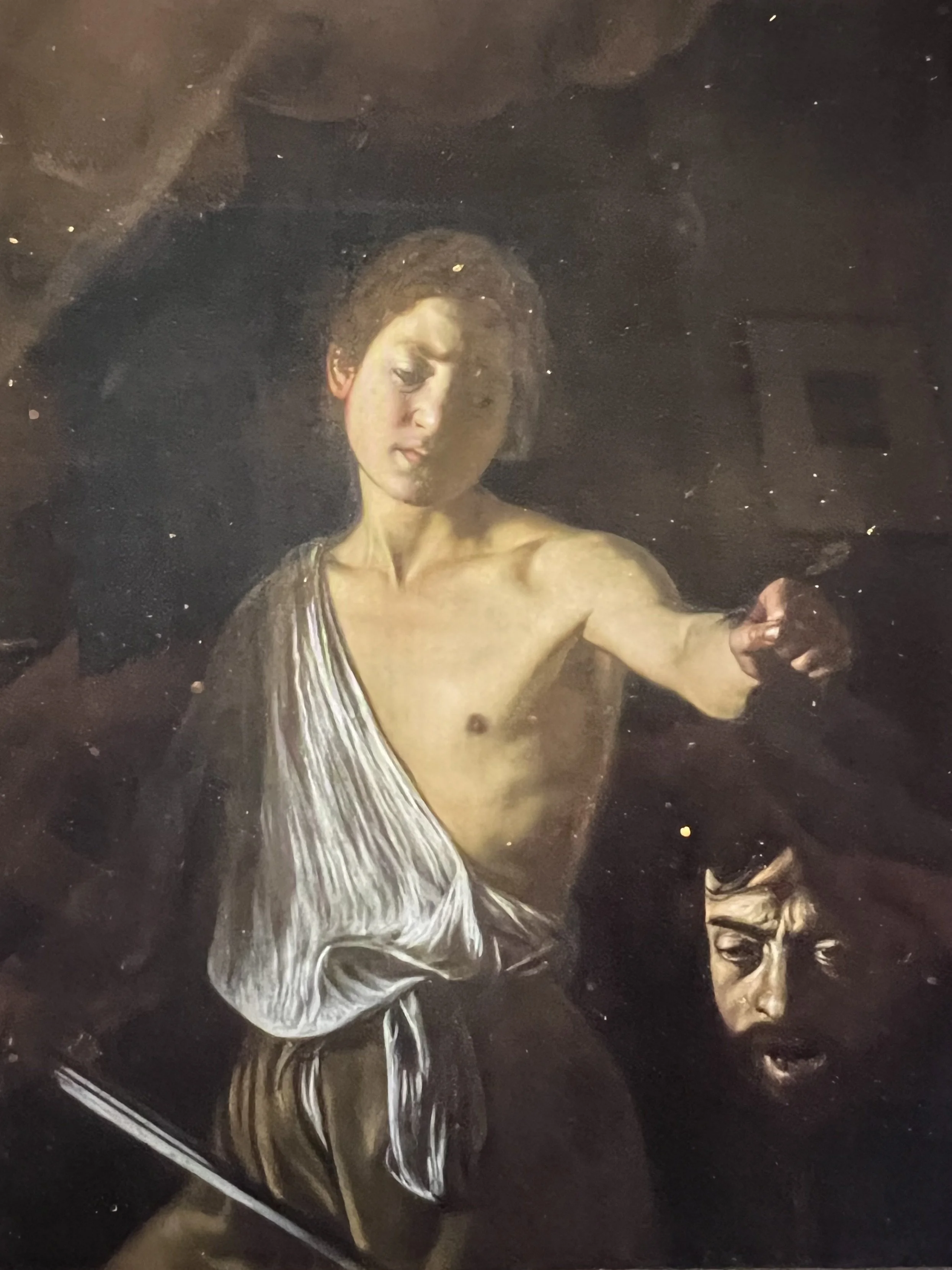
Caravaggio, “David With The Head of Goliath”, 1609-10, Galleria Borghese, Rome.
Caravaggio died believing himself hunted, disgraced, and unfinished. Yet within decades, his revolutionary use of extreme chiaroscuro transformed European painting.
As artists across Italy, Spain, France, and the Netherlands became known as “Caravaggisti. Today, he is considered one of the most influential painters in Western art, despite—or perhaps because of—his violent, volatile life.
Ultimately, Caravaggio is not an easy watch. It is dark and unapologetically serious. This film lingers in the mind long after the screen fades to black.
