
A fourth-generation Washingtonian's tour
By Lanita K. Brooks Colbert, Tour Guide
I'm a fourth-generation Washingtonian. Four generations of my family have lived, worked, worshipped, and danced in this city. That's a rarity now, and I don't say it to brag. I say it so you know I'm not reading this off a plaque. When I tell you about this music, I'm telling you about the soundtrack to my family's life.
My people have always said Washington, D.C., with respect. It's Washington, D.C. Not "the DMV," not "the District". That's the name on our family history, and it's the name I use. You'll also hear me say "The 202." That's our area code, and in this city, we wear it like a badge of honor.
“Chocolate City“ is the name the world gave us. “The 202” is the name we gave ourselves. One is a nickname that celebrates who we were as a Black city with power and style. 202, our area code; the three digits we say to tell people exactly where we're from. Together they say the same thing: this is home, and we claim it. And you can hear it in the music. Every club, every cowbell, and every shout-out to a neighborhood is a way of saying "The 202" out loud.
The best-known cultural nickname for Washington, D.C. is “Chocolate City.” It comes from Parliament’s 1975 song and album of the same name. It celebrated D.C. as a majority-Black city with deep political, cultural, and musical power. After the Civil War, in the 1880’s with the arrival of the Washington D. C. streetcar system, Shaw was shifting to a predominantly African American neighborhood. Between 9th Street and 15th Street, from the 1920’s – 1960’s, the U Street corridor was known as “Black Broadway”, a phrase coined by singer, Pearl Bailey. During that era, the local clubs hosted performers, Cab Callaway, Louis Armstrong, Miles Davis, Sarah Vaughan, Billie Holiday, and more.
Duke Ellington came up in this city, and he was far from alone. Washington, D.C. has been home to many jazz pioneers, including singer and pianist Shirley Horn, pianist Billy Taylor, and saxophonist Frank Wess. The Howard Theatre and the clubs along the corridor gave Black artists a stage when much of the country gave them a back door. My elders didn't have to be told that Black music was serious art. Generations before me, our people built a community here that had everything: our own theaters, our own businesses, our own schools, our own stars.
Now, on a warm evening, you can walk U Street and hear the whole story at once. A saxophone drifts out of a doorway. A cowbell cuts through the air from a passing car. Somewhere a young MC is trading bars with a conga player. Three genres with three separate histories, and here they act less like neighbors than like cousins at the same cookout. They share ancestors, rhythms, and the same stubborn belief that the crowd is part of the band.
So, when I say jazz, hip hop, and go-go are family, I'm not being poetic. They all come out of African rhythmic traditions and the call-and-response that has held Black American music together for generations. The preacher calls and the congregation answers. The bandleader shouts and the dance floor shouts back. In jazz, it's the conversation between horn and rhythm section. In go-go, it's the lead talker calling out a neighborhood while the whole room roars it back. In hip hop, it's the MC working the crowd like a conductor.
And go-go, our music, was born with jazz in its blood. The early bands drew on jazz-funk, swing, and big-band horn arrangements. Trumpets and saxophones took complex, jazz-inspired solos over a drum pocket that never stopped. That pocket is our signature: congas, cowbells, and roto toms rolling in syncopation, one song melting into the next, so the party never has to end. When I explain that to visitors, their shoulders start to move. That's how you know it's real.
I can't give the tour and tell this story without Chuck Brown. We call him the Godfather of Go-Go, and nobody around here argues about it. He's credited as the architect of that unbroken pocket. But what I make sure everyone understands is that Chuck was a jazz and blues guitarist first, and he never forgot it. On stage he'd take Louis Armstrong's "What a Wonderful World," or a swing-era standard like "Moody's Mood for Love," and set it down right on top of a heavy go-go groove, talking to the crowd the whole time like an MC. Jazz, funk, and pure showmanship lived together in one set, no apology.
Chuck passed in 2012, and this city felt it in our bones. His family and the Chuck Brown Band still carry the origins forward. The lesson he left us is the one I come back to on every tour: in Washington, you don't pick a lane. You honor everything that raised you, all at once.
The Pocket: Our Signature Sound
Let me explain the pocket, because everything else in this tour grows out of it. The pocket is the go-go beat itself, the groove the rest of the music is built around. It's a syncopated, interlocking pattern: kick drum and snare holding the bottom, with congas, timbales, roto toms, and cowbells weaving in and out on top. It rolls instead of stomps. Once it starts, it doesn't stop. Kip Lornell and Charles Stephenson Jr., who wrote the book on go-go, call it the most important component in the sound. If you've ever felt your shoulders move before you knew the song, you were in the pocket.
So where did it come from? Like most of our best things, it came from many places at once. Chuck Brown played in a Latin band called Los Latinos in the '60s, and he fell in love with the way congas and Latin percussion pushed a groove forward. He folded that together with funk, soul, and jazz. He has also said that part of the beat came from the gospel rhythms found in Black churches. And he had a practical problem to solve. DJs were spinning records and keeping the floor packed, then the live band would stop between songs and lose the room. Chuck's answer was to never stop. He kept the percussion going between tunes, talked to the crowd, and let one song melt into the next. As he put it, the music "keeps going and going." His band, the Soul Searchers, took that idea to the top of the R&B charts in 1978 with "Bustin' Loose." Originating in the 1970s, Go-Go music blossomed in a club called “The Maverick Room” in D.C.’s Edgewood neighborhood with the headliner, Chuck Brown and Soul Searchers.

Chuck Brown, "The Godfather of Go-Go" a subgenre of funk music developed around the Washington, D.C., area in the mid-1970s.
But I'd be telling you only half the story if I said one man built it alone. Go-go was an architecture with many hands. The Young Senators, a Washington band, are credited with an early prototype of the style, with their 1971 release "Jungle." Black Heat and Chuck Brown and the Soul Searchers are among the groups credited with developing most of its hallmarks. Rare Essence carried the beat into the late '70s and helped set the standard for a new generation. Trouble Funk gave us "Pump Me Up" in 1982. E.U., Experience Unlimited, took the pocket to the screen and the world in 1988 with "Da Butt." And bands like Junkyard helped perfect it. Chuck is the Godfather, and we say it with love. But the pocket belongs to all of them, and to every drummer, conga player, and cowbell hitter who kept it alive on a stage in a neighborhood club or a school gym, and then Hip Hop Came Down 1-95.
When hip hop rose out of New York in the late '70s and '80s, we didn't turn it away. We did what Washington does and made it ours. Go-go bands, built on live instruments and heavy percussion, started covering hip hop hits in the middle of their sets. We folded rap into a form that was already built to hold a room.
The bridge is DJ Kool, one of our own, celebrated for connecting go-go culture to hip hop. He took the high-energy, crowd-participation spirit of go-go and carried it into party records. That road led to his 1996 hit "Let Me Clear My Throat," a live Washington party set over a classic breakbeat that carried our energy out to the rest of the country.
And the exchange ran both ways. Producers elsewhere fell for our raw, syncopated drum breaks and cowbell patterns. Salt-N-Pepa's "Shake Your Thang" leaned on E.U., Experience Unlimited, one of our go-go bands. Our call-and-response seeped into party rap and changed how MCs held an audience. When you hear a rapper shout out a crew and the crowd answers, you're hearing a little piece of Washington, whether they know it or not.
Now let me take you to the rooms where it lived, our cultural landmarks, because music doesn't live in the air. It lives in rooms. And Washington, D.C. had rooms, more than most cities could dream of. Let me take you back to the 1970’s and 80’s, when our jazz clubs were still the heartbeat of the night. A musician could climb the steps of one club, play the late set, and walk down the street to sit in at another. That's a whole ecosystem, a city that treated live music as part of daily life.
Let me say some of those names out loud, because names are how we keep the departed with us. The Place Where Louis Dwells. One Step Down. The Pigfoot. Etcetera. Mr. Henry's. Pirate's Hideaway. Say them slowly. Each one was somebody's first gig, somebody's date night, somebody's regular stool at the end of the bar. When I say these were landmarks, I don't mean they have a historic plaque out front. Most don't. I mean they were landmarks in our lives, the places our parents and grandparents navigated by.
And I must pause on Mr. Henry's, because of the soft sounds that came out of that room. Roberta Flack was the house pianist there before the world knew her name. A Washington teacher and Howard-trained musician by day, she sat at that piano at night and played with a tenderness that made a noisy room lean in. The Grammy-winning recording artist the world came to love for "The First Time Ever I Saw Your Face" and "Killing Me Softly with His Song" found her voice right here in the 202. Her sound is proof that Washington's music could be quiet and powerful at the same time. Not every stage needs a cowbell or a shout-out. Sometimes the city says its truest things in a whisper.
And you can't speak of soft sounds with a conscience without saying the name Marvin Gaye. He was born right here, a Washingtonian, and he carried this city's church-raised voice all the way to Motown. In 1971 he gave the world What's Going On, one of the great studio albums in American music. It started with a protest. Renaldo "Obie" Benson of the Four Tops had watched police turn on anti-war demonstrators in Berkeley, California, on what became known as "Bloody Thursday," and it shook him. He brought the idea of a song asking what was going on in the world to Marvin, and Marvin made it his own.
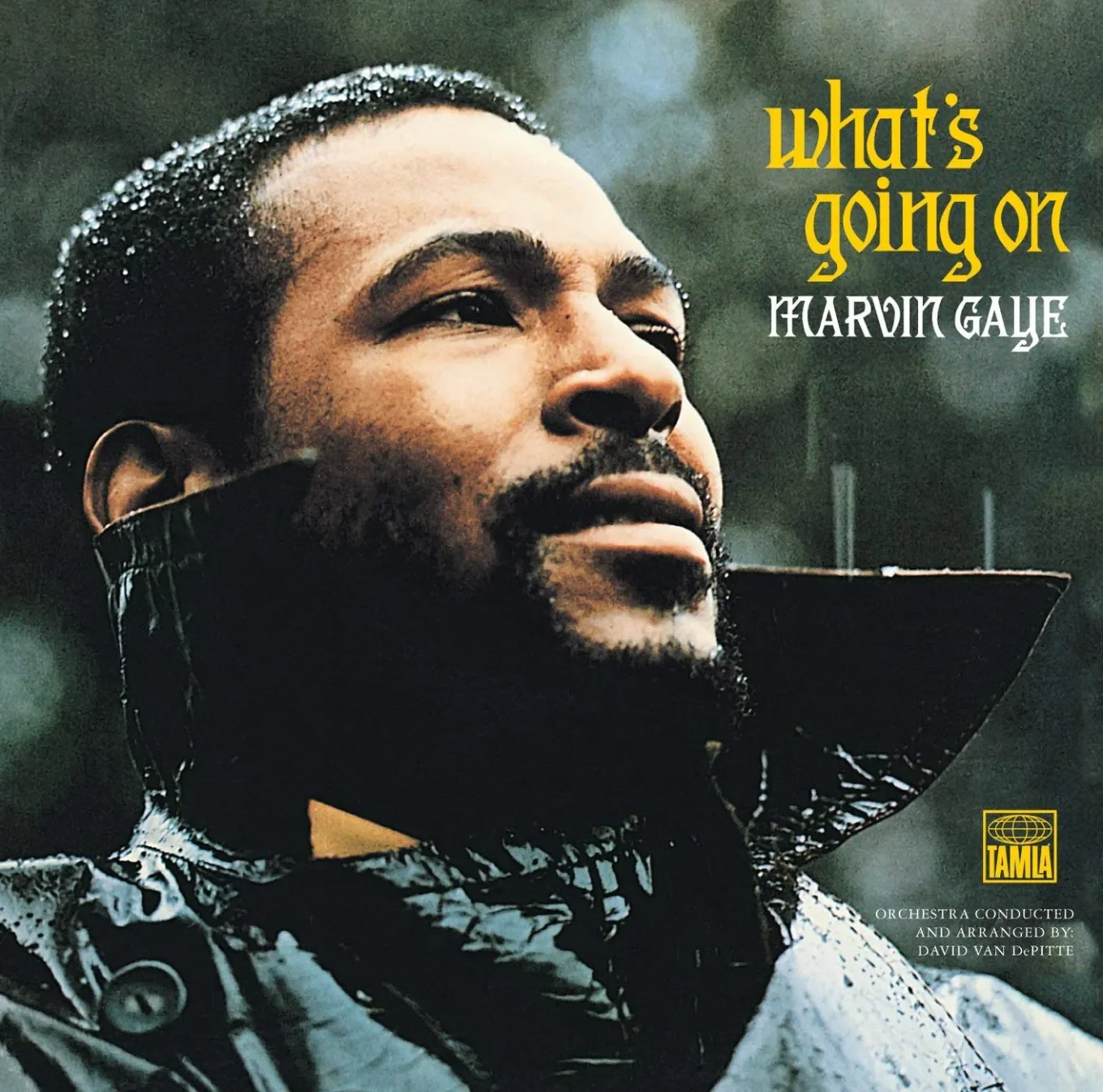
Marvin Gaye, What's Going On (1971)
The album is a suite that flows from one song into the next, much like a go-go set that never lets the room go quiet. It speaks as a returning Vietnam veteran, and it names what ordinary people were living through: the suffering of those who came home from the war, poverty, drug use, and a world that seemed to be losing its way. There was nothing loud about it. Marvin sang it soft and sorrowful, with strings and congas, and that made it hit harder. The record helped open the door to progressive soul, a music that could carry a serious message and still make you want to move. Soul stopped being only about love songs and started speaking about the world.
That's the other thing Washington gave us. A voice that could whisper a hard truth and be heard around the world. Marvin Gaye, Roberta Flack, Duke Ellington: three Washington artists, three different decades, and one habit of using music to tell the truth about how we live.
Right alongside them, the go-go clubs of the '80s and '90s carried the torch. Chapter III. The Taj Mahal. Triples. These were the rooms where the pocket never stopped, where the lead talker called out your neighborhood and your whole section hollered back. If you were there, you know the feeling of a packed floor moving as one body, cowbells cutting the air, sweat on the walls. If you weren't, I'll do my best to describe it, but it's like describing the ocean to someone who's only seen a picture.
And in the '90s, the hip hop clubs arrived, and the city kept building. DC Live. Dream. Zanzibar. H2O. New rooms, new sounds, a new generation walking in with the same old hunger to be seen, to be heard, to belong to something louder than themselves. These clubs didn't erase what came before. They stood on its shoulders, the same way the music did.
Here's what I want you to notice. Jazz clubs, go-go clubs, hip hop clubs: different decades, different dress codes, different drums. But look at the pattern. In every era, our people built a stage when nobody was going to hand us one. A club is never just a club. It's a community deciding that its music matters enough to give it a home, and the wall kept time too.
The music blend was never only for the ears. In the '80s and '90s, as graffiti spread around the world with hip hop, Washington grew its own look, and it moved in step with our music. Our writers were known for clean, towering straight letters and blockbusters, built for speed, visibility, and rhythm instead of fancy curves.
The names on those walls were our bands: Rare Essence, Trouble Funk, Chuck Brown's crew. And lead talkers shouted out the best writers live on stage and on the PA tapes that passed hand to hand through our neighborhoods. Painters and percussionists were talking to each other across the city.
The figure who embodied it was the late Cool "Disco" Dan, Danny Hogg, whose story is told in the documentary The Legend of Cool "Disco" Dan. The tradition lives on through Words Beats & Life, whose Go-Go Graffiti Class teaches young people our straight-letter style. That's how a culture survives. You hand it to the kids.
By the 2010s, a new generation across Washington, Maryland, and Virginia had grown up hearing all of it at once. Out of that came what some call "crank," or go-go rap. Wale became its loudest champion, putting go-go percussion, horns, and live arrangements right into mainstream hip-hop albums. Tracks like "Chillin" and "The Bait" wrap a rap delivery around our pocket. Other voices from the region, including Yung Gleesh, Cordae, and IDK, slide their bars into the cadences go-go lead talkers first carved out.
Then came the ensembles that put all three on one stage on purpose. Mambo Sauce, formed in the 2000s, layered old-school soul and jazz melodies with hard rap verses and raw go-go congas and cowbells, and "Welcome to D.C." is an anthem for how we see ourselves. The JoGo Project, founded by saxophonist Elijah Jamal Balbed, exists to unite jazz and go-go, seating elite jazz soloists, classically trained horn players, hip hop vocalists, and go-go percussionists’ side by side. GoGo Symphony, founded in 2012, re-voices symphonic, classical, and jazz compositions over go-go and hip hop beats, performing with groups like the Capital City Symphony. That's our music proving it belongs in any concert hall. And Dante' Pope, a multi-instrumentalist and educator, carries his jazz, hip hop, and go-go hybrid around the world through drum clinics and live shows. Now, who keep the legacy?
A living musical legacy needs dedicated keepers, and I'm proud to say we have them. On the hip hop side stands the National Hip-Hop Museum, the first of its kind in the world, protecting more than 5,000 pieces of memorabilia and artifacts. Jeremy Beaver, owner of Listen Vision Studios here in Washington, founded it. Master Gee, the voice of The Sugarhill Gang, is executive director, and DJ Quicksilva, a longtime radio personality, serves as executive vice president, helping lead the push for a permanent downtown home.
For go-go, you can visit the Go-Go Museum & Cafe in Anacostia, co-founded by Ronald Moten. The DC Public Library's Go-Go Archive collects and digitizes memorabilia, live PA tapes, unreleased photographs, and oral histories. The Smithsonian's National Museum of African American History and Culture tells how go-go became our city's heartbeat. And the writers did their part: Kip Lornell and Charles C. Stephenson Jr. gave us The Beat: Go-Go Music from Washington, D.C., and Kato Hammond's Take Me Out to the Go-Go has been our digital archive and news source since the 1990s, and don’t let me leave out the voice of the dial: WPFW 89.3
WPFW, 89.3 FM, signed on at 8 p.m. on February 28, 1977, and the first record it played was Duke Ellington and Billy Strayhorn's "Take the 'A' Train." Think about that choice. It was Washington's own Duke, opening the airwaves for a station built for us. WPFW was the fifth station in the Pacifica network, but it was different from its sisters. It was established as a Black-staffed, Black-formatted community station for the largely African American city we lived in. It took a nine-year struggle just to get on the air, and that fight tells you how much it mattered.
From the start, the station's mission was a mix of jazz, world music, news, and public affairs, commercial-free and listener-supported, with a promise to act as archivist, educator, and entertainer for a cultural resource that was too often overlooked. People came to call it the Jazz and Justice station, and the name fits. Volunteers have been at its heart since day one, and for generations WPFW has been where this city's sound gets played, explained, and remembered. When I say a station can be a keeper of memory, this is what I mean. The music and the community's story came over the same signal.
And you can't talk about WPFW without saying the name Tom Porter. He was an early host at the station and a longtime programmer, the voice behind Jazz and Justice and his Morning Conversations program, where music and the issues of the day sat side by side. In 1993, while serving as acting general manager, he resigned on the air, a moment people at the station still talk about. Whatever side anyone took, it showed how deeply the people behind that microphone cared about what WPFW was supposed to be. That's the spirit that kept the station honest: a community radio station that belongs to the people who built it, argue over it, and listen. Jazz holds the door open.
The Capitol Hill Jazz Foundation, founded by Washington native and alto saxophonist Herb Scott, treats the blending of all three genres as part of its mission. It doesn't want jazz frozen behind glass. It builds live spaces, education, and policy work so the music can keep cross-pollinating. Its HillFest Conference and Festival pairs young and veteran jazz players with regional go-go bands, R&B vocalists, and soul ensembles.
HillFest also takes on the gatekeepers. Its panels have hosted open conversations about national jazz figures who dismissed hip hop, and the foundation's leaders answer that modern Black American music can't be separated from its jazz roots. Herb Scott lives that argument. His single "The Jazz Show" lays traditional alto sax solos over trap beats and raps about the economic realities facing working jazz musicians. The foundation also lifts artists like producer and composer Sequoia "REDWOOD" Snyder, who loops contemporary jazz, R&B, and hip hop.
One City, One Fight. This part of tour isn't just about sound. It's about survival. Remember those jazz clubs of the 70’s and '80s, and the go-go and hip hop rooms that followed? Count how many of them you can still walk into tonight. That's the story. Jazz and go-go face the same threats in Washington: rapid gentrification, noise ordinances, and the loss of historic independent venues, like the closing of U Street's Bohemian Caverns. Those aren't abstractions to me. When your family has been here four generations, you don't read about change in the news. You watch it happen on your own block, and you feel it when a place your people gathered becomes something you can't afford to walk into.
That's why the foundation's work with the D.C. Jazz Lobby matters. It presses officials at the Wilson Building for economic relief and performance spaces. And the weekly Capitol Hill Jazz Jam gives young musicians a place to experiment, so the next generation can keep blending jazz with hip hop and with go-go, our official music.
So that's the tour, and if you take one thing with you, take this: Washington's sound isn't a museum piece, and it doesn't sit on separate shelves. It's a conversation. It started with a drum, passed through a horn section and a painted wall, found a microphone, and it's still going tonight on some corner of this city. Someone calls out. Someone answers back. That's Washington, D.C. That’s “The 202”
Let me close with what this music means to me. This city has changed in my lifetime. Neighborhoods turned over, corners I knew by heart now carry other names, and rooms where my people gathered are gone. But every time Washington changed, the music changed with it, and it held us together while it did. Jazz gave us dignity when the doors were closed to us. Go-go gave us a sound that belonged to nobody else and a way to say our own names out loud. Hip hop gave a new generation a microphone and told them they had something to say. Each one was our answer to the moment we were living in.
That's why I stand here and tell this story. The music didn't just play in the background of Washington's history. It defined who we were becoming, and it still tells the truth about who we are. Wherever this city goes next, I hope it never forgets the sound that raised it. I carry that sound with me, and I'm proud to pass it on.
Thank you for walking this story with me. This is “The 202”—our rhythm, our memory, our home.
