
From the Publisher
Just back from the Miami Art Fairs, there was some same as and some unexpected, some very commercial, some uplifting, some gloriously bright and cheery, some touchable to spirit and hand. Grandaddy Art Basel added new sectors, showing lots of both primary and secondary market work, mostly US produced. New tariffs and restrictions and difficulty of travel and visas to the US kept Europeans and Asians away and anyway, they have their own Art Basel’s, in Paris weeks before and in Hong Kong, coming up soon. At lower price points, virtual and real work sold to younger buyers, entering the market but watching their wallets, discovering new and affordable artists’ work. Happy to see them coming, having fun and becoming the new vanguard of collectors. And it was fun, with parties into the wee hours, at the Sagamore, where the emphasis was on women shining in the art and the financial worlds, helping each other, and increasingly giving, at the Faena where a library floated, at the Bass, where I loved the huge Murakami-like mural, but with faces and figures alluding to US politics, seen above the dancing crowd. Private collections showing newly attained work were open to the invited, partying and brunching. Untitled, still in a tent on the beach, having changed curatorial hands, was less conceptual, showing more paintings and prints of US based subjects, cowboys and such. Catering to a younger crowd, their Spotlight sector featured work that was clearly over the top from, as the NY Times wrote, “an art world where the outrageous can be common”.
Some of the galleries from last year had moved on to Art Basel and other fairs. Farther south on the beach, Scope was surprisingly bright, showing work that made me smile, brightly colored, textured (welcome after years of Covid-inspired prohibitions on touch) and whimsical. Overall, textural work, embroidered, tapestried, collaged abounded, inviting the perception of touch. The surprise announcement at Scope of Pantone’s color of the year, Cloud White, referenced for me, an empty canvas of possibilities for the year ahead, keeping with their optimistic showing.
At Aqua, our favorite DC sound artist, Steve Wanna, mixed sound and visuals in his increasingly interesting sculptures. He was joined at Aqua by fellow DMV artist, Lenny Campello, whose drawings are some of the greatest in Miami Beach.
The 6-figure segment sold well throughout as did the mid-market, but Young Collectors Day only netted $500,000 in sales, lots of work sold at lower price points. Good for the young collectors entering the market.
Just returning from the Miami art fairs. I saw work that I expected, some surprises, good and bad and a secondary market equal in quality to the primary. Attendance was down during the VIP days, up and massively crowded during the public days. All aimed to sell. Art Basel, hard to navigate (can anyone make a google map app for the floor of Art Basel please?) had the highest priced work and the secondary market work, at galleries in the top tiers of US galleries, and to a much lesser degree, European and UK galleries. Tariffs have clearly made their mark and generally, fewer galleries without a location in the US came. Made in the USA, keeping made elsewhere art out is clearly affecting the art market.
I saw much less environmental work and none, marked as such at Art Basel, although curiously, there was a plethora of work depicting water, (natural borders?) and even less political work. I was glad to see the latest ever-changing map of the now-deceased artist, Alighiero Boetti, whose Mappa series,
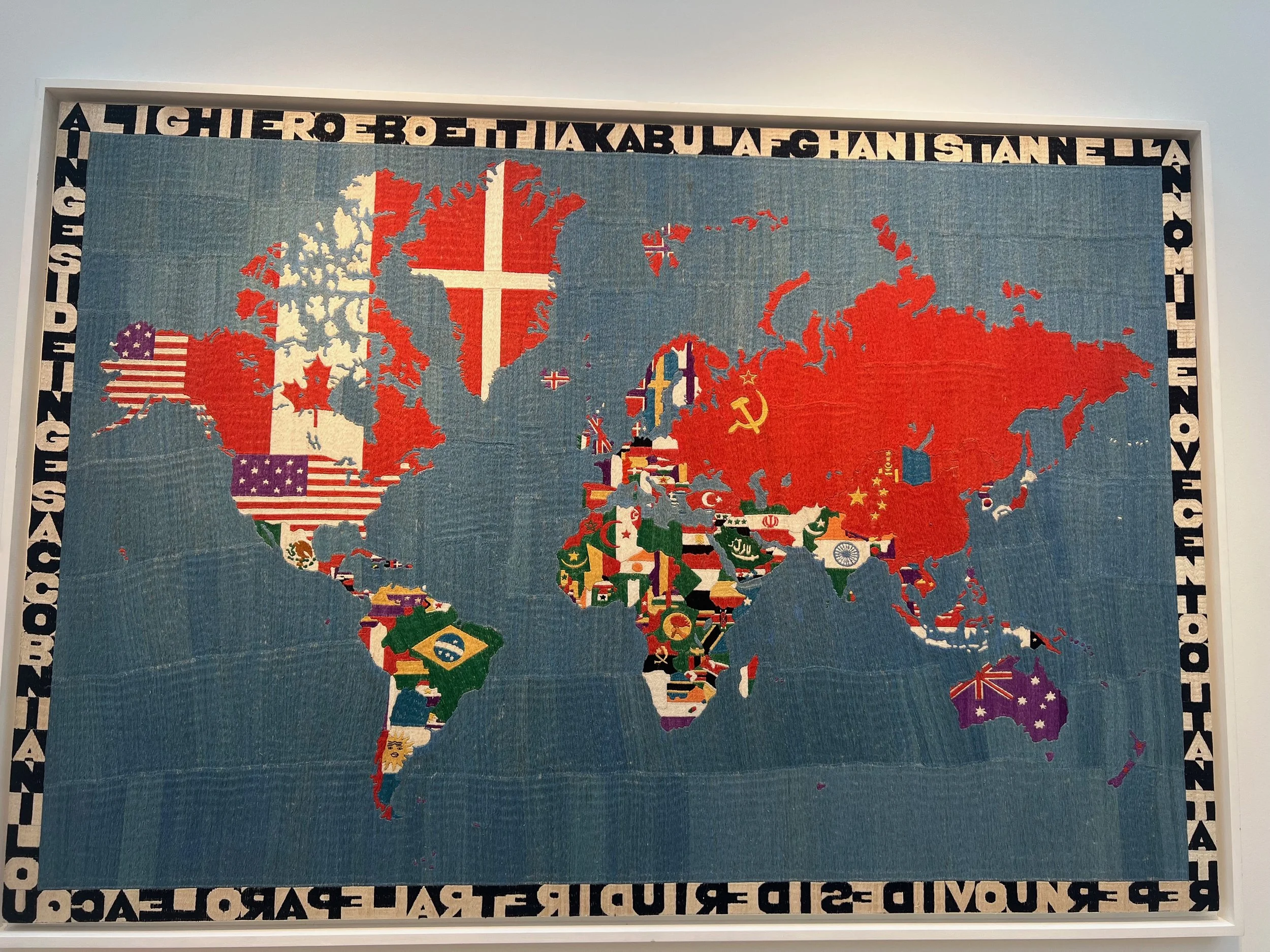
Alighiero Boetti
“Map of the World”, 1971-1994.
depicting rapidly changing borders of the Cold War period from the 1970s until his death in 1994, traced geopolitical shifts as borders changed and nations were added and deleted over his years of map-making.
Tonya Bonadkar, showing Olafur Eliasson did not disappoint, but I had seen the work before. Likewise for other Chelsea and Soho galleries. British galleries showed new work, perhaps because the older work had sold at Paris Art Basel. In October. I did love Lisa Yuskasavage’s hotly colored painting of a studio (hers?) model posed nude next to a window inhabited by a lone peacock, with the tail hanging down rather than extended.
I wondered but was happy to see an entire gallery filled with work by Washington Color School Artists, Morris Louis among them, making a comeback after decades, but then realized this was secondary market work bought in its twentieth century heyday.
Across the board in Miami Beach and Miami art fairs, more work sold at a lower price point, partly because it sold to younger people, willing to buy work, discovering new and affordable artwork, and even supporting friends but not spending inordinate amounts, lacking massive walls to install the art in their soho and Chelsea condos. Some of their spending money came from inherited work sold through galleries and at auctions.
Down toward South Beach, Untitled was a disappointment. Unlike last year, when the old team who founded Untitled reigned, the new team which presided at the new Untitled fair in Houston in Fall, 2025 had several new ideas. Besides the various “clubs” providing networking and lounging space to those with the right credentials, they tried to bring in the younger, sometimes hipper crowd with such tactics as subsidizing emerging galleries. The Art Newspaper reported sightings of Mera Rubell (originally a DC collector and gallerist) and Hans Ulrich Obrist at Tuesday’s preview. With represented galleries from Latin America, the Caribbean, Asia and Africa (as well as the US), the six figure and mid-market sold well. But Young Collectors Day netted only $500,000 overall, attesting to much work sold at much lower price points. Not complimentary, the NY Times called Untitled Spotlight Section artists’ work “over the top”, noting “even in an art world where the outrageous can be common”. There was humor, but no irony behind it.
The Podcast sector underscored the lack of Europeans and Brits, as noted, and I particularly missed Jean Wainwright of the Andy Warhol Foundation’s analysis of the “outrageous” work displayed. Its ok to just display the work, but I wanted more. Why have podcasts if there is little commentary and no analysis worth hearing.
Just down the beach, I entered the happy world of Scope. Almost every canvas, sculpture, print and especially textile art piece wielded my cares away in the bright colors and airiness of the work. Unveiling the Pantone color of the year as cloud white, the color of an empty canvas, a space of possibilities for the art world’s year ahead seemed apropos to be at a Scope booth, celebrated by handing out (cloud) white roses.
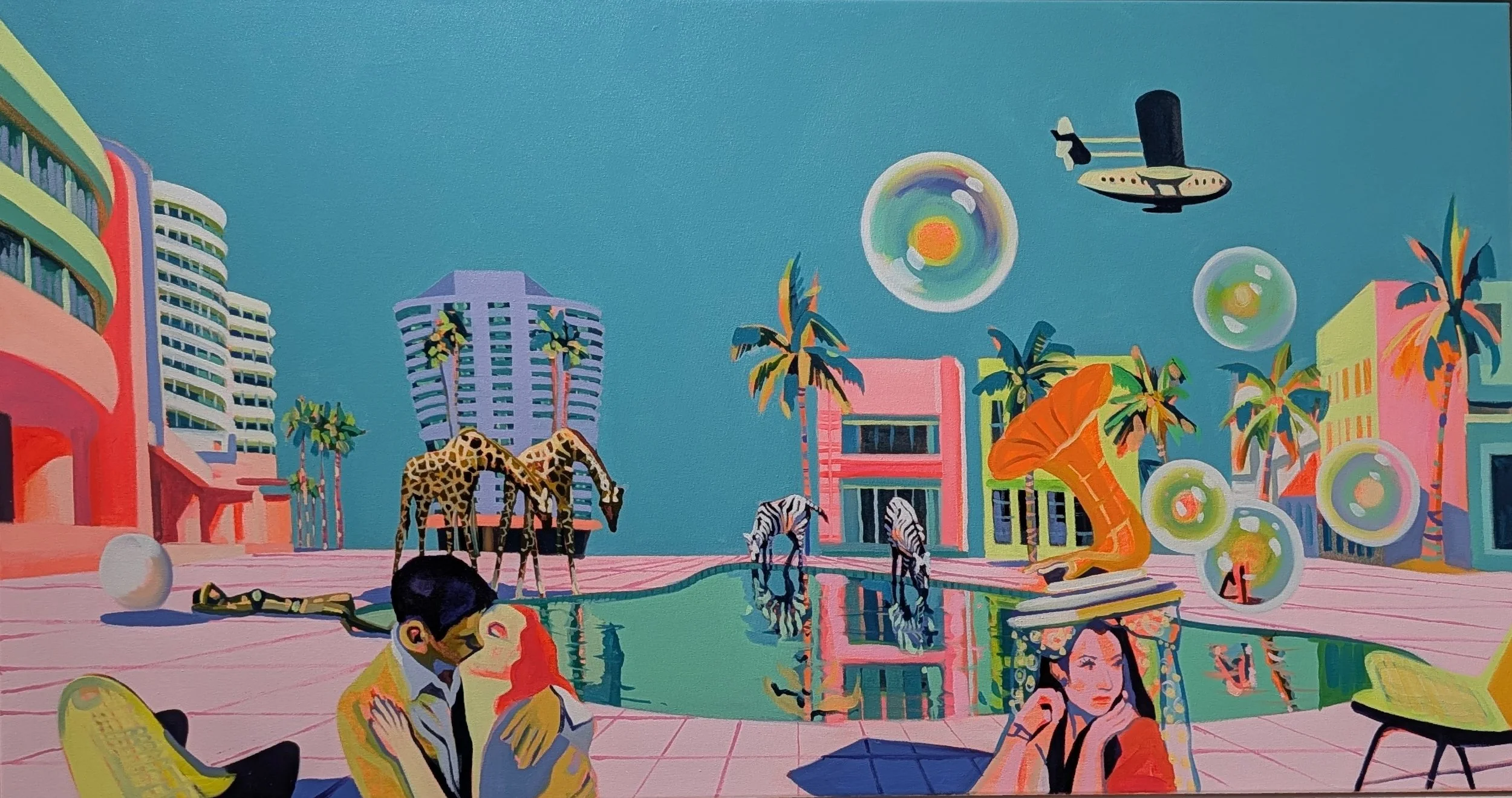
Ruth Mulvie, “KISS of the Year”, courtesy DaSilva Gallery/ GALLERyLABS, Buenos Aires and New Haven.
The Ink art fair was a hidden surprise, near Art Basel where I found two favorite artists from DC, the sound artist/sculptor Steve Wanna exhibiting his magical sculptures, full of light and sound, and Lenny Campello, whose drawings, humorous and serious, always delight me. Joined by Jim Kempner, whose online series, “The Madness of Art” makes light and brings humor, starring himself and his mother, to the art world, and who exhibited his gallery artists in this motel-y venue, Ink had some real treasures.
Exhibited at the Sagamore, during a morning of women supporting women artists and entrepreneurs, Ekaterina Sky enthralled me with her hidden poems under gold, surrounded by a sunburst of linear patterned colors begun on an iPad. Finally, a great use of new tech, recalling, for me, Ken Noland’s gold-centered target paintings shown decades ago in Maine. Sky’s work also recalled Lita Albuquerque’s Untitled 2024, shown at Art Basel’s Michael Kohn Gallery booth, with its gold leaf quilted circle on resin. That quilting resonated with the plethora of textile work at the fairs in Miami. I thought it may be the impetus to touch, which we had to relinquish during covid, but the textile work shown at Richard Beavers Gallery, New York were some of my favorites. Showing older black men and women, from all economic classes, and occupations, dressed in overalls and going to church clothes by turn, the artist made paintings, photographed them and sent them to a textile firm to create the paintings exhibited here. I was told they sold out. As usual, the parties, the installations at the Faena and the beach made the fair week sunny and warm, ignoring the dark world outside for a week, just a week.
