
Paris in Autumn Glow
by Elga Wimmer
Paris looked decidedly festive in autumn, as Art Basel Paris got underway, with art spread across the whole city from October 24 to 26, with VIP and press previews starting as early as October 21.
Some 100 000 art enthusiasts, dealers, collectors and artists converged on the French capital, to see the art fair that replaced the legendary FIAC art fair, which had reigned for nearly half a century. This second Art Basel Paris fair was held in the city’s Grand Palais, which had long been home to FIAC, following an extensive renovation of the palatial structure.
Galleries, satellite fairs, museums, foundations, and public art projects all gathered to show the best of the world’s art, current and historic. In front of the Grand Palais with its meticulously restored Coppola, Czech artist Voojtech Kovarik’s outdoor sculpture, “Atlas Calming The Troubled World” a large bronze sculpture offered solace to a world wracked with war and social upheaval, depicting Atlas gently cradling the heavy burden of the world, holding up the earth in his strong arms.
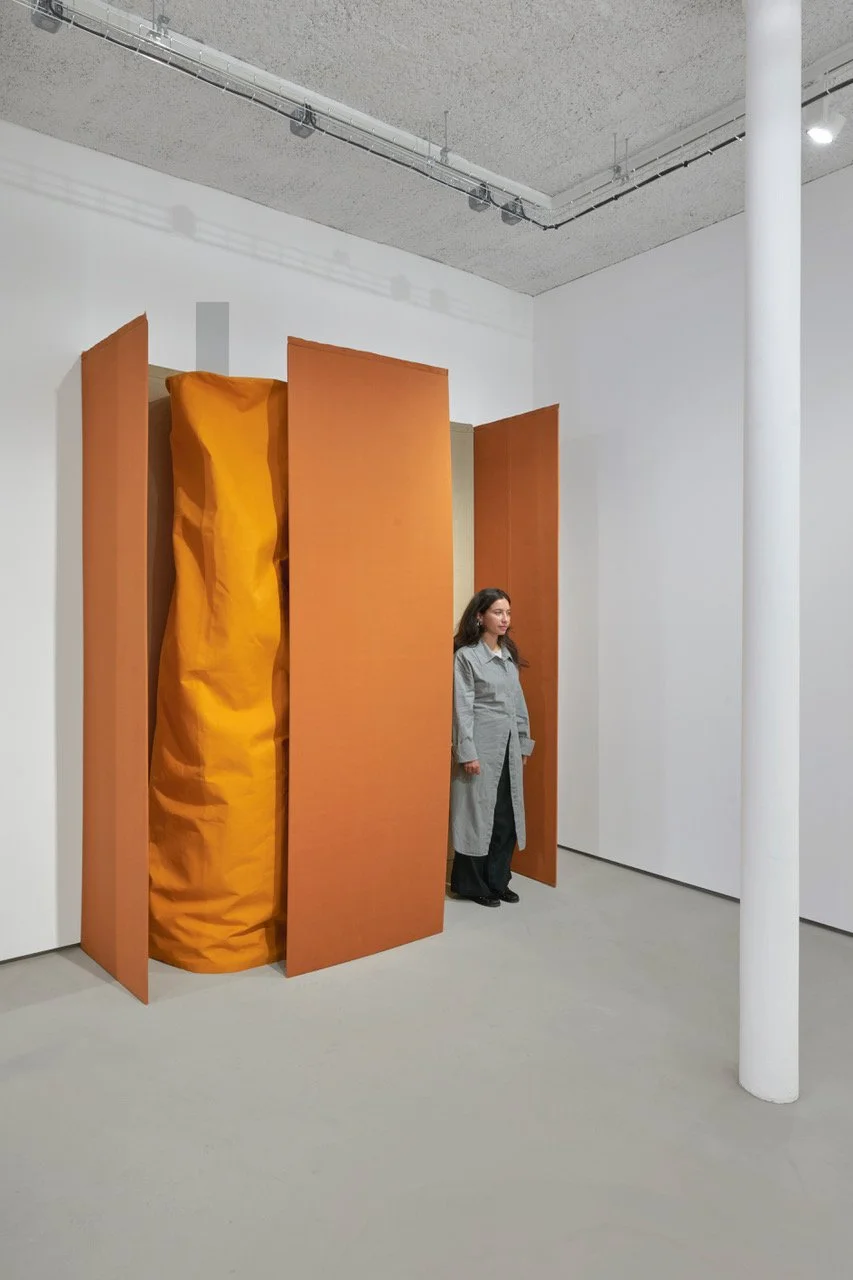
Franz Erhardt Walther, installation view. Courtesy Jocelyn Wolff Gallery.
A day before Art Basel Paris held its VIP and Press Preview, galleries in the Golden Triangle, on Avenue Matignon, held their own Vernissage titled MASH (Matignon Saint Honoré) with tables set outside as champagne flowed against a backdrop of art performances. Standouts at MASH 2025 included an exceptional selection of modern art; work by Roberto Matta and Max Ernst at Galerie Malingue, German artist Franz Erhardt Walther’s minimal interactive sculptures at Galerie Jocelyn Wolff; Thai artist Yuree Kensaku, at Enrico Navarra Galerie, showed a fresh approach to pop culture; brightly colored cartoonish images inspired by manga, kitsch, street art, animation and comics echoing Jeff Koon’s early work.
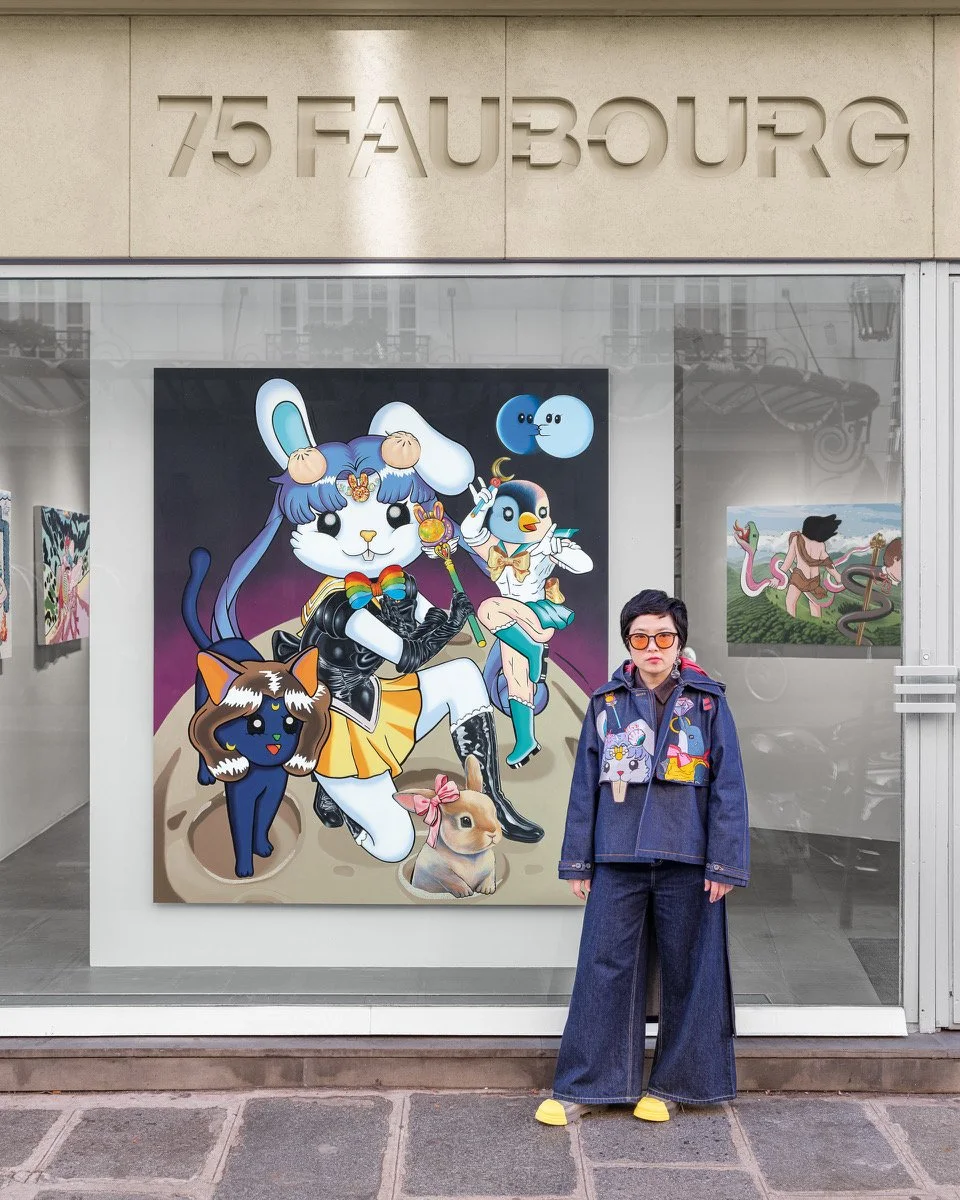
Yuree Kensaku, “Sailor Usagi from the Rainbow Universe”, 2024, 78.7 x 66.9 in. Photo Gregory Copitet. Courtesy Enrico Navarra Gallery.
At Perrin Antiquaires, New York based curator Valerie Cueto transformed the gallery into an apartment, in a show titled “The Nomadic Eye.” where masterworks in decorative and historic art interacted with contemporary works — a Louis XV console, ca. 1700, displaying a female Dogon sculpture, an 18th century Japanese mask and a 19th Century war hat set beneath a painting by Antoni Tapies, (1961). The bedroom is dominated by Max Ernst’s “Cage Bed and Screen, The Great Ignoramus,” (1974), blurring the boundaries between sculpture, furniture and installation. The piece is at once a bed, a mental prison and a vehicle for fantasy.
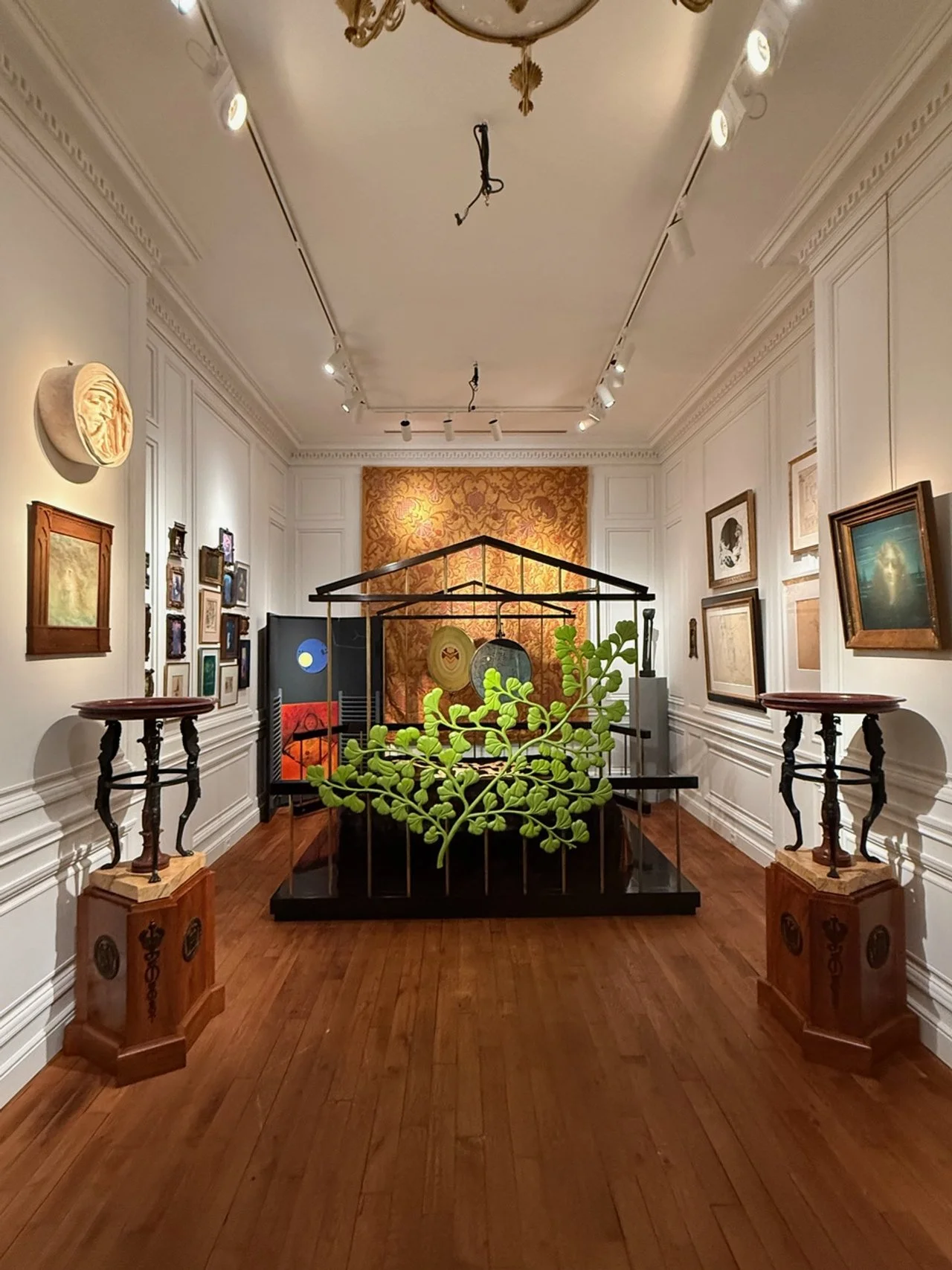
“The Nomadic Eye”, curated by Valerie Cueto. Courtesy Perrin Antiquaires.
Art Basel Paris opened on October 21st, with 206 galleries from 41 countries filling the Grand Palais in a well-attended show, members and friends of the art world pushing attendance and sales to record levels.
This year, many galleries that typically show recent contemporary artwork focused on works from the secondary market from early/mid 20th Century to historic art. Karma Gallery offered a Milton Avery, “Gliding Gull” (1956); Meyer Riegger showed a wonderful painting by Meret Oppenheim, “Le Grand Chapeau,” (1954), Pace Gallery had Modigliani’s, “Jeune Fille aux Macarons” (1918); Thaddaeus Ropac offered a work by Alberto Burri, “Sacco e oro” (1959) and an amazing piece by Robert Rauschenberg, “Able Was/Ere/ISawElba,” (1983).
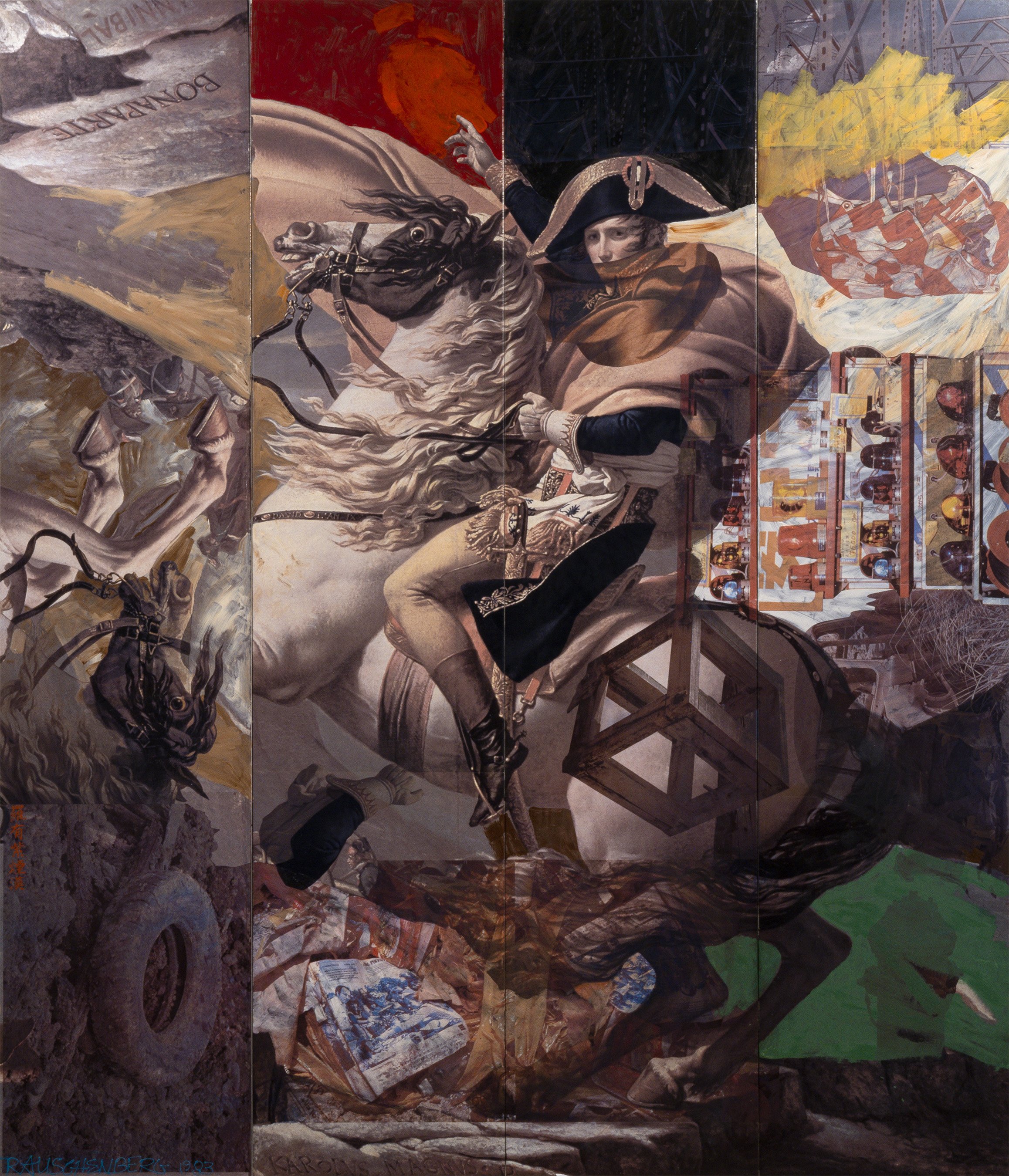
Robert Rauschenberg, “Able Was/Ere/ISawElba”, 1983, Transfer and glaze on high-fired ceramic, 106.42 x 90.98 x 2.68 in, ©Robert Rauschenberg Foundation/ARS, New York 2025. Courtesy Galerie Thaddaeus Ropac, London • Paris • Salzburg • Milan • Seoul.
Gagosian featured a Peter Paul Rubens painting, “The Virgin and Christ Child, with Saints Elizabeth and John the Baptist” (c.1611-14), and Rodin’s bronze “Le Baiser” (The Kiss), c.1905-10. Probably due to the volatile nature of current world affairs, top galleries hedged their bets, placing big names, with established market value, alongside lesser-known artists.
That said, there was something for everyone: The upper-level section of the fair showcased younger artists at prices accessible to new collectors. The French gallery We Do Not Work Alone presented a quirky array of unusual objects by Ulla von Brandenburg, Ryan Gander, Nicola L, and Erwin Wurm. The Columns Gallery, Seoul/Singapore, showed paintings by Manuel Ocampo, that recall historic paintings by Hieronymus Bosch, mixing grotesque looking animals and humans with political undertones in an apocalyptic scenery suggesting a collapse of moral and spiritual order. The work could serve as an allegory examining the intricate and often shadowy theater of the global art market.
Two outstanding galleries in the main section of the fair, Jocelyn Wolff, Paris and Meyer Riegger, Berlin, showed Swiss artist Miriam Cahn and Argentine artist Santiago de Paoli. Cahn paints in layered transparent colors depicting victims of violence, in war, in uniquely haunting imagery. While Harald Klingelhoeller‘s, “Waende, Mass und Woerter,” (2002), evoked the roughhewn austerity of Joseph Beuys.
Among the satellite fairs, OffScreen at the Chapelle de la Salpetriere was particularly notable. The chapel itself and adjacent psychiatric hospital has a remarkable history. Jean-Martin Charcot, the French neurologist and professor of anatomical pathology developed his theories about hysteria here, mostly by practicing on female patients. One of the rooms shows vintage photographs of the latter as part of the fair. The 17th Century chapel’s historic paintings and sculptures offered a marvelous backdrop to the fair’s focus on contemporary art.
The Luis Adelantado Gallery from Valencia, Spain presented an installation by Dario Villalba. The central piece, “El Enfermo” (1974 – 1991), depicts the body of a patient inside a methacrylate chrysalis, suspended in an atmosphere of pain and silence. On the opposing wall is a painting by Villalba, “D’Apres El Greco” (1995), evoking a spiritual calling. Kerlin Gallery, Ireland, showed work by sculptor Dorothy Cross including “Room,” (2019). In the chapel, the Carrara marble work includes what appears a baby shark on a large white platform in front of two bronze sculptures of Madonna, in front of a round stained-glass window. Another historic marble sculpture depicts lamenting Christ lying at the Madonna’s feet. The dialogue between the stark, minimalist marble sculpture by Dorothy Cross and its historical surrounds is powerful.
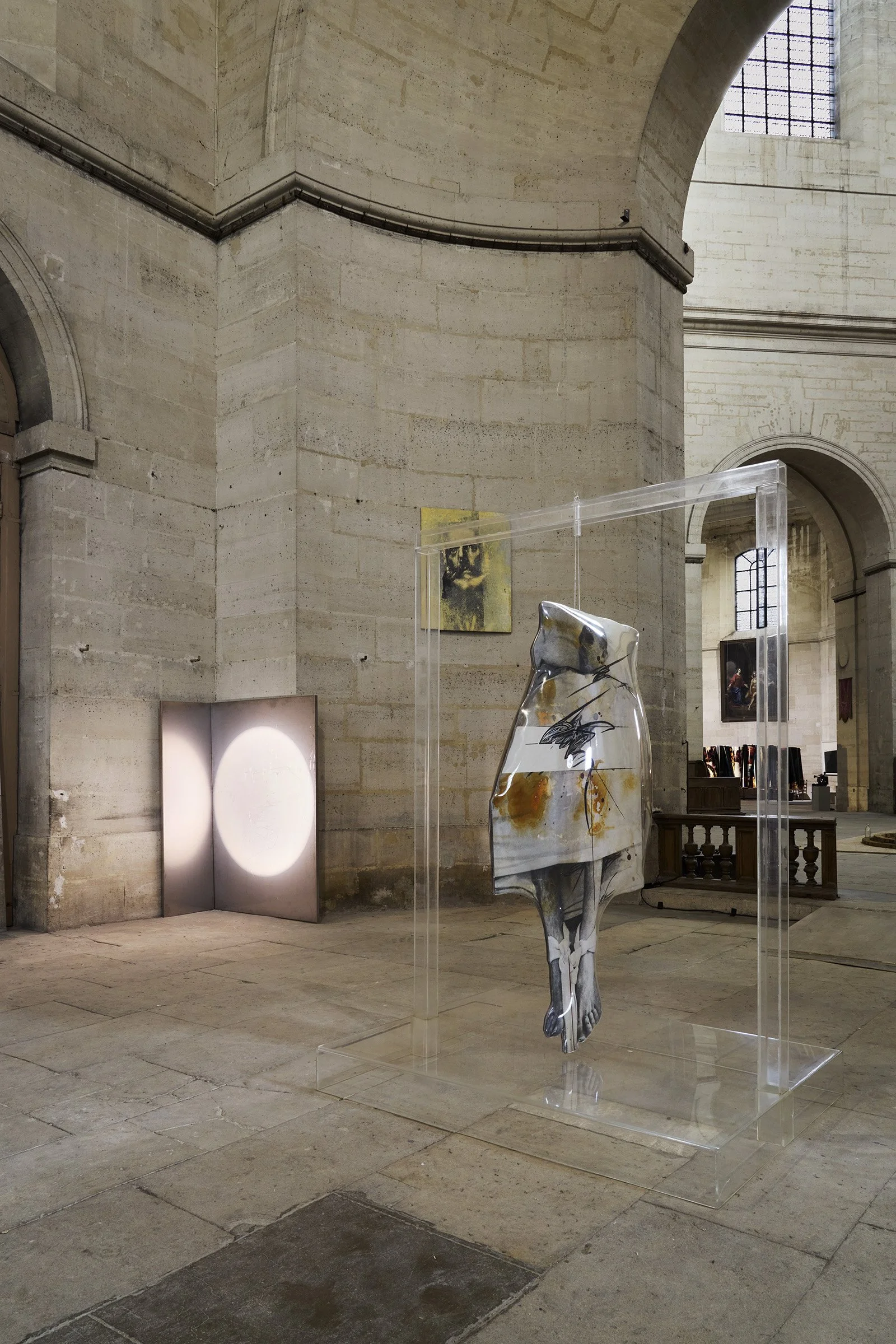
Dario Villalba, “El Enfermo”, 1974-1991. Photo by Graysc studio. Courtesy Luis Adelantado and the Legacy.
Another notable satellite fair, AKAA (Also Known as Africa) presented a mix of European and African galleries, mostly from Nigeria and Senegal, that spanned the visual arts, fashion and installation. Anne de Villepoix featured Atsoupe, from Togo, and Bouvy Enkobo, born in Kinsasha, in what is now the DRC. Atoupe’s paintings play with an apparent paradox of childhood bliss and violence, telling stories with doll-like characters. Enkobo’s collages utilize abstract figurative imagery to reflect on the reality of the street around him, juxtaposed with his imaginary world. French-Moroccan fashion designer Sophia Kacimi, based in London, exhibited her line of Zoubida (wearable art), precious coats made of hand-woven fabrics in rich colors, reminiscent of Yves St Laurent’s earlier Moroccan inspired collection. The atmosphere at AKAA was decidedly upbeat, Upscale souk meets art fair chic, young and adventurous.
An unexpected surprise was the performance “Le Dernier Carnaval” (The Last Carnaval) by Cai Guo-Quiang & cAI, amid fireworks in front of the Pompidou Museum, bidding a temporary farewell before its five-year closing for renovations. The artist and his team produced an extraordinary daytime fireworks performance on October 22, to coincide with the vibrant setting of Art Basel Paris. The façade of the Centre Pompidou was transformed into a monumental painting, depicting historic pieces in the museum’s collection.
For the serious museumgoer, Paris never disappoints. The amazing contemporary collection of the Fondation Cartier in its newly christened location in the Louvre des Antiquaires; Gerhard Richter at the Fondation Louis Vuitton in the Bois de Boulogne, honoring the German artist at ninety-three years with a comprehensive retrospective; work by the Baroque painter Georges de la Tour, a master of light, at the Jacquemart-Andre museum, and Jacques-Louis David’s major retrospective exhibition at the Louvre, an absolute highpoint with all three primary versions of his most famous painting, “The Death of Marat” and the legendary painting of “Napoleon Crossing the Alps” displayed, was a marvelous citywide art museum.
Paris has always been a feast for the senses, from its breathtaking architecture to the work of the artists who have immortalized the city, to its living history, food and lifestyle.
When Western culture is experiencing an identity crisis, social upheaval and even what had once seemed unthinkable — war raging again in Europe, “We’ll always have Paris,” a wistful movie line from “Casablanca” comes to mind. Rick’s famous sendoff to a lost love, and by extension a lost era, rings eerily true today.
